Astronomers have identified a remarkable celestial phenomenon approximately 300 light-years from Earth: a star system where a small star is engaged in a prolonged, gradual consumption of a nearby brown dwarf. This is not a sudden, cataclysmic event, but rather a slow, steady siphoning of material, a cosmic feeding process that scientists predict could persist for billions of years. This discovery challenges previous understandings of stellar interactions, offering a nuanced alternative to the more commonly observed scenarios of stable planetary orbits or rapid engulfment.
The Unveiling of a Novel Stellar Interaction
The system, designated ZTF J0440+2325, represents the first observed instance of a low-mass star steadily drawing material from another low-mass object, a brown dwarf. Typically, when astronomers consider interactions between stars and their companions, the narrative often concludes with the star engulfing the smaller body. This is the anticipated fate of Earth, for example, when our Sun eventually expands into a red giant. However, ZTF J0440+2325 presents a different paradigm: a slow, sustained act of cosmic sustenance.
This groundbreaking observation was made by an international team of researchers, led by scientists at the Massachusetts Institute of Technology (MIT), and published on October 5 in the prestigious journal Nature Astronomy. The study details a process that falls into a unique category, bridging the gap between stable, peaceful orbital arrangements and the violent, rapid destruction of celestial bodies.
A Mysterious Signal: The Genesis of Discovery
The initial hint of this unusual stellar relationship emerged from data collected by the Zwicky Transient Facility (ZTF), an astronomical survey dedicated to identifying celestial objects that exhibit variations in their brightness over time. Operating with a powerful telescope at the Palomar Observatory in California, ZTF systematically photographs vast swathes of the night sky. Its sophisticated camera is designed to detect transient phenomena, such as the explosive death of stars (supernovae), the intense bursts of energy known as gamma-ray bursts, and the cataclysmic collisions of neutron stars.
Several years ago, Dr. Kevin Burdge, an assistant professor of physics at MIT and a lead author on the study, was scrutinizing ZTF observations when he encountered a peculiar signal. Astronomers use a graphical representation called a light curve to study changes in an object’s brightness. For certain supernovae, these curves typically display a smooth, rounded, bell-like shape as the star brightens and then gradually fades.
The signal Burdge observed, however, deviated dramatically. Instead of a gradual rise and fall, the brightness fluctuations formed a distinct, repeating triangular pattern. "I remember first looking at this and thinking, stars don’t make triangular waveforms like this," Dr. Burdge recalled.
At the time, Burdge and his colleagues were actively investigating another anomalous signal that had been identified as originating from a "black widow binary" system. These systems are characterized by a rapidly spinning neutron star, the incredibly dense remnant of a massive star, that systematically strips material from a much smaller companion star. The name "black widow" is derived from the predatory behavior of the female black widow spider, which often consumes its mate.
Initially, Burdge considered whether the newly observed triangular signal might also stem from a black widow system. However, the observational data did not align with the established characteristics of such systems. In a typical black widow binary, the substantial mass disparity between the neutron star and its companion leads to a pronounced orbital motion. The smaller companion orbits the much more massive neutron star at high speed, causing detectable variations in the light that reaches Earth.
Crucially, the mysterious triangular signal exhibited no evidence of this pronounced orbital motion. "We weren’t seeing that whipping back and forth here," Burdge stated. "It didn’t make any sense. We couldn’t explain what this was."
This significant discrepancy prompted researchers to explore alternative explanations. Perhaps the system did not involve an extremely massive object paired with a much lighter companion. Instead, they posited that both objects might possess relatively modest masses, allowing them to orbit each other with less dramatic, less detectable motion. "If you have less mass in the system overall, things can gently orbit each other without whipping back and forth," Burdge explained. "That was the idea. But we never had any proof. And this weird triangle just sat for years."
Pinpointing the Source: A Brown Dwarf’s Close Embrace
The persistent enigma of the triangular signal eventually drew the attention of Dr. Burdge and Aaron Householder, a graduate student in MIT’s Department of Earth, Atmospheric, and Planetary Sciences. They returned to the original ZTF observations and successfully pinpointed the source of the signal to an object located approximately 300 light-years away within the Milky Way galaxy.
To gain a more detailed understanding of the system, they directed multiple telescopes toward ZTF J0440+2325. A critical measurement involved assessing the degree to which the objects in the system moved in response to their mutual gravitational attraction. While the researchers did detect some degree of "wobble" in their orbital paths, it was significantly less pronounced than the motion typically associated with black widow binaries.
"That was the real clincher for this system," Householder commented. "When we measured that wobble, we found we were not seeing a black widow. This was a low-mass star that’s orbited by a brown dwarf. The wobble was too small in amplitude to be anything else."
The subsequent observations revealed two unusually compact objects locked in an extremely close orbital dance. The central star possesses approximately 85 times the mass of Jupiter, while the brown dwarf companion weighs in at about 25 Jupiter masses. For context, our Sun is more than 1,000 times as massive as Jupiter.
The brown dwarf completes a full orbit around its host star in an astonishingly short period of just 87 minutes. The entirety of its orbit is so minuscule that it would fit comfortably within the diameter of our Sun. This extraordinarily close proximity suggested to the researchers that gravity might be exerting an influence beyond merely maintaining their orbits. They hypothesized that the star could be actively drawing material away from its brown dwarf companion.
A New Form of Stellar Cannibalism: Accretion in Action
When one celestial object draws gas or other material from another, the process is known as accretion. Accretion is a familiar phenomenon in systems involving black holes and neutron stars. These objects, despite their immense mass, are physically very small, leading to material forming a swirling disk around them before being pulled inward.
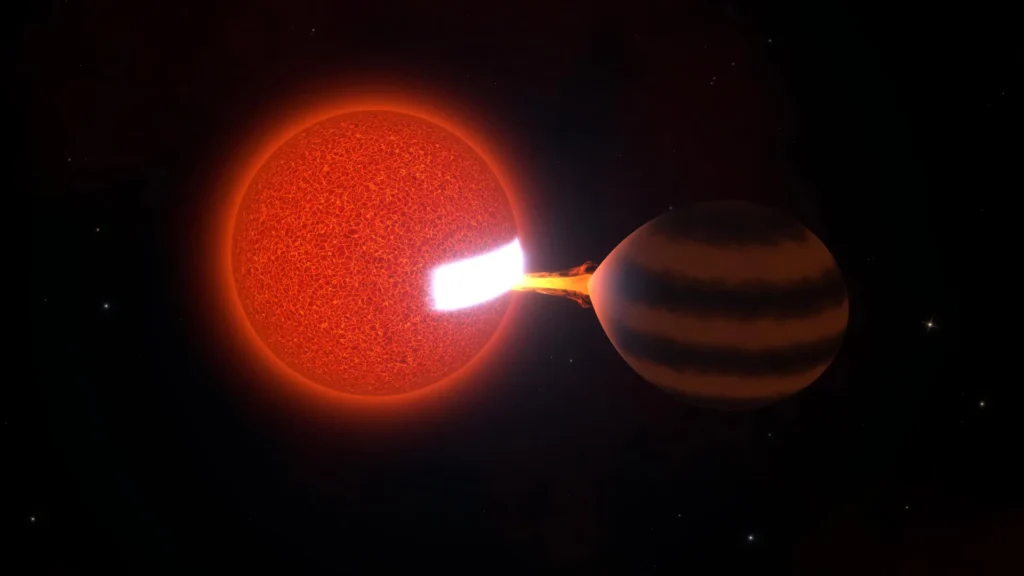
However, ZTF J0440+2325 operates under a different mechanism. Instead of a black hole or neutron star accreting matter, it is an ordinary, low-mass star that is actively receiving material from a nearby brown dwarf. Because the star has a considerably larger physical surface area compared to compact objects like black holes, the incoming material can directly impact its surface.
"The difference here is, the thing absorbing matter is not a tiny black hole but a star, which is relatively big in size," Dr. Burdge elaborated. "So matter just pummels directly onto the surface, at very high speeds, like an asteroid hitting the Moon."
To verify their hypothesis, the research team employed sophisticated computer simulations. They modeled particles originating from the brown dwarf and calculated their trajectories under the gravitational influence of both celestial bodies. These simulations incorporated the measured properties of the star and its companion, along with the fundamental physical equations governing orbital motion.
The simulation results strongly supported the team’s suspicions. Material ejected from the brown dwarf followed paths that led directly onto the surface of the star. "When we track those test particles, we see they indeed fall right onto the surface of the star," Householder confirmed. "This is the first time we’ve caught a low-mass star actively accreting from another low-mass object."
A Cosmic Feast Measured in Billions of Years
The researchers also undertook the task of estimating the rate at which the brown dwarf is losing mass. Their calculations indicate that the star is consuming approximately one hundred-thousandth of Earth’s mass annually. While this figure might seem small, it represents an enormous quantity of matter. The researchers aptly compare this rate to approximately 40 million dump trucks’ worth of material, or about 1.3 trillion one-pound burritos every second.
Despite these staggering figures, the brown dwarf is sufficiently massive that this loss of material constitutes only a minuscule fraction of its total mass. This "feeding" process is remarkably gradual in astronomical terms. Based on the system’s characteristics and the estimated rate of mass transfer, scientists believe the star could continue to draw matter from its companion for billions of years.
This slow, sustained transfer of material stands in stark contrast to the sudden, catastrophic collisions that often characterize interactions between celestial bodies. The star appears to be sustaining a relatively steady flow of material from its neighbor, rather than a rapid, destructive engulfment.
This gradual accretion process also provides a compelling explanation for the peculiar triangular light pattern that initially baffled Dr. Burdge. As matter streams from the brown dwarf towards the star, it strikes the stellar surface at high velocities, generating a intensely heated region. This luminous hotspot acts like a persistent fireball on the star’s surface.
As the brown dwarf traverses its 87-minute orbit, this hotspot repeatedly rotates into and out of the observer’s line of sight. These cyclical changes in visibility produce the distinctive pattern of brightening and dimming that had previously eluded scientific understanding. "It’s like you’ve got this continuous fireball onto one of the objects, and as one orbits the other, that hotspot comes in and out of view, and the peak of the triangle signal is when you’re looking right at the fireball," Dr. Burdge explained.
Implications for Planetary Evolution and the Search for More
With the enigmatic triangular signal finally deciphered, the researchers are now keen to identify other stellar systems that exhibit similar behaviors. Prior to this discovery, observations of close interactions between stars and their planetary or substellar companions predominantly focused on either stable orbital configurations or relatively rapid engulfment events.
ZTF J0440+2325 demonstrates that a third possibility exists: under specific conditions, a small star can steadily extract matter from a nearby brown dwarf without immediately destroying it. The identification of additional such systems could significantly advance our understanding of the prevalence of this process, its duration, and the ultimate fate of objects locked in such exceptionally close orbital relationships.
Furthermore, this discovery may offer novel insights into the evolutionary pathways of planets and brown dwarfs that orbit in close proximity to their host stars. The implications extend to understanding how such close binaries form and evolve over cosmic timescales.
"It’s inspiring a lot of new searches on our part," Householder remarked. "I think we’re going to learn a lot about a different kind of way that planets and brown dwarfs interact with their host stars."
The research was partially supported by grants from the National Science Foundation, underscoring the importance of fundamental scientific inquiry in unraveling the universe’s most intriguing mysteries. This slow-motion cosmic drama unfolding 300 light-years away promises to rewrite chapters in our understanding of stellar dynamics and the intricate dance of celestial bodies.