Scientists are melting holes in the bottom of the world, transforming the stark, icy landscape of Antarctica into a revolutionary astronomical observatory. This pioneering work, spearheaded by the IceCube Neutrino Observatory, has culminated in a monumental achievement: the awarding of the Nobel Prize in Physics to a founding leader of the IceCube Collaboration, recognizing unprecedented discoveries in the field of high-energy astrophysics.
A Glimpse into the Deepest Universe
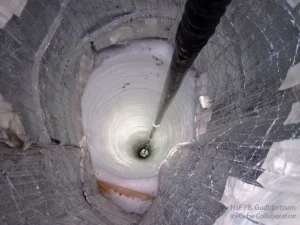
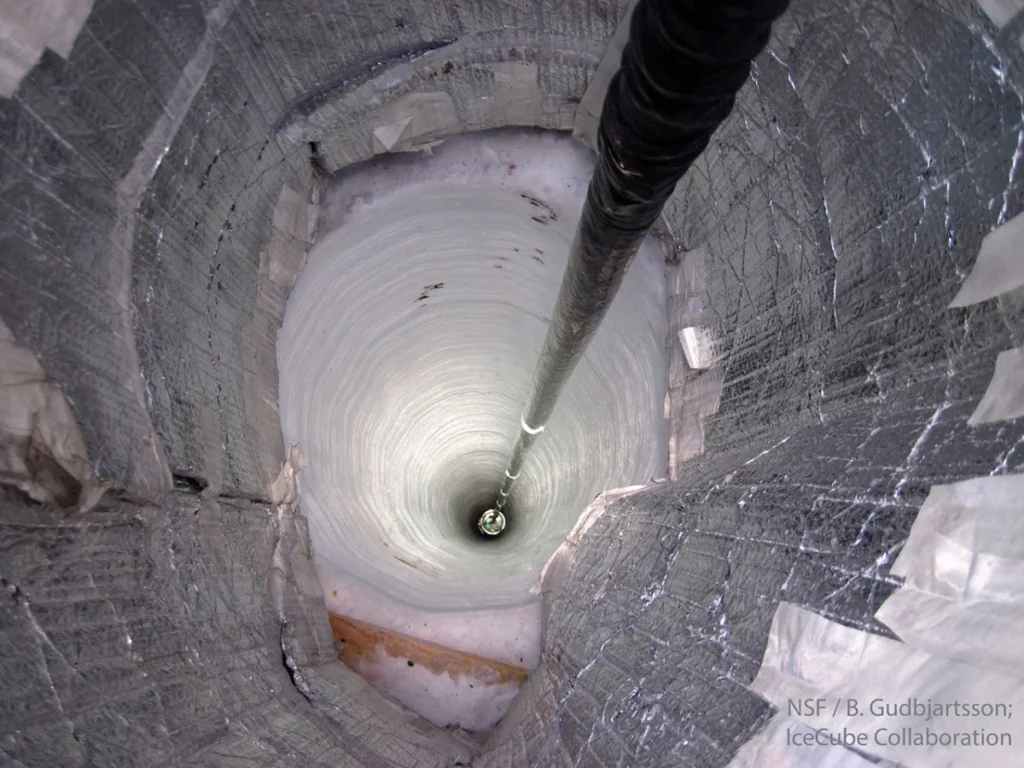
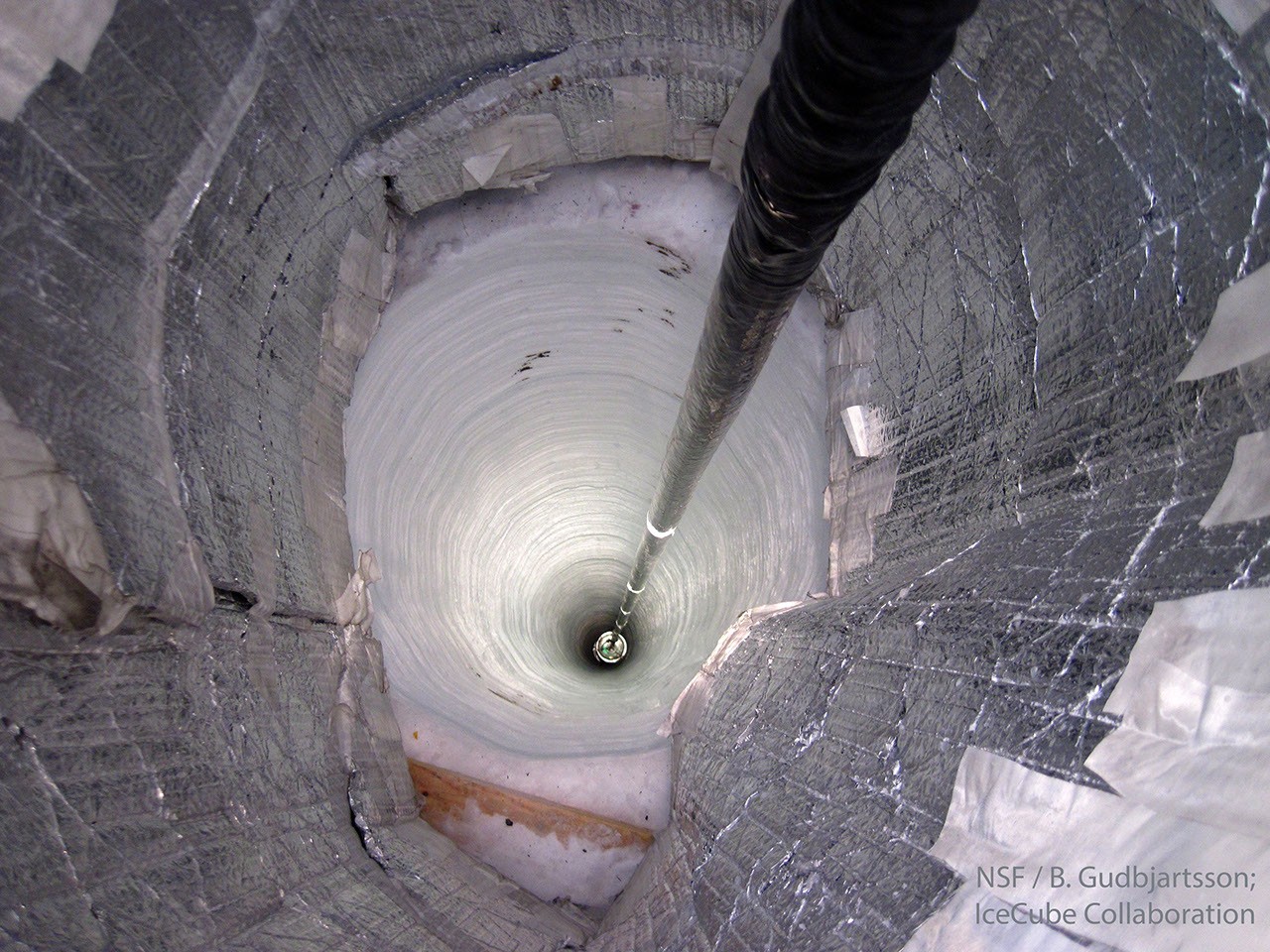
The image, captured in 2010, depicts one of the final detector strings being carefully lowered into a deep, precisely melted hole near the South Pole. These boreholes, some reaching depths of nearly a mile and a half, are not merely geological curiosities; they are the conduits through which humanity is beginning to “see” the universe in a way never before possible. Almost 100 such holes, strategically drilled in the pristine ice, form the core of the IceCube Neutrino Observatory, a testament to human ingenuity in the pursuit of cosmic knowledge.
Within these frigid depths, a network of basketball-sized light detectors, known as Digital Optical Modules (DOMs), are suspended on long, interwoven strings. Once submerged, the water within the boreholes rapidly refreezes, encasing the detectors in the exceptionally clear Antarctic ice. This transparent medium acts as a canvas, allowing the detectors to capture faint flashes of blue light. This light is not emitted spontaneously but is a consequence of a fascinating physical phenomenon: Cherenkov radiation.
The Elusive Messenger: Neutrinos
The IceCube detectors are designed to sense this Cherenkov radiation, which is produced when high-energy charged particles, primarily muons, travel through the ice at speeds exceeding the speed of light in that medium. These muons are themselves secondary particles, born from the interaction of even more energetic and elusive particles: neutrinos.
Neutrinos are fundamental particles with almost no mass and no electric charge, making them incredibly difficult to detect. They are produced in vast quantities by powerful astrophysical processes occurring throughout the universe, from the nuclear furnaces of stars to the violent aftermath of supernovae and the energetic jets emanating from supermassive black holes at the centers of galaxies. Billions of neutrinos pass through our bodies every second, yet they interact so rarely with matter that most of them go unnoticed.
However, when these cosmic messengers do collide with the nuclei of ice molecules within the IceCube detector, they can liberate secondary particles, including muons. As these muons streak through the ice at relativistic speeds, they emit Cherenkov radiation, a faint blue glow that is then detected by the sophisticated array of DOMs. By analyzing the timing and intensity of these light signals, scientists can reconstruct the trajectory and energy of the original neutrino, effectively turning the entire Antarctic ice sheet into a colossal neutrino telescope.
A Chronicle of Discovery and Engineering
The journey to establish the IceCube Neutrino Observatory was a monumental undertaking, spanning years of planning, engineering, and deployment. The concept of using ice as a detection medium for neutrinos had been explored for decades, but the scale and precision required for IceCube presented unique challenges.
The project’s genesis can be traced back to the late 1990s and early 2000s, with initial feasibility studies and the development of key technologies. The drilling of the initial boreholes began in the Antarctic summer of 2003-2004. Each borehole required specialized drilling equipment capable of melting through over a mile of ice, a process that took weeks to complete for a single hole. The refreezing process, crucial for stabilizing the boreholes and embedding the detectors, also took time.
By 2005, the first detector strings were being deployed. The year 2010, when the pictured event occurred, marked a significant milestone, with the lowering of one of the last detector strings, signifying the near-completion of the observatory’s primary configuration. This vast network, comprising over 5,000 DOMs spread across a cubic kilometer of ice, officially became operational in 2011, solidifying its status as the largest neutrino detector ever created.
Unprecedented Discoveries and Nobel Recognition
Since its full operational status, IceCube has been instrumental in a series of groundbreaking discoveries that have reshaped our understanding of the universe. It has successfully detected a significant flux of high-energy neutrinos originating from beyond our solar system, providing the first direct evidence of these cosmic accelerators.
The observatory has also identified specific astrophysical sources of these energetic neutrinos, such as blazars – active galactic nuclei with powerful jets pointed towards Earth. This ability to pinpoint the origins of these cosmic messengers has opened a new window into the most energetic phenomena in the cosmos, a field often referred to as multi-messenger astronomy, where light, gravitational waves, and particles are studied in concert.
The announcement earlier this week that a founding leader of the IceCube Collaboration will be awarded the Nobel Prize in Physics is a recognition of these profound contributions. While the specific laureate has not been explicitly named in the provided text, the mention of "a founding leader" and the associated link to Francis Halzen, the principal investigator of IceCube, strongly suggests his pivotal role in the project and its scientific triumphs. Halzen, a renowned theoretical physicist, has been a driving force behind the conceptualization and realization of IceCube, advocating for its scientific potential for decades.
The Implications of Neutrino Astronomy
The implications of IceCube’s discoveries and the Nobel Prize awarded to its leading figure are far-reaching. Neutrino astronomy offers a unique probe of environments that are opaque to light, such as the cores of active galaxies and the interiors of supernovae. Because neutrinos interact so weakly, they can escape these dense regions unimpeded, carrying invaluable information about the processes occurring within them.
The ability to detect and identify the sources of high-energy neutrinos allows scientists to test and refine our models of particle acceleration in extreme astrophysical environments. It provides a new tool to study the life and death of stars, the dynamics of black holes, and the composition of cosmic rays. Furthermore, the precision of IceCube’s measurements contributes to our fundamental understanding of particle physics, potentially revealing new physics beyond the Standard Model.
The success of the IceCube project also highlights the power of international collaboration. The IceCube Collaboration involves hundreds of scientists from institutions around the world, pooling expertise and resources to tackle complex scientific challenges. This global effort underscores the shared human endeavor to explore the universe and expand the boundaries of knowledge.
Looking Ahead: The Future of the Deepest Observatory
The IceCube Neutrino Observatory continues to operate and evolve, with ongoing upgrades and expansions planned. The insights gained from this unique observatory are not just academic; they push the boundaries of technology and inspire future generations of scientists and engineers.
The Nobel Prize serves as a powerful validation of the scientific vision and engineering prowess that brought IceCube to life. It solidifies the significance of neutrino astronomy as a critical component of modern astrophysics and a testament to humanity’s persistent curiosity about the cosmos. As scientists continue to listen to the whispers of the universe carried by these elusive particles, the secrets held within the deepest reaches of space are slowly but surely being unveiled, thanks to this extraordinary observatory at the bottom of the world.
Tomorrow’s Picture: Moons Planet