The skies above Iceland on August 12, 2026, offered a rare and breathtaking spectacle: a total solar eclipse. But for a select group of NASA personnel, the experience transcended the typical ground-based observation. A specially equipped WB-57F high-altitude research aircraft, operating at an astonishing altitude of 50,000 feet, was strategically positioned to chase the Moon’s umbra, the darkest part of its shadow. This pioneering effort aimed to capture unprecedented scientific data and provide a unique perspective on one of nature’s most awe-inspiring celestial events.
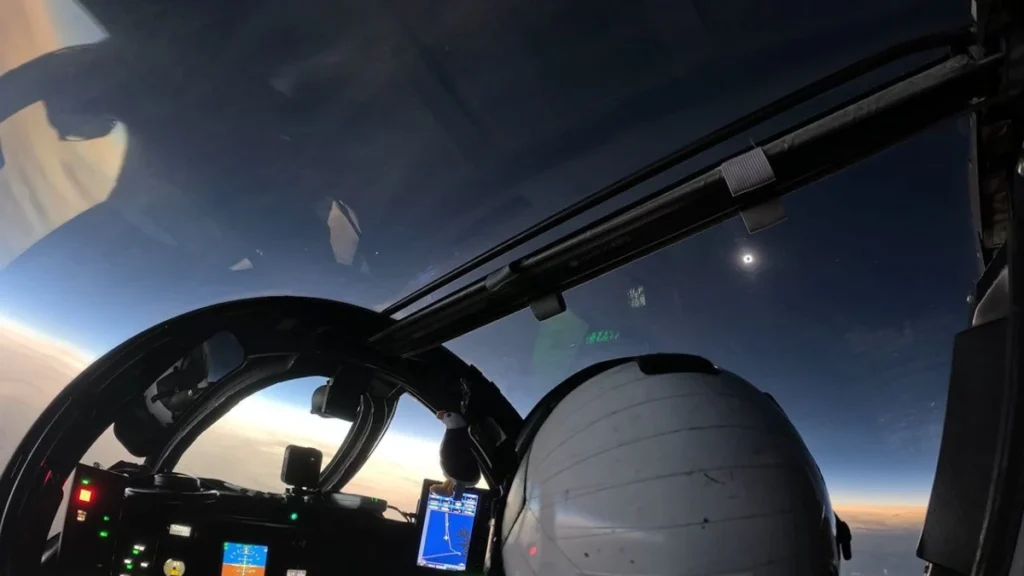
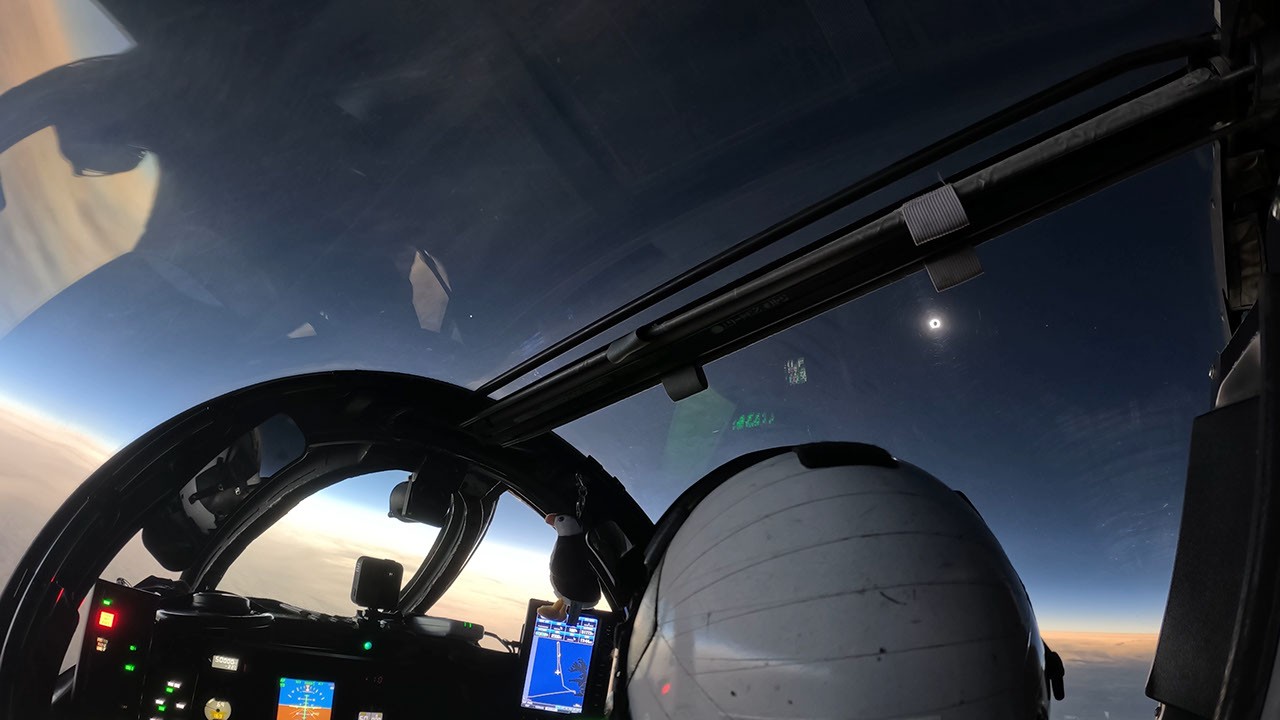
The image captured from the cockpit of the WB-57F, as featured by Astronomy Picture of the Day (APOD), offers a dramatic glimpse into this extraordinary mission. It depicts the ethereal glow of the solar corona, the Sun’s outermost atmosphere, as it emerges during the brief, yet profound, period of totality. The sky within the Moon’s shadow appears dark, a stark contrast to the brilliant horizon visible beyond the reach of the umbra, where the sky remains illuminated. Celestial bodies, including Venus shining to the left of center, and Jupiter and Mercury faintly visible to the right of the eclipsed Sun, add to the cosmic tableau.
Chasing Totality: A High-Altitude Pursuit
The mission’s primary objective was to maximize the duration of observation within the Moon’s shadow. By flying at 50,000 feet, the WB-57F could maintain its position along the precisely calculated path of totality for an extended period. This altitude places the aircraft above the majority of Earth’s atmospheric disturbances, including clouds, dust, and water vapor, which can significantly hinder ground-based observations.
The WB-57F, a dual-engine jet bomber originally developed in the 1950s and later adapted for high-altitude atmospheric research, proved an ideal platform. Its ability to reach extreme altitudes allows scientific instruments to operate in an environment closer to the vacuum of space, minimizing atmospheric distortion and enabling clearer, more detailed data collection. The aircraft was outfitted with a suite of high-resolution cameras specifically designed to record the intricate details of the solar corona and other phenomena associated with the eclipse.
The strategic decision to fly off the coast of Iceland was crucial. The path of the August 12, 2026, total solar eclipse was predicted to traverse a significant portion of the North Atlantic, making oceanic observation a necessity for those seeking the longest possible totality. Iceland, with its relatively predictable weather patterns during the summer months, provided a favorable location for this ambitious airborne endeavor.
The Science Behind the Spectacle
Observing a total solar eclipse from such an elevated vantage point offers distinct scientific advantages. The solar corona, a region of plasma extending millions of kilometers into space, is typically only visible during totality. Its study is crucial for understanding solar flares, coronal mass ejections, and the space weather that can impact Earth’s technological infrastructure, including satellites, communication systems, and power grids.
By capturing high-resolution imagery from above the densest layers of the atmosphere, scientists could potentially gather more detailed information about the corona’s structure, temperature, and magnetic field. This data can contribute to a better understanding of the Sun’s activity, its influence on the heliosphere, and its long-term evolution. Furthermore, the extended duration of totality experienced by the aircraft could allow for more comprehensive analysis of dynamic coronal features that might otherwise be missed.
The mission also aimed to record eclipse data that would complement observations made by ground-based telescopes and space-based observatories. The integration of data from multiple platforms provides a more holistic view of the eclipse event, allowing scientists to cross-reference findings and validate their interpretations. This multi-faceted approach is fundamental to advancing our knowledge of solar physics.
A Timeline of the Mission (Inferred)
While specific operational timelines for the WB-57F mission are not detailed in the provided excerpt, a typical mission of this nature would involve extensive planning and preparation.
- Pre-Mission Planning and Research: Years of astronomical calculations to precisely determine the eclipse path, optimal observation locations, and the trajectory for the WB-57F. Selection and calibration of scientific instruments.
- Aircraft Preparation: Equipping the WB-57F with specialized cameras and data acquisition systems. Crew training for high-altitude flight operations and eclipse observation protocols.
- Flight to Observation Point: The aircraft would have departed well in advance of the eclipse to reach its designated position off the coast of Iceland.
- Eclipse Event (August 12, 2026):
- Approach of Totality: As the Moon began to cover the Sun, the WB-57F would have adjusted its course to align with the predicted path of totality.
- Totality: The aircraft entered the Moon’s shadow, and the cameras began their intensive recording. Pilots would have maintained the precise flight path to maximize the observation window.
- Emergence of the Sun: As the Moon moved off the Sun, the period of totality concluded.
- Post-Mission Data Analysis: Upon landing, the collected data would undergo rigorous analysis by a team of astronomers and heliophysicists.
Supporting Data and Context
The August 12, 2026, total solar eclipse is a significant celestial event for several reasons. Its path of totality is predicted to cross parts of North America, including Greenland and Iceland, before continuing across the North Atlantic. For those in the path, the duration of totality will vary, but this particular eclipse offers an extended period for observation, especially from high-altitude platforms.
The WB-57F aircraft has a proven track record in scientific research. It has been instrumental in atmospheric studies, including tracking volcanic ash plumes, sampling stratospheric air, and observing Earth’s climate. Its capability to fly for extended periods at altitudes where the air is thin and the view is unobstructed makes it a valuable asset for astronomical observation, especially for events like solar eclipses where atmospheric interference can be a limiting factor.
The image itself, taken from an inflight video, provides compelling visual evidence of the mission’s success. The clarity of the solar corona, even with the inherent limitations of video capture, suggests the quality of the data being collected. The presence of visible planets further adds to the richness of the celestial scene, offering a multi-layered astronomical snapshot.
Official Responses and Broader Implications
While direct official statements from NASA regarding this specific mission at the time of the APOD feature are not detailed, the involvement of NASA’s Airborne Science Program and the continuous efforts to observe celestial events underscore the agency’s commitment to advancing scientific understanding. Such missions are typically a collaboration between various NASA centers, including the Johnson Space Center, which is mentioned in the explanation for its pilots’ role.
The implications of this high-altitude eclipse observation are far-reaching. The data gathered could contribute to improved models of solar activity, enhancing our ability to predict space weather events. This, in turn, has direct relevance for the safety and reliability of our increasingly technology-dependent society. Understanding the Sun’s behavior is not merely an academic pursuit; it is a practical necessity for protecting critical infrastructure and ensuring the continuity of modern life.
Furthermore, these visually stunning images and the scientific narratives that accompany them play a vital role in public engagement with science. The Astronomy Picture of the Day initiative, by showcasing such remarkable phenomena, inspires curiosity and fosters a broader appreciation for the wonders of the universe. The move of APOD’s main NASA site to science.nasa.gov/apod signifies a continued commitment to making cutting-edge scientific discoveries accessible to the public.
The success of missions like this also highlights the ongoing evolution of observational astronomy. While ground-based telescopes and space telescopes remain paramount, specialized platforms like the WB-57F offer unique observational capabilities that can fill critical gaps in our knowledge. The ability to precisely position an instrument within the path of totality, above atmospheric distortions, represents a significant advancement in our capacity to study the Sun and its dynamic influence on our solar system.
Looking Ahead: Enhancing Our Understanding
The APOD feature also provides a glimpse into future content, with "Tomorrow’s picture: enhancing Pluto." This indicates a continuous stream of astronomical imagery and scientific insights, suggesting a broad scope of coverage from planetary science to solar physics. The ongoing effort to capture and disseminate such information underscores the dynamic and ever-evolving nature of space exploration and scientific discovery.
In conclusion, the observation of the August 12, 2026, total solar eclipse from the cockpit of a NASA WB-57F aircraft represents a sophisticated and scientifically valuable endeavor. By leveraging advanced technology and strategic positioning, NASA scientists are pushing the boundaries of our understanding of the Sun and the cosmos, offering both breathtaking visuals and crucial data that will shape our knowledge for years to come. The image from the cockpit serves as a powerful testament to human ingenuity and our unyielding quest to unravel the mysteries of the universe.