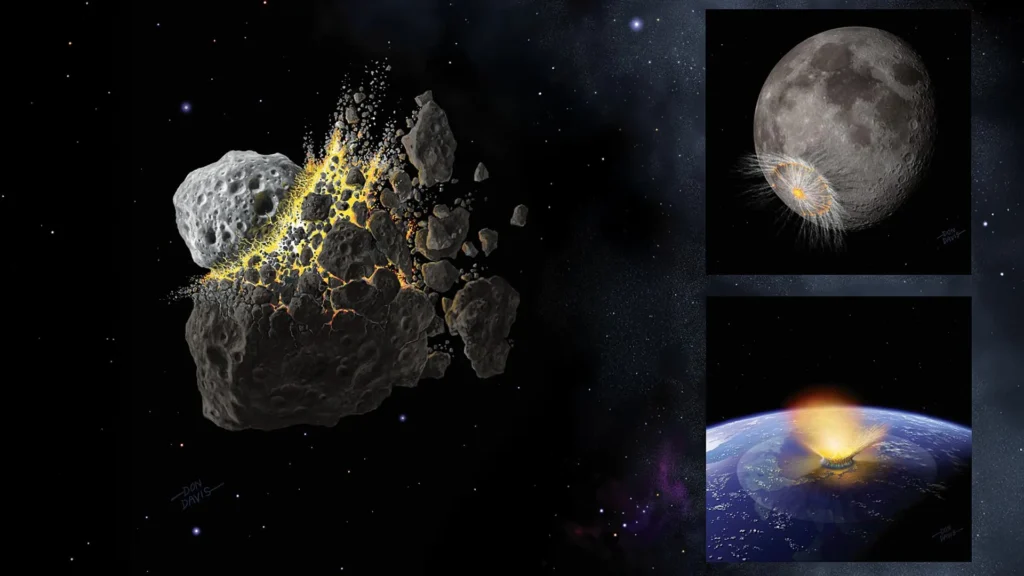
A cataclysmic collision within the main asteroid belt approximately 800 million years ago may have been the instigator of a prolonged and widespread wave of impacts that bombarded the inner solar system, including Earth, the Moon, and Mars. This groundbreaking hypothesis, put forth by researchers at the Southwest Research Institute (SwRI), suggests that the fragmentation of a large parent asteroid not only created the Eulalia asteroid family but also propelled vast quantities of debris on trajectories that led to a significant increase in extraterrestrial bombardments across our planetary neighborhood. If confirmed, this ancient cosmic event could have been a powerful driver of geological transformations on multiple worlds and potentially exerted a profound influence on Earth’s climate and the evolution of its biosphere.
Unraveling Ancient Cosmic Catastrophes
The intricate dance of celestial bodies and the profound impact of asteroid and comet collisions on the origin and evolution of life remain areas of intense scientific inquiry. While the devastating Chicxulub impact event, which famously led to the extinction of the non-avian dinosaurs 66 million years ago, is well-documented and strongly linked to specific biological consequences, the record of much older impacts is far more elusive.
"The role impacts have played in shaping the origin and evolution of life in our solar system is poorly understood," stated Dr. William Bottke, an executive director at SwRI’s Solar System Science and Exploration Division and lead author of the study published in a peer-reviewed journal. "The heavily cratered surface of the Moon serves as a reminder of the large impacts in Earth’s past, but so far, only the Chicxulub impact event 66 million years ago has been strongly linked to a specific effect on life, namely the mass extinction of the dinosaurs."
Earth’s dynamic geological processes, including volcanic activity, plate tectonics, and relentless weathering, continuously reshape and recycle its surface, effectively erasing or burying evidence of ancient impacts. This constant renewal makes reconstructing the planet’s impact history a formidable challenge. However, the Moon, with its geologically static surface, devoid of significant atmosphere, flowing water, or active plate tectonics, acts as a pristine archive, preserving a much more complete record of bombardment over billions of years.
The Moon’s Silent Testimony to an Impact Surge
Previous scientific investigations, analyzing the estimated ages of major lunar craters and impact glass samples collected during the Apollo missions, had already pointed towards a discernible surge in large impacts on the Moon around 800 million years ago. Impact glass, formed when the immense heat of a collision melts terrestrial rock, contains crucial chemical and chronological signatures that allow scientists to date these ancient events. This lunar evidence provided a compelling clue that a significant increase in extraterrestrial activity had occurred, but the precise source of this bombardment remained an open question.
To bridge this gap, Dr. Bottke and his team employed sophisticated collisional and dynamical models. Their "cosmic forensics" approach aimed to identify a plausible event within the main asteroid belt that could account for the observed lunar impact surge. The researchers focused on the breakup of a large parent object that formed the Eulalia asteroid family, a group of asteroids believed to have originated from a single progenitor. Their simulations revealed that the parent body’s location was a critical factor. It fragmented precisely at the gravitational threshold of the 3:1 mean motion resonance with Jupiter, a region known for its ability to perturb asteroids and send them on trajectories that could intersect with the inner solar system.
Jupiter’s Gravitational Influence and the Eulalia Breakup
The 3:1 mean motion resonance with Jupiter is a dynamic orbital zone where asteroids complete three orbits around the Sun for every single orbit Jupiter completes. This precise orbital relationship means that asteroids within this resonance experience regular, amplified gravitational tugs from the giant planet. Over extended periods, these repeated gravitational nudges can gradually destabilize asteroid orbits, effectively acting as an "escape route" from the main asteroid belt. Objects perturbed into this resonance are often flung into highly elliptical orbits that frequently cross the paths of the inner terrestrial planets, including Earth.
The research posits that the parent asteroid responsible for the Eulalia family’s formation was a primitive carbonaceous chondrite-like object. These meteorites are among the oldest materials in the solar system, offering insights into its early composition and conditions. Their fragmentation at the edge of the J3:1 resonance was particularly consequential. According to the SwRI team’s models, approximately half of the resulting debris fragments were immediately injected into this resonant pathway.
This injection into the J3:1 resonance acted as a cosmic slingshot, scattering the fragments throughout the inner solar system. The consequence was a dramatic increase in the rate of impacts experienced by the Moon, Earth, Mars, and potentially other rocky bodies. The bombardment, however, was not an instantaneous event. The study highlights that over the subsequent 100 to 150 million years, an additional 25% of the Eulalia fragments gradually drifted into the J3:1 resonance. This slow migration was influenced by the Yarkovsky effect, a subtle yet significant force generated by the uneven emission of thermal radiation from an asteroid as it absorbs sunlight and re-radiates heat. This minute push, accumulating over vast timescales, can slowly alter an asteroid’s orbit, gradually feeding more debris into the resonant pathways and prolonging the period of increased impact flux.
Broader Implications for Earth and Mars
The modeling conducted by Dr. Bottke and his colleagues suggests that the Eulalia breakup provides a compelling explanation for the observed increase in lunar craters dating back to approximately 800 million years ago. Furthermore, the study extrapolates these findings to infer the potential impact flux on Earth. Given Earth’s larger size and stronger gravitational pull, it would have experienced a significantly higher rate of impacts compared to the Moon. The researchers estimate that for every large impactor that struck the Moon, roughly twenty objects of similar or greater size would have impacted Earth during this period.
While direct geological evidence of these numerous ancient impacts on Earth has largely vanished due to ongoing geological processes, the timing of this proposed bombardment coincides with a crucial period in Earth’s history marked by widespread global cooling and substantial shifts in its biosphere. This temporal correlation raises a tantalizing possibility: that this ancient barrage of extraterrestrial material may have played a significant role in driving these profound environmental and biological changes.
"Given that the peak of this barrage coincides with a period of widespread cooling and major shifts in our biosphere, it is tempting to suggest that the former produced the latter," Dr. Bottke commented. "On Mars, these impacts would have triggered substantial episodes of seismic shaking and can be linked in time with a surge in volcanic activity. Together, this showcases how certain catastrophic collisions in the main belt could have had far-reaching consequences for the history of the terrestrial planets."
The implications for Mars are particularly noteworthy. The modeling suggests that these impacts could have triggered significant seismic activity, potentially contributing to or coinciding with a period of increased volcanic eruptions on the Red Planet. Such a scenario underscores the interconnectedness of geological and atmospheric evolution on terrestrial planets, influenced by external cosmic forces.
Future Research and Unanswered Questions
While the study establishes a strong theoretical link between the Eulalia asteroid family’s formation and the increased impact rate in the inner solar system, it is important to note that it does not definitively prove causation for the observed climatic and biological changes on Earth. However, the compelling coincidence provides a robust foundation for future research. Scientists are now keen to explore this connection further, seeking more direct geological or geochemical evidence on Earth that might corroborate the proposed impact surge and its potential influence on ancient life.
The research also opens avenues for investigating the broader impact of such events on planetary habitability and the long-term evolution of solar systems. Understanding the frequency and consequences of large-scale asteroid belt disruptions can provide crucial context for assessing the potential risks posed by asteroid impacts in the present day and for refining our understanding of how life might arise and persist on other worlds. The continued study of lunar geology, coupled with advanced modeling of asteroid dynamics, promises to shed further light on these ancient cosmic events and their enduring legacy on the worlds we inhabit and explore.