A collaborative team of scientists from the CSIR-Central Salt and Marine Chemicals Research Institute (CSMCRI), the Indian Institute of Technology Gandhinagar (IITGN), Nanyang Technological University (NTU) in Singapore, and the S N Bose National Centre for Basic Sciences has announced the development of a groundbreaking filtration technology that could fundamentally alter the landscape of industrial manufacturing. The research, detailed in a recent publication in the Journal of the American Chemical Society (JACS), introduces "POMbranes"—a new class of crystalline membranes engineered with molecular-level precision. This innovation arrives at a critical juncture as global industries face mounting pressure to reduce carbon footprints, minimize energy consumption, and adopt circular water economies.
Industrial separation processes, which include the purification of chemicals, the desalination of water, and the recovery of solvents, are the silent workhorses of the modern economy. Despite their importance, these processes are notoriously inefficient. Current estimates suggest that separation-related tasks account for approximately 40% to 50% of the total energy consumed by the global industrial sector. The reliance on traditional thermal-based methods, such as distillation and evaporation, contributes significantly to global greenhouse gas emissions. While membrane-based filtration has long been proposed as a more sustainable alternative, the limitations of existing materials have hindered widespread adoption in high-stakes industrial environments.
The Technological Bottleneck of Conventional Filtration
For decades, the industry has relied primarily on polymer-based membranes. While cost-effective to produce, these membranes suffer from inherent structural flaws. The pores within polymer matrices are often non-uniform in size and distribution, leading to a "wide-net" effect where unwanted molecules can slip through, or desired molecules are trapped. Furthermore, under the high pressure and harsh chemical conditions typical of industrial processing, polymer pores tend to deform, swell, or degrade over time. This lack of structural "rigidity" leads to a decline in selectivity and requires frequent, costly replacements.
To solve this, the multi-institutional research team looked toward nature for a blueprint. In biological systems, proteins called aquaporins facilitate the rapid and highly selective transport of water molecules across cell membranes while blocking ions and other solutes. They achieve this through perfectly sized, static channels. Replicating this biological perfection in a synthetic, scalable material has been a "holy grail" for materials scientists.
POMbranes: Nature-Inspired Engineering at the Atomic Scale
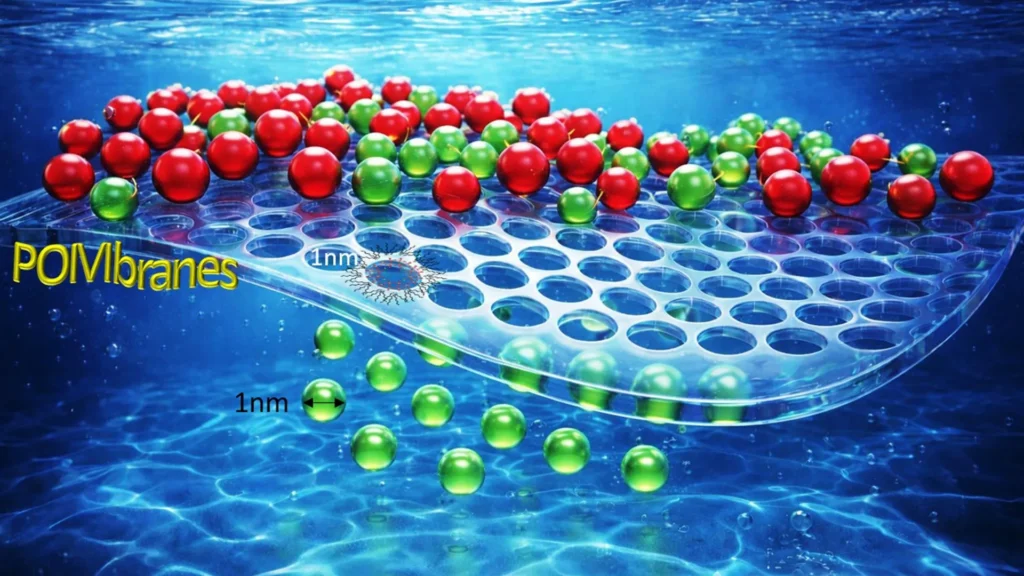
The breakthrough lies in the use of polyoxometalate (POM) clusters. Dr. Shilpi Kushwaha, Senior Scientist at CSMCRI, explained that the team engineered these ultra-selective membranes to contain pores exactly one nanometer wide—roughly 80,000 times thinner than a human hair. These "POMbranes" represent a shift from random polymer entanglement to precise crystalline architecture.
The core component, the POM cluster, is a tiny, crown-shaped metal-oxygen framework. Unlike synthetic polymers, these clusters possess a permanent, rigid central cavity. Ms. Priyanka Dobariya, a research scholar at CSMCRI and co-first author of the study, noted that the biggest hurdle with traditional plastic filters is their tendency to lose shape. In contrast, the POM clusters provide a "perfect hole" that remains stable regardless of the external pressure or the chemical environment.
Creating a functional membrane, however, required more than just the clusters themselves; it required a method to assemble billions of these microscopic rings into a cohesive, defect-free sheet. The researchers achieved this by grafting flexible chemical chains onto the POM clusters. When these modified clusters were introduced to a liquid interface, they underwent a process of self-organization, spreading out to form an ultrathin, continuous film. By adjusting the length and density of these chemical "tethers," the team could control the packing of the clusters, ensuring that the only way for a molecule to pass through the membrane was through the one-nanometer central pore.
Performance Metrics and Molecular Simulations
The efficiency of the POMbranes was validated through rigorous testing and advanced molecular-level simulations. Dr. Raghavan Ranganathan, Associate Professor at IITGN’s Department of Materials Engineering, led the computational efforts alongside PhD scholar Vinay Thakur. Their simulations provided a window into the "sieve" mechanism, showing exactly how the membrane distinguishes between molecules based on minute differences in size and weight.
The results were stark. The POMbranes demonstrated the ability to distinguish between molecules that differ by as little as 100 to 200 Daltons (a unit of molecular mass). This level of resolution is nearly impossible for conventional membranes to maintain consistently. According to Dr. Ketan Patel, Principal Scientist at CSMCRI, the POMbranes showed nearly ten times better separation performance than existing commercial technologies. Furthermore, the membranes remained stable across a wide range of pH levels, a vital requirement for treating acidic or alkaline industrial waste.
Strategic Impact on India’s Textile and Pharmaceutical Sectors
The implications of this technology are particularly profound for India, where the textile and pharmaceutical industries are pillars of the national economy. The Indian textile and apparel sector currently contributes more than 2.3% to the national GDP and accounts for 13% of industrial production. With the domestic market projected to reach up to $350 billion by 2030, the environmental toll of this growth is a major concern.
Textile manufacturing is one of the most water-intensive industries in the world. The dyeing and finishing stages produce vast quantities of effluent contaminated with complex organic dyes. Traditional treatment methods often fail to recover water to a grade high enough for reuse within the factory, leading to massive freshwater consumption. POMbranes offer a solution by selectively removing dye molecules—which are typically larger than the one-nanometer pore—while allowing water and essential salts to pass through. This could enable a "closed-loop" system where water is perpetually recycled, drastically reducing the industry’s environmental footprint.
Similarly, in the pharmaceutical sector, the purification of drug compounds and the recovery of expensive solvents are critical to maintaining product quality and controlling costs. "Processes like drug purification are both energy-intensive and quality-sensitive," noted Vinay Thakur. The high selectivity of POMbranes ensures that active pharmaceutical ingredients (APIs) can be isolated with minimal loss and without the need for energy-heavy thermal distillation, which can sometimes damage heat-sensitive medical compounds.
Economic and Environmental Analysis
From a broader economic perspective, the adoption of POMbrane technology aligns with global "Green Manufacturing" initiatives. By replacing distillation columns with membrane units, industrial facilities can potentially reduce their separation-related energy consumption by up to 90%. In a world where energy prices are volatile and carbon taxes are becoming more common, such efficiency gains directly translate to improved bottom-line margins for manufacturers.
Furthermore, the scalability of the POMbrane production process is a key factor in its potential for commercial success. The researchers have demonstrated that these membranes can be manufactured in large sheets, moving the technology out of the laboratory and toward industrial-scale applications. The ability to maintain flexibility and mechanical strength in a large-format crystalline membrane is a significant material science achievement.
Timeline and Future Outlook
The development of POMbranes is the result of several years of interdisciplinary collaboration, combining expertise in synthetic chemistry, materials engineering, and computational physics. Following the successful publication of their findings in the Journal of the American Chemical Society, the team is expected to move toward pilot-scale testing.
The next phase of research will likely involve "stress-testing" the membranes in real-world industrial effluents, which are often more complex than laboratory-prepared solutions. If the POMbranes maintain their ten-fold performance advantage in these settings, they could see commercial deployment within the next five to seven years.
As the global community strives to meet the United Nations Sustainable Development Goals (SDGs)—specifically Goal 6 (Clean Water and Sanitation) and Goal 9 (Industry, Innovation, and Infrastructure)—technologies like the POMbrane provide a tangible pathway forward. By applying the elegant efficiency of biological systems to the rigors of industrial engineering, this Indo-Singaporean research team has provided a powerful tool for the next generation of sustainable manufacturing. The "perfect hole" found in a tiny metal cluster may indeed be the key to solving some of the world’s most massive industrial challenges.