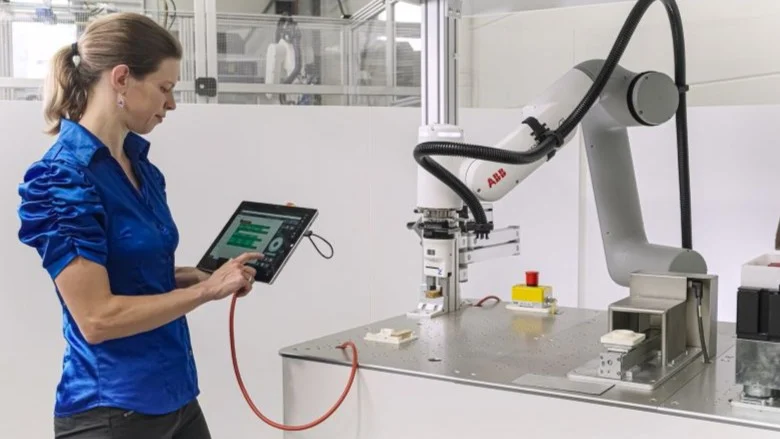
AUBURN HILLS, Mich. – ABB Robotics has unveiled a significant innovation in industrial automation, introducing a novel safety interface, dubbed the E-Device, that empowers manufacturers to leverage their existing tablets and personal computers for the programming, operation, and monitoring of both industrial robots and collaborative robots (cobots) powered by the company’s advanced OmniCore controllers. This development marks a pivotal step towards democratizing robot control, making sophisticated automation more accessible and user-friendly across diverse manufacturing environments.
The core of the E-Device’s appeal lies in its seamless integration with the OmniCore control platform. By standardizing the user interface across ABB’s entire portfolio of robots and cobots, the E-Device eliminates the steep learning curve traditionally associated with managing multiple robotic systems. This universal interface ensures that employees can transition effortlessly between different robot types and applications without the need to master distinct programming languages or proprietary control panels for each machine. Such uniformity promises substantial efficiencies in training, reducing both the time and resources required to bring new operators up to speed and maintain a versatile workforce.
Beyond simplified operation, the E-Device significantly enhances the robot development and deployment lifecycle. Engineers can now utilize ABB’s powerful RobotStudio software – a leading simulation and offline programming tool – to develop and rigorously test robot programs in a virtual environment. Once optimized, these programs can be directly deployed to the production line using the very same tablet or PC equipped with the E-Device. This streamlined process eliminates the need for transferring files between different hardware, accelerating commissioning and reducing potential errors. Furthermore, the E-Device provides access to AppStudio, ABB’s intuitive no-code tool, which allows users to create highly customized, application-specific interfaces without requiring extensive programming expertise. This capability is particularly beneficial for manufacturers needing tailor-made human-machine interfaces (HMIs) for specific tasks, further simplifying complex operations.
In manufacturing facilities characterized by multiple robotic installations, the E-Device offers unparalleled flexibility. A single mobile device, whether a tablet or a PC, can be moved seamlessly between various E-Device-equipped robotic systems. This portability not only reduces the capital expenditure on dedicated teach pendants or control stations but also streamlines operational workflows. Operators can monitor performance, make adjustments, or deploy new programs from virtually anywhere on the shop floor, fostering a more agile and responsive production environment. ABB anticipates that this innovative approach will lead to substantial reductions in training requirements, engineering time, and commissioning efforts, thereby accelerating production ramp-up for new products and processes. While specific time or cost savings figures were not disclosed by the company, the inherent efficiencies of a unified, mobile control system strongly suggest considerable economic benefits for adopting manufacturers.
Addressing the Critical Aspect of Industrial Safety
A paramount concern when integrating consumer-grade devices like tablets and PCs into industrial control systems is safety. Industrial robots operate with significant power and speed, posing potential hazards to human operators if not managed with robust safety protocols. The E-Device meticulously addresses these concerns by incorporating critical safety features directly into its compact interface. It includes a physical emergency-stop button, providing an immediate and universally recognized means to halt robot operation in critical situations. Additionally, a three-position enabling switch is integrated for manual robot operation, adhering to stringent industrial safety standards that require a "dead man’s switch" functionality to prevent unintended movements.
This commitment to safety is underscored by the device’s compliance with international standards. The E-Device meets the requirements of ISO 10218:2025, the global benchmark for industrial robot safety. This standard specifies the safety requirements for industrial robots and robot systems, ensuring that they are designed and operated in a manner that protects human workers. Furthermore, the E-Device has received both CE and UL certifications, signifying its conformity with European health, safety, and environmental protection standards, and its compliance with the safety standards of the United States and Canada, respectively. These certifications provide manufacturers with the assurance that the E-Device is a safe and reliable component for their automation strategies, enabling them to confidently deploy consumer-grade hardware for industrial control without compromising worker safety.
Background Context: The Evolution of Robot Control and Industry Trends
The introduction of the E-Device is not an isolated event but rather a direct response to, and an acceleration of, several overarching trends transforming the global manufacturing landscape. For decades, industrial robot programming was the domain of highly specialized engineers, often requiring proprietary teach pendants with arcane interfaces and complex, text-based coding languages. This exclusivity created significant barriers to entry for smaller manufacturers and limited the flexibility of larger enterprises.

The rise of collaborative robotics (cobots) in the last decade has significantly shifted this paradigm. Cobots, designed to work alongside humans without safety caging, inherently demanded more intuitive programming methods, often featuring lead-through programming or graphical user interfaces. The E-Device takes this concept further, extending the ease of use typically associated with cobots to the broader spectrum of industrial robots, thereby blurring the lines between these categories from a control perspective.
This innovation also aligns perfectly with the principles of Industry 4.0 and the Smart Factory concept. These paradigms emphasize interconnectedness, data exchange, and human-machine collaboration to achieve greater efficiency, flexibility, and customization in manufacturing. By enabling control through standard, widely available devices, the E-Device facilitates greater connectivity and data access, pushing manufacturers closer to fully integrated and intelligent production systems. It represents a move towards what is often termed "democratization of automation," making sophisticated robotic capabilities accessible to a wider range of users, including those without extensive robotics expertise.
A Chronology of Programming Evolution
The journey of robot programming has been one of continuous simplification and abstraction:
- 1960s-1970s: Early Text-Based Programming: First industrial robots were programmed using assembly languages or rudimentary, proprietary text-based languages, often requiring deep computer science knowledge.
- 1980s-1990s: Teach Pendants and Structured Languages: Dedicated teach pendants became standard, allowing point-to-point programming by physically moving the robot and recording positions. Proprietary, structured programming languages (e.g., VAL for Unimation, RAPID for ABB) emerged, offering more control but still demanding specialized training.
- 2000s: Graphical User Interfaces (GUIs) and Simulation Software: PC-based simulation software like ABB RobotStudio gained prominence, allowing offline programming and visualization. Teach pendants evolved with more user-friendly GUIs, but remained proprietary hardware.
- 2010s: Lead-Through Programming and Cobot Interfaces: The advent of cobots popularized lead-through programming, where operators physically guide the robot to teach paths, and highly intuitive tablet-like interfaces, significantly lowering the entry barrier.
- 2020s: No-Code/Low-Code and Universal Control: The E-Device, along with tools like AppStudio, represents the latest evolution, bringing no-code interface creation and the flexibility of common consumer hardware (tablets/PCs) to control a full range of industrial and collaborative robots. This shift emphasizes accessibility, rapid deployment, and a standardized user experience across diverse robot types.
Statements and Inferred Reactions
Marc Segura, President of ABB Robotics, articulated the strategic vision behind the E-Device, stating, "Customers are looking for ways to quickly and easily customize and build solutions that can be readily adapted and scaled as their needs change, without the need to spend time learning how to use new interfaces or programming." This statement encapsulates the modern manufacturer’s imperative for agility and adaptability in a rapidly changing market. The E-Device directly addresses this need by providing a flexible, future-proof control solution that reduces operational friction and accelerates innovation.
Industry analysts are likely to view the E-Device as a significant competitive move for ABB. In a market increasingly focused on ease of integration and total cost of ownership, a solution that leverages existing IT infrastructure and reduces training burdens offers a compelling value proposition. Manufacturers, particularly small and medium-sized enterprises (SMBs) who have historically been deterred by the complexity and cost of traditional automation, are expected to react positively. The ability to use familiar devices to control sophisticated robotics could significantly lower the psychological and financial barriers to automation adoption, making advanced manufacturing more attainable for a broader segment of the industrial base.
Broader Impact and Implications
The implications of ABB’s E-Device extend far beyond mere convenience. This innovation is poised to have a transformative impact on several fronts:
- Empowering Small and Medium-sized Businesses (SMBs): For SMBs operating with tighter budgets and fewer specialized personnel, the E-Device can be a game-changer. By reducing the need for expensive, proprietary teach pendants and simplifying the programming process, it lowers the initial investment and ongoing operational costs associated with robotics. This could unlock automation for a segment of the market previously underserved, enabling them to compete more effectively with larger enterprises.
- Workforce Development and Upskilling: The E-Device supports the ongoing shift in the manufacturing workforce. Instead of requiring highly specialized robot programmers, companies can train existing staff – even those with limited technical backgrounds – to operate and make minor adjustments to robotic systems. This democratizes access to automation skills, making the workforce more adaptable and resilient to technological change. It frees up expert engineers to focus on more complex tasks, driving innovation.
- Enhanced Productivity and Flexibility: The ability to quickly program, deploy, and reconfigure robots using a familiar mobile device will significantly boost manufacturing flexibility. Production lines can be adapted faster to new product variants, seasonal demands, or design changes, leading to shorter lead times and improved overall equipment effectiveness (OEE). The portability of the control interface also means less downtime for troubleshooting or adjustments, directly impacting productivity.
- Future of Human-Robot Interaction (HRI): The E-Device represents a critical step in the evolution of HRI, moving towards more natural and intuitive control paradigms. As interfaces become more akin to everyday consumer devices, the interaction between humans and robots will become smoother, safer, and more collaborative, ultimately leading to more integrated and efficient human-robot teams on the factory floor. This sets a precedent for how future industrial technologies might be controlled, emphasizing user experience (UX) and accessibility.
- ABB’s Strategic Advantage: For ABB, the E-Device strengthens its position as a leader in robotics innovation. By anticipating and responding to the market’s demand for simpler, more flexible, and safer automation solutions, ABB reinforces its commitment to empowering manufacturers with cutting-edge technology. This move could attract new customers and solidify relationships with existing ones, driving market share in a highly competitive industry.
In conclusion, ABB Robotics’ E-Device is more than just a new piece of hardware; it signifies a fundamental shift in how industrial automation is perceived and implemented. By bridging the gap between sophisticated robotic technology and the intuitive interfaces of everyday devices, it promises to make advanced manufacturing more accessible, efficient, and safer for a broader spectrum of industries worldwide. This innovation is poised to accelerate the adoption of robotics, driving productivity gains and fostering a more adaptable and resilient manufacturing sector in the years to come.