The burgeoning field of artificial intelligence is increasingly demonstrating its transformative potential across various scientific disciplines, and cosmology is proving to be a particularly fertile ground for its application. A recent study, published in the prestigious Journal of Cosmology and Astroparticle Physics (JCAP), has shed new light on how advanced machine learning techniques, specifically transfer learning, can revolutionize the quest for understanding the fundamental laws governing our cosmos. While offering unprecedented efficiency, the research also presents a cautionary tale about the inherent biases AI can develop, potentially hindering the very discoveries it aims to accelerate.
Unraveling the Universe’s Mysteries: The $Lambda$CDM Model and Its Limits
At the heart of modern cosmology lies the Standard Model, known as Lambda-Cold Dark Matter ($Lambda$CDM). This model has been remarkably successful in explaining a vast array of cosmological observations, from the large-scale structure of the universe and its accelerating expansion to the cosmic microwave background (CMB) radiation – the faint afterglow of the Big Bang. $Lambda$CDM posits that the universe is composed of roughly 5% ordinary matter (the atoms that make up stars, planets, and ourselves), 27% mysterious cold dark matter (an invisible substance that interacts gravitationally but not electromagnetically), and 68% even more enigmatic dark energy (a force driving the universe’s accelerated expansion).
Despite its successes, the $Lambda$CDM model is not considered a complete picture. Over the past two decades, high-precision observations have begun to reveal subtle discrepancies and "tensions" that hint at physics beyond the Standard Model. For instance, the "Hubble tension" refers to a persistent disagreement between measurements of the universe’s expansion rate (the Hubble constant) derived from the early universe (via the CMB) and those from the late universe (via observations of supernovae and other local phenomena). This discrepancy, currently standing at around 8-9%, has stubbornly persisted despite improved measurements, prompting cosmologists to consider novel physical explanations. Other anomalies include potential inconsistencies in the clustering of matter (the S8 tension) and the observed abundance of primordial lithium.
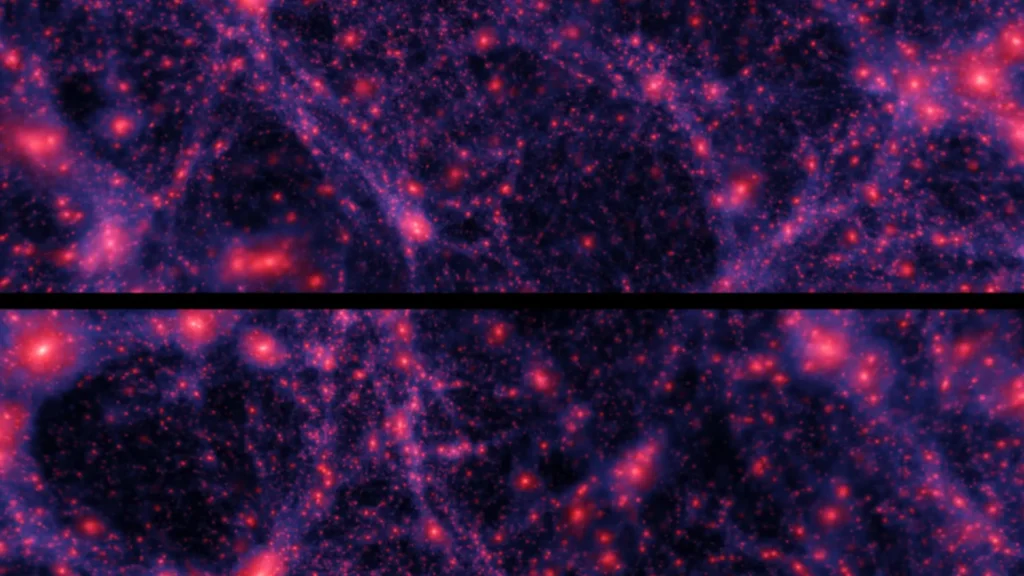
These unresolved questions motivate the search for new physics, which could involve phenomena such as the existence of massive neutrinos (particles that, despite their tiny mass, could influence large-scale structure), modifications to Einstein’s theory of general relativity (modified gravity), or a more dynamic form of dark energy that evolves over cosmic time. Exploring these possibilities is a monumental computational challenge. Researchers must generate enormous numbers of detailed computer simulations, each representing a "virtual universe" constructed under different physical assumptions. These simulations are not mere artistic renderings; they are complex numerical experiments that evolve gravitational interactions, baryonic matter, and dark components over billions of years of cosmic history.
Producing these high-fidelity simulations is extraordinarily computationally expensive, demanding access to some of the world’s most powerful supercomputers, consuming vast amounts of energy, and requiring significant human expertise to set up and analyze. A single cutting-edge cosmological simulation can take weeks or even months to run on thousands of CPU cores, generating petabytes of data. This bottleneck significantly limits the scope and speed of theoretical exploration, creating a demand for more efficient methodologies.
Transfer Learning: A Shortcut to Cosmic Understanding
It is within this context that the new research, led by first author Veena Krishnaraj, an undergraduate student at Princeton University, and co-authored by Adrian Bayer, a cosmologist at the Flatiron Institute and Princeton University, investigated the potential of transfer learning. This machine learning technique offers a compelling strategy to mitigate the prohibitive costs associated with cosmological simulations.
Transfer learning is a paradigm in artificial intelligence where a model, trained to perform a specific task, is then repurposed or "fine-tuned" for a different but related task. Instead of building and training a neural network from scratch for every new scenario, which can be time-consuming and data-intensive, transfer learning allows the system to leverage pre-existing knowledge. Imagine training an AI to recognize cats, and then adapting that knowledge to recognize lions; the foundational understanding of feline features is transferable.
In the cosmological application, the research team adopted an ingenious two-step approach. Rather than directly training a neural network on the most complex and computationally costly simulations, which incorporate various new physics models, they first subjected the AI to a "pretraining" phase. During this phase, the neural network was trained on simpler, less expensive simulations based solely on the well-understood $Lambda$CDM model. These simulations, while still demanding, are significantly less resource-intensive than those exploring exotic physics.
"It’s basically a shortcut," explains Adrian Bayer. "Usually people train the AI directly on the most computationally expensive simulations. What we do instead is first use simpler and less expensive $Lambda$CDM simulations to give the AI an idea of what’s happening, and only afterward move to the more complex models."
Bayer draws an accessible analogy to human learning: "You first read a basic book to get an idea of the knowledge, and then move to the really complicated book." This sequential learning prevents the AI from being overwhelmed, allowing it to build a foundational understanding of the universe’s dynamics under known physics before tackling the more nuanced deviations proposed by new physics. Veena Krishnaraj further elaborates, stating that this strategy prevents the AI from having to "digest everything at once."
The results of this innovative approach were remarkably positive. The study demonstrated that by employing transfer learning, the number of expensive simulations required to train the AI to a satisfactory level could be reduced by more than a factor of ten in some cases. This translates directly into substantial savings in computational time, energy consumption, and financial resources – a critical advancement for a field perpetually constrained by these factors. Such efficiency gains could dramatically accelerate the pace at which cosmologists can test new theories, sift through vast parameter spaces, and home in on potential breakthroughs.
The Unexpected Pitfall: When Prior Knowledge Becomes a Blind Spot
However, the study by Krishnaraj, Bayer, and their colleagues also brought to light a less intuitive, and potentially problematic, phenomenon known as "negative transfer." While transfer learning is generally lauded for its efficiency, there are instances where prior knowledge can become a hinderance rather than a help.
Returning to Bayer’s textbook analogy, consider a medical student who has extensively studied common diseases. When confronted with a rare condition that presents with symptoms strikingly similar to a prevalent illness, the student’s well-established knowledge, while generally beneficial, might inadvertently lead them to misdiagnose, pushing them towards the more familiar conclusion.
The same issue can manifest in AI systems. In the context of cosmological research, the study revealed that the "signatures" of certain new physics phenomena can closely resemble patterns that the AI has already learned to associate with parameters within the standard $Lambda$CDM model. When this happens, the pretrained neural network, steeped in its existing knowledge, may misinterpret unfamiliar information, attempting to fit it into its established framework rather than recognizing it as genuinely novel. This can make it significantly harder for the AI to discern and correctly identify the true nature of new effects.
The researchers observed this negative transfer effect most prominently when studying simulations that included massive neutrinos. Neutrinos, often called "ghost particles" due to their elusive nature, are fundamental particles that interact very weakly with matter. While long thought to be massless, experiments have confirmed they possess a tiny but non-zero mass. This mass, though minuscule, could have observable cosmological effects, particularly on the clustering of matter in the universe.
The challenge arose because some of the observational signatures linked to neutrino mass closely resemble changes associated with an existing $Lambda$CDM parameter called $sigma_8$. The parameter $sigma_8$ (sigma-eight) is a crucial measure of how strongly matter clusters in the universe, quantifying the amplitude of density fluctuations on a specific scale (typically 8 megaparsecs). A universe with a lower $sigma_8$ would appear smoother, with less pronounced galaxy clusters, while a higher $sigma_8$ implies more clumpy structure.
Because the effects of massive neutrinos on large-scale structure can mimic certain changes in $sigma_8$, the pretrained neural network initially struggled to differentiate between the two. The AI, having learned extensively about $sigma_8$ during its pretraining phase, tended to attribute the observed changes to this familiar parameter, even when massive neutrinos were the true underlying cause.
"The negative transfer is not random. It is driven by underlying physical degeneracies in the model," emphasizes Krishnaraj. This insight is crucial: it’s not simply an AI error, but a reflection of the inherent ambiguities in the physical universe itself, where different fundamental processes can sometimes produce very similar observable consequences. This phenomenon, known as "degeneracy" in physics, means that multiple theoretical models can fit the same observational data, making it difficult to distinguish between them.
"So this is something we need to be aware of and try to mitigate," Krishnaraj concludes, underscoring the necessity for future research to develop strategies to overcome this inherent bias in AI-driven discovery.
Broader Implications for the Future of Cosmology
The findings of this study resonate far beyond the specifics of cosmological simulations, highlighting both the immense promise and the inherent limitations of applying sophisticated AI concepts, similar in spirit to those powering modern generative AI systems and large language models, to fundamental physics. The paper explicitly notes that while pretraining can undoubtedly speed up inference, it "may also hinder learning new physics." This duality presents a fundamental challenge for the scientific community.
The implications for upcoming cosmological surveys are particularly significant. Missions such as the European Space Agency’s Euclid telescope, NASA’s Nancy Grace Roman Space Telescope, and ground-based projects like the Dark Energy Spectroscopic Instrument (DESI) and the Vera C. Rubin Observatory are poised to collect unprecedented amounts of high-precision data about the universe in the coming years. These surveys will generate exabytes of information, far exceeding human capacity for manual analysis. AI and machine learning are not merely helpful tools; they are indispensable for extracting meaningful insights from this deluge of data.
The ability of transfer learning to rapidly process and interpret complex observational data could be a game-changer, allowing cosmologists to accelerate the testing of various theoretical models against real-world observations. However, the discovery of negative transfer means that researchers must be acutely aware of the potential for AI to inadvertently overlook or misinterpret genuinely new phenomena if those phenomena bear a superficial resemblance to known physics. This calls for a careful, human-guided approach to AI deployment, perhaps involving methods to explicitly challenge or "de-bias" AI models in the search for the truly unexpected.
Ultimately, this research underscores a fundamental truth about the scientific process, even when augmented by advanced technology: the human element of critical thinking, skepticism, and the pursuit of anomalies remains paramount. AI can be an incredibly powerful assistant, a tireless data processor, and a formidable pattern recognizer. But the ultimate interpretation, the recognition of true novelty, and the willingness to question even the most successful models, still rest with human scientists. The journey to uncover the universe’s deepest secrets is becoming a collaborative endeavor, merging the boundless computational power of artificial intelligence with the unique intellectual curiosity and discernment of the human mind. The paper, "Transfer Learning Beyond the Standard Model" by Veena Krishnaraj, Adrian E. Bayer, Christian Kragh Jespersen, and Peter Melchior, published in JSTAT (Journal of Statistical Mechanics: Theory and Experiment), marks a crucial step in understanding this evolving scientific frontier.