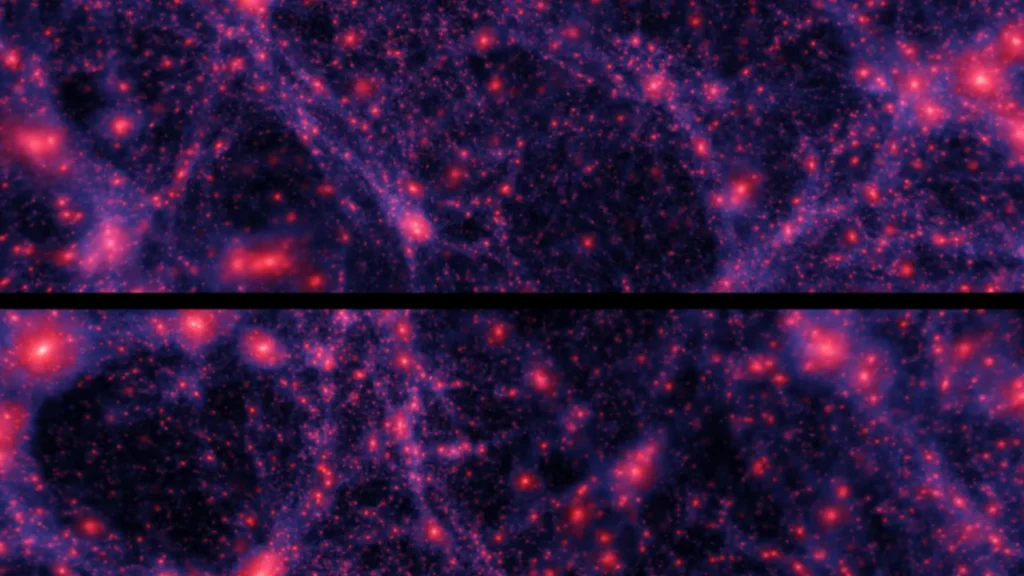
The findings, published in the Journal of Cosmology and Astroparticle Physics (JCAP), illuminate both the transformative potential and inherent limitations of advanced AI techniques in probing the universe’s most profound mysteries. This work arrives at a critical juncture, as astronomical observatories worldwide prepare to unleash unprecedented torrents of data, demanding innovative computational approaches to extract scientific insights.
Unveiling the Universe’s Hidden Chapters: The Quest Beyond ΛCDM
For decades, the standard cosmological model, known as Lambda-Cold Dark Matter (ΛCDM), has stood as the bedrock of modern cosmology. This elegant framework successfully describes a vast array of observations, from the large-scale structure of the universe and its accelerating expansion to the Cosmic Microwave Background (CMB) – the relic radiation from the Big Bang. ΛCDM posits that the universe is composed of roughly 5% ordinary matter, 27% mysterious cold dark matter (which provides gravitational scaffolding for galaxies), and 68% equally enigmatic dark energy (represented by the cosmological constant, Lambda, driving accelerated expansion).
The success of ΛCDM is undeniable, providing a consistent narrative for the universe’s evolution over 13.8 billion years. It has allowed cosmologists to make precise predictions that have been repeatedly validated by observational campaigns. However, despite its triumphs, ΛCDM is not considered the final answer. It leaves several profound questions unanswered and presents a few tantalizing anomalies that hint at physics beyond its current scope. What is the true nature of dark matter and dark energy? Are there additional relativistic particles, like massive neutrinos, whose collective mass could subtly influence cosmic evolution? Does gravity behave differently on cosmological scales than predicted by Einstein’s General Relativity? And is dark energy truly a constant, or does it evolve over time?
Recent observational discrepancies, such as tension in the Hubble constant (the universe’s expansion rate) measurements between early and late universe probes, further fuel the suspicion that our current model might be incomplete. Exploring these frontiers requires scientists to venture into theoretical landscapes beyond ΛCDM, proposing alternative models that incorporate phenomena like massive neutrinos, modified theories of gravity, or dynamic dark energy fields.
The Computational Conundrum of Cosmic Simulations
Investigating these "new physics" theories is not merely a matter of theoretical speculation; it demands rigorous testing against observational data. This process typically involves generating vast numbers of detailed computer simulations. Each simulation represents a virtual universe, meticulously constructed from first principles using different physical assumptions and parameter values. By comparing the outputs of these simulated universes to real astronomical observations, researchers can constrain parameters, rule out models, or identify signatures of new phenomena.
However, producing these cosmic simulations is an astronomical undertaking in itself, both in terms of computational power and time. A single state-of-the-art cosmological simulation can track billions of particles (representing dark matter, gas, stars, and black holes) across billions of years of cosmic evolution, evolving their gravitational and hydrodynamic interactions within a dynamic, expanding spacetime. These simulations require supercomputers running for weeks or even months, consuming enormous amounts of energy and generating petabytes of data.
The sheer scale of this computational challenge creates a significant bottleneck for exploring the vast parameter space of potential new physics. Each variation in a theoretical model – a different mass for neutrinos, a slightly altered gravitational law, or a novel dark energy equation of state – necessitates new, computationally intensive simulations. The scientific community’s ability to efficiently navigate this landscape of possibilities directly impacts the pace of discovery.
Transfer Learning: A Shortcut to Cosmic Understanding
It is against this backdrop of immense computational demand that the new research, spearheaded by Veena Krishnaraj and Adrian Bayer, emerges as a potential game-changer. Their study explored whether transfer learning, a sophisticated machine learning technique, could significantly accelerate the search for new physics by making the simulation process more efficient and less resource-intensive.
Transfer learning is an AI paradigm where a model, initially trained on one task, is subsequently adapted or "transferred" to perform a different but related task. Instead of training a neural network from scratch on the most complex and computationally costly simulations of hypothetical new physics, the team first trained it on a foundational dataset of simpler, less expensive simulations based on the well-understood ΛCDM model. This initial phase, known as pretraining, provides the AI with a robust understanding of the "standard" cosmic behavior. Subsequently, this pretrained network undergoes additional, targeted training using a comparatively smaller set of more sophisticated simulations that incorporate the specific nuances of potential new physics.
Adrian Bayer, a cosmologist at the Flatiron Institute and Princeton University and a co-author of the study, likens this approach to human learning. "It’s basically a shortcut," Bayer explains. "Usually people train the AI directly on the most computationally expensive simulations. What we do instead is first use simpler and less expensive ΛCDM simulations to give the AI an idea of what’s happening, and only afterward move to the more complex models." He further elaborates, "You first read a basic book to get an idea of the knowledge, and then move to the really complicated book."
Veena Krishnaraj, an undergraduate student at Princeton University and the first author of the paper, emphasizes the cognitive advantage this strategy offers the AI. It prevents the network from having to "digest everything at once," allowing it to build foundational knowledge before tackling more complex and subtle variations.
The results of this innovative approach were compelling. In several test cases, transfer learning dramatically reduced the number of expensive, full-scale simulations required to train the AI to a desired level of accuracy. The researchers reported reductions by more than a factor of ten in some scenarios, signifying a potential revolution in the efficiency of cosmological research. Such a reduction translates directly into immense savings in computing resources, energy consumption, and research time, potentially freeing up valuable resources for other scientific endeavors.
The Double-Edged Sword: When Prior Knowledge Becomes a Problem
While the efficiency gains of transfer learning were unequivocally impressive, the study also uncovered a less obvious, yet critical, challenge: the phenomenon of "negative transfer." This occurs when the knowledge acquired during pretraining, instead of facilitating new learning, actively hinders it.
Continuing with Bayer’s analogy, imagine a medical student learning about common diseases from an introductory textbook. This foundational knowledge is usually invaluable. However, if the student later encounters a rare, novel disease whose symptoms bear a superficial resemblance to a common ailment, their pre-existing knowledge might inadvertently lead them to misdiagnose or struggle to recognize the truly new condition.
The same issue can arise in AI systems. The researchers observed that in certain instances, the subtle "signatures" of new physics models bore striking resemblances to patterns that the AI had already firmly associated with parameters within the standard ΛCDM model. When confronted with such ambiguous information, the pretrained neural network, relying heavily on its established understanding, tended to interpret the unfamiliar data through the lens of what it already knew, making it exceedingly difficult to discern genuinely novel effects.
A prime example of this negative transfer was seen when the team studied simulations that included the effects of massive neutrinos. While neutrinos are extremely light, their sheer abundance in the universe means that if they possess even a tiny mass, they could collectively exert a significant gravitational influence, subtly suppressing the formation of large-scale structures. The observational signatures linked to neutrino mass, such as changes in the clustering of matter, closely resemble alterations associated with an existing ΛCDM parameter: σ8 (sigma-eight). σ8 is a fundamental cosmological parameter that quantifies the amplitude of matter fluctuations in the universe, essentially measuring how strongly matter clusters.
Because of this inherent physical similarity – or "degeneracy" – between the effects of neutrino mass and changes in σ8, the pretrained neural network initially struggled to differentiate between the two. It was biased towards interpreting new data within the framework it already understood, even when that interpretation was incomplete or incorrect.
"The negative transfer is not random. It is driven by underlying physical degeneracies in the model," states Krishnaraj. This insight is crucial: it highlights that the AI’s "blind spots" are not arbitrary errors but stem from fundamental ambiguities in how different physical processes can manifest in observable data. In essence, different physical mechanisms can produce very similar observational outcomes, posing a profound challenge not just for AI, but for human scientists as well. "So this is something we need to be aware of and try to mitigate," she concludes, underscoring the necessity for careful consideration of these limitations.
Implications for Future Cosmological Surveys and the Era of Big Data
The findings from this study carry significant implications for the future of cosmology, particularly as the field enters an era of unprecedented data deluge. Upcoming cosmological surveys are poised to collect vast quantities of high-precision data that will dwarf previous datasets. Projects like the Vera C. Rubin Observatory’s Legacy Survey of Space and Time (LSST), the European Space Agency’s Euclid mission, NASA’s Nancy Grace Roman Space Telescope, and the Dark Energy Spectroscopic Instrument (DESI) are designed to map billions of galaxies across billions of light-years, charting the universe’s expansion history and the growth of cosmic structure with exquisite detail.
Such colossal datasets are both a blessing and a curse. While they offer the potential for groundbreaking discoveries, their sheer volume and complexity render traditional analysis methods impractical. Machine learning and AI are widely recognized as indispensable tools for processing, analyzing, and extracting meaningful scientific information from this avalanche of data. Transfer learning, with its promise of accelerating the analysis of new theoretical models, could become an essential component of this analytical toolkit.
The researchers note in their paper, "pretraining can speed up inference, but may also hinder learning new physics." This duality demands a nuanced approach. While the efficiency gains are undeniable, cosmologists must remain vigilant about the potential for negative transfer to mask truly novel phenomena. This necessitates developing strategies to detect and overcome these AI-induced "blind spots," perhaps through hybrid human-AI approaches, careful validation against diverse datasets, or the development of more robust AI architectures that are explicitly designed to identify anomalous or truly unexpected signals.
Broader Context: AI, Foundation Models, and the Philosophy of Discovery
This research also resonates with broader discussions surrounding the capabilities and limitations of "foundation models" – a class of AI models, exemplified by large language models (LLMs) and generative AI, that are trained on vast datasets and then adapted for various downstream tasks. The transfer learning technique employed in this cosmological study shares a conceptual lineage with these powerful AI systems. They excel at recognizing patterns and making predictions within established frameworks, but their ability to truly "discover" something fundamentally outside their training distribution remains a profound question.
The philosophical implications are significant. If AI becomes the primary engine of scientific discovery, and if that AI is inherently biased towards recognizing variations of what it already knows, could it inadvertently lead humanity to overlook genuinely revolutionary insights? The history of science is replete with instances where unexpected observations, initially dismissed as anomalies or errors, ultimately led to paradigm shifts. The discovery of cosmic expansion, the existence of dark matter (inferred from galaxy rotation curves), and the accelerating expansion of the universe were all, in some sense, "new physics" that challenged prevailing assumptions.
The current research serves as a timely reminder that while AI is an incredibly powerful tool for accelerating the scientific process, human intuition, critical thinking, and a willingness to question established paradigms remain indispensable. The goal is not to replace human scientists with AI, but to empower them with more efficient and potent instruments for exploration.
The Road Ahead: From Simulations to Cosmic Observations
So far, the transfer learning approach developed by Krishnaraj, Bayer, and their collaborators – Christian Kragh Jespersen, and Peter Melchior – has been rigorously tested using synthetic data generated from computer simulations. The logical and crucial next step is to apply these techniques to real astronomical observations. This transition will involve confronting the messiness and complexities of real-world data, including observational noise, systematic uncertainties, and the inherent challenges of astronomical measurement.
The team believes that by carefully addressing the challenges posed by negative transfer and refining their AI models, transfer learning could indeed become an important, perhaps even essential, tool for upcoming cosmological surveys. As the universe continues to unveil its secrets through the lenses of our most advanced telescopes, the judicious integration of sophisticated AI techniques will be paramount in distinguishing subtle hints of new physics from the familiar echoes of the standard model, ultimately guiding humanity toward a deeper understanding of our cosmos.