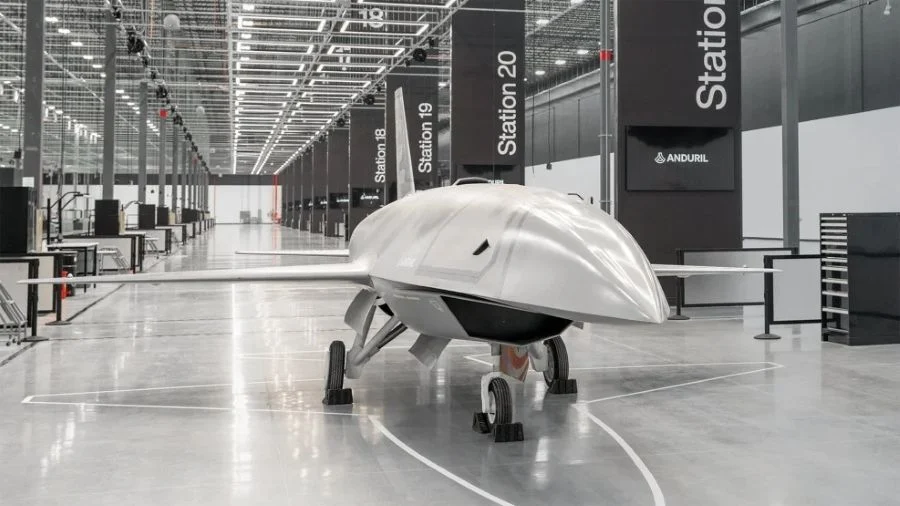
COLUMBUS, OH – Anduril Industries Inc. has officially rolled out its inaugural fighter jet, the semiautonomous Fury, from its groundbreaking new manufacturing facility here. This significant milestone, achieved with remarkable speed, signals a profound shift in the landscape of defense manufacturing and the rapid development of autonomous aerial systems for the United States military. The Fury, officially designated as the FQ-44 by the U.S. Air Force, is a sleek, 17-foot-long aircraft engineered to serve as a "loyal wingman" alongside crewed fighter jets, augmenting their capabilities and extending their reach in contested airspace.
A New Paradigm in Defense Manufacturing Takes Flight
The maiden Fury jet emerged from Arsenal-1, a colossal 5-million-square-foot advanced manufacturing campus spanning 500 acres situated strategically near Rickenbacker International Airport. Anduril has branded this $1 billion complex as a multi-building "hyperscale manufacturing facility," asserting that it will "redefine the scale and speed that autonomous systems and weapons can be produced for the United States." This claim is not merely aspirational; the rapid establishment and operationalization of Arsenal-1 challenge the conventional timelines and methodologies that have long characterized the aerospace and defense industry.
The conventional aerospace sector is notorious for its extended development and production cycles, where new factories typically require three to five years from the initial announcement to the first delivery. In stark contrast, Anduril, bolstered by robust assistance from local government entities and a relentless focus on agility, accomplished this feat in less than two years. The entire process—from the initial announcement, securing permits, construction, equipping the facility, hiring a dedicated workforce, to finally producing the first aircraft—was compressed into an astonishing 18 months. This accelerated timeline underscores Anduril’s disruptive approach to defense procurement and manufacturing, aiming to bring Silicon Valley’s rapid iteration and deployment philosophy to a sector often criticized for its slow pace and high costs.
Jonas Peterson, chief economic development officer and president of One Columbus, lauded the collaborative effort that underpinned this achievement. "Securing Arsenal-1 demanded close coordination among partners across the region," Peterson stated. "The first Fury rolling off the line 557 days after the announcement shows what that alignment can deliver." This sentiment reflects the powerful synergy between innovative private enterprise and supportive public administration, creating an environment conducive to rapid technological advancement.
The Fury: A Game-Changer in Autonomous Combat
The Fury’s role as a "loyal wingman" is central to the U.S. Air Force’s vision for future air combat. This concept involves uncrewed aircraft operating semi-autonomously, or even fully autonomously, in conjunction with manned platforms like the F-35 or future Next Generation Air Dominance (NGAD) fighters. These unmanned combat aerial vehicles (UCAVs) are designed to undertake a variety of missions that might be too dangerous, dull, or dirty for human pilots. This includes acting as advanced sensor platforms, electronic warfare escorts, missile trucks, or even decoys to draw enemy fire, thereby enhancing the survivability and lethality of manned aircraft.
The FQ-44 designation highlights its integration into the Air Force’s broader uncrewed aircraft portfolio, signifying its potential to significantly multiply combat power at a fraction of the cost and risk associated with crewed platforms. The 17-foot length positions the Fury as a relatively compact, yet highly capable, platform capable of deploying various payloads. Its semiautonomous nature means it can operate with varying degrees of human oversight, from fully supervised to largely independent, depending on the mission profile and risk tolerance. This flexibility is crucial for adapting to the dynamic and complex environments of modern warfare.
Arsenal-1: A Vision of Hyperscale Production
Anduril’s commitment to "hyperscale manufacturing" at Arsenal-1 is not just a catchy phrase; it represents a fundamental rethinking of defense production. Unlike traditional aerospace factories that are often designed for bespoke, low-volume production of highly complex aircraft over many years, a hyperscale facility aims for high-volume, rapid, and modular production. This involves extensive automation, advanced robotics, digital manufacturing techniques, and a streamlined supply chain to churn out autonomous systems at an unprecedented pace.
The 5-million-square-foot campus provides ample space for multiple production lines, research and development facilities, and testing areas, all integrated to maximize efficiency. The $1 billion investment underscores the long-term strategic importance Anduril places on this site as the cornerstone of its autonomous systems production. By focusing on speed and scale, Anduril seeks to overcome one of the enduring challenges of the defense industrial base: the inability to rapidly scale production to meet urgent national security demands, especially in an era of renewed great power competition. The facility’s proximity to Rickenbacker International Airport, a major cargo hub, further enhances its logistical capabilities, allowing for efficient inbound supply chain management and outbound delivery of finished systems.
Unprecedented Speed: A Timeline of Rapid Development
The timeline for Arsenal-1’s development is a testament to what is possible with a concerted effort and a clear vision. While the traditional defense procurement process can often stretch over decades, Anduril and its partners compressed years of work into months:
- Initial Conception & Planning (Pre-2022): Anduril, founded in 2017 by Palmer Luckey (co-founder of Oculus VR), had already established a reputation for agile development in defense technology, focusing on AI-powered systems. The concept for a hyperscale manufacturing facility for autonomous aircraft was a natural extension of its mission.
- Site Selection & Announcement (Late 2022/Early 2023): Columbus, Ohio, emerged as the ideal location, offering a skilled workforce, strategic logistical advantages, and strong government support. The formal announcement of the $1 billion investment and the Arsenal-1 project sent ripples through the defense and manufacturing sectors.
- Permitting & Groundbreaking (Early 2023): With rapid coordination between Anduril, One Columbus, and various state and local agencies, the necessary permits were fast-tracked. Groundbreaking for the massive complex commenced almost immediately, leveraging existing infrastructure and expedited processes.
- Construction & Equipping (Mid-2023 to Early 2024): The sheer scale of the construction project was immense, but advanced construction techniques and efficient project management ensured rapid progress. Simultaneously, the procurement and installation of cutting-edge manufacturing equipment, including robotic assembly lines and advanced inspection systems, were underway.
- Hiring & Training (Throughout 2023-2024): Anduril embarked on an aggressive hiring campaign, recruiting engineers, technicians, manufacturing specialists, and support staff. The company emphasized creating a workforce proficient in advanced manufacturing technologies and autonomous systems.
- First Aircraft Production & Rollout (Mid-2024): Just 557 days after the initial announcement, the first Fury jet fighter successfully rolled off the production line, a clear demonstration of the facility’s operational readiness and Anduril’s ability to execute on its ambitious timelines.
Strategic Partnerships Fueling Innovation
The success of Arsenal-1 is not solely an Anduril achievement but a product of strategic partnerships. One Columbus, a private, non-profit economic development organization, played a pivotal role in facilitating the project. Their efforts in coordinating local government entities, securing incentives, and streamlining regulatory processes were instrumental in accelerating the timeline. The State of Ohio also offered significant support, recognizing the potential for job creation, economic diversification, and establishing Ohio as a hub for advanced aerospace manufacturing. This collaborative model, where public and private sectors align to overcome traditional bureaucratic hurdles, is increasingly seen as vital for fostering innovation in critical industries.

Inferred statements from Ohio state officials would likely highlight the state’s commitment to attracting high-tech manufacturing and its readiness to support companies pushing the boundaries of technology. For instance, a representative from the Ohio Governor’s office might state, "Ohio is proud to be at the forefront of defense innovation, providing the environment and workforce that allows companies like Anduril to deliver critical capabilities to our nation with unprecedented speed. This facility is a testament to Ohio’s growing strength in advanced manufacturing and aerospace."
Economic Vibrancy and Regional Impact
The establishment of Arsenal-1 represents a substantial economic boon for Columbus and the broader Ohio region. The $1 billion investment translates into significant capital expenditure, stimulating local construction, engineering, and service industries. More importantly, the facility is expected to create hundreds, if not thousands, of high-skill jobs in advanced manufacturing, engineering, and technology. This influx of high-paying jobs will attract talent, bolster the local tax base, and further diversify Ohio’s economy, moving it beyond traditional manufacturing towards a more technology-driven future.
The ripple effect extends to the supply chain, as Anduril will require a vast network of suppliers for components, materials, and specialized services. This creates opportunities for existing Ohio businesses and encourages new businesses to relocate or establish operations in the region. Educational institutions, such as Ohio State University and local community colleges, are also likely to benefit through partnerships focused on workforce development, research, and talent pipelines tailored to the needs of advanced aerospace manufacturing.
The "Loyal Wingman" Concept: Reshaping Air Combat
The "loyal wingman" concept, epitomized by the Fury, is a cornerstone of the U.S. Air Force’s vision for future air combat, particularly within its Collaborative Combat Aircraft (CCA) program. The strategic rationale behind CCAs is multifaceted:
- Force Multiplication: A single crewed fighter can control multiple loyal wingmen, significantly increasing the number of sensors, weapons, and platforms available in a fight without increasing the number of human pilots at risk.
- Reduced Risk to Human Pilots: Loyal wingmen can be sent into highly contested or dangerous areas, performing tasks like suppressing enemy air defenses or conducting reconnaissance, thereby shielding human pilots from the most immediate threats.
- Cost-Effectiveness: While advanced, autonomous systems are generally less expensive to procure, operate, and maintain than crewed fighters. This allows for greater numbers of aircraft to be fielded, enhancing overall deterrence and combat power.
- Adaptability and Modular Design: The Fury, like other CCAs, is expected to feature modular payloads, allowing it to be rapidly reconfigured for different missions—whether carrying air-to-air missiles, electronic warfare jammers, or surveillance equipment.
- Accelerated Development: The relatively simpler design (no life support systems, cockpit, or pilot controls) of uncrewed aircraft often allows for faster development and upgrades compared to complex manned platforms.
This strategic shift is also a response to the rapid military modernization efforts of potential adversaries, particularly China, which is heavily investing in its own autonomous systems and advanced aerospace capabilities. The ability to rapidly field large numbers of sophisticated, autonomous aircraft is seen as a crucial component of maintaining a qualitative and quantitative edge.
Anduril’s Disruptive Approach to Defense
Anduril Industries, under the leadership of Palmer Luckey, has consistently sought to disrupt the entrenched practices of the defense industry. Their philosophy centers on:
- Software-First Approach: Leveraging AI and advanced software as the core of their systems, enabling rapid upgrades and adaptability.
- Commercial Off-the-Shelf (COTS) Technologies: Where appropriate, integrating commercially available components and technologies to reduce costs and accelerate development.
- Rapid Prototyping and Iteration: Embracing a Silicon Valley-style iterative development cycle, quickly moving from design to prototype to production, learning and improving along the way.
- Vertical Integration: Controlling more aspects of the design, manufacturing, and software development process to maintain speed and quality.
This approach stands in stark contrast to the traditional defense contractors—Lockheed Martin, Boeing, Northrop Grumman—which often face lengthy government contracting cycles, complex requirements, and a more conservative development ethos. While these incumbents are also adapting, Anduril represents a new breed of defense prime, challenging the status quo and demonstrating that speed and innovation can indeed be brought to bear on critical national security needs.
Broader Implications for National Security and Industrial Future
The successful rollout of the Fury from Arsenal-1 carries profound implications for U.S. national security and the future of its industrial base. It demonstrates that the U.S. can still innovate rapidly and scale production when faced with strategic imperatives. This capability is vital for maintaining technological superiority in an increasingly contested global environment.
Furthermore, Anduril’s "hyperscale" model could serve as a blueprint for other critical manufacturing sectors. The lessons learned in optimizing speed, automation, and supply chain efficiency at Arsenal-1 could be applied to other areas where rapid, high-volume production is essential, from renewable energy components to advanced medical devices. This signals a broader trend towards more agile, technologically advanced manufacturing across various industries.
However, the rapid deployment of autonomous systems also raises important ethical and operational questions. The degree of autonomy in future warfare, the legal frameworks governing their use, and the potential for unintended consequences are ongoing discussions within defense and policy circles. While Anduril focuses on the technological aspects, these broader societal implications will continue to be debated as such systems become more prevalent.
Looking Ahead: The Future of Autonomous Systems
The first Fury jet rolling out of Arsenal-1 is not merely a manufacturing achievement; it is a declaration of intent. It signifies Anduril’s ambition to become a dominant player in autonomous defense systems and the U.S. Air Force’s commitment to integrating advanced uncrewed capabilities into its force structure. As the production lines at Arsenal-1 ramp up, the facility is poised to deliver a steady stream of Fury jets and potentially other autonomous platforms, fundamentally altering the calculus of air power. This pivotal moment in Columbus, Ohio, marks the dawn of a new era where speed, scale, and artificial intelligence converge to redefine the future of defense.