The world of haute horlogerie is often characterized by a pursuit of neoclassical elegance and meticulously refined finishing. Brands vie for attention through intricate perlage, pristine anglage, and the subtle gleam of polished surfaces. Yet, within this established landscape, certain creators emerge who challenge conventional aesthetics, drawing inspiration from sources far removed from traditional watchmaking ateliers. Jiro Katayama, the founder and sole designer/watchmaker behind Otsuka Lotec, is one such individual, forging a unique path that prioritizes raw, industrial beauty and a profound appreciation for mechanical ingenuity. This article delves into the distinctive philosophy and remarkable execution of the Otsuka Lotec No. 8, a timepiece that exemplifies Katayama’s vision and has captivated a discerning segment of the watch community.

A Rejection of Tradition: The Otsuka Lotec Ethos
Jiro Katayama’s approach to watchmaking is a deliberate departure from established norms. Rather than adhering to the time-honored traditions often associated with Swiss or even established Japanese watchmaking, Katayama draws inspiration from the tactile and robust world of analog machines, precision measuring instruments, and the industrial design of the pre-digital era. His workshop, nestled within the dense urban environment of Tokyo, has fostered an aesthetic that is intentionally rough, seemingly unpolished, yet possesses a profound intentionality. This ethos is evident in the surfaces of his watches, which are typically brushed metal, rarely painted, and feature only the occasional striking highlight, such as a stark red accent.
This artistic direction is a direct consequence of his self-taught journey. Unlike watchmakers who inherit a legacy of craftsmanship passed down through generations, Katayama’s learning has been a process of self-discovery, informed by the utilitarian beauty of industrial components. The absence of traditional decorative techniques like perlage or anglage is not an oversight but a deliberate choice, emphasizing the raw mechanics at the heart of his creations. This aesthetic, while potentially polarizing, has resonated deeply, speaking to a fundamental appreciation for the pure joy of exposed mechanics.

The Evolution of Innovation: From Miyota Modules to In-House Ambitions
Otsuka Lotec’s journey has been marked by a consistent drive to innovate, often by integrating sophisticated in-house modules onto reliable base movements. Historically, the brand has utilized robust Miyota calibers, allowing for accessible pricing while showcasing Katayama’s unique complications. This strategy proved effective, building a loyal following appreciative of the brand’s distinctive design language and mechanical inventiveness.
A pivotal moment in Otsuka Lotec’s trajectory arrived with the announcement of the No. 9. This ambitious undertaking represented a significant leap, featuring a fully in-house movement that incorporated a tourbillon, a jump hour complication, rewinding minutes, a piston power reserve indicator, and a sonnerie au passage (an hourly chime). The No. 9 also debuted a striking rectangular case, a shaped crystal, and commanded a six-figure price tag, signaling the brand’s potential to ascend into the highest echelons of luxury watchmaking. While an impressive testament to Katayama’s engineering prowess, this development also sparked concern among fans that Otsuka Lotec might be moving beyond the accessibility that had defined its early success.

Fortunately, these concerns were assuaged with the subsequent unveiling of the No. 8. While sharing some conceptual DNA with the No. 9, the No. 8 represented a return to the brand’s established formula: a Miyota base caliber augmented by a complex in-house module. This approach allowed Otsuka Lotec to maintain its characteristic price point, making its innovative creations more attainable for a broader audience. The No. 8, in particular, felt like a distillation of the lessons learned from the No. 9, refining the brand’s core principles into a compelling and accessible package.
The Otsuka Lotec No. 8: A Masterclass in Functional Art
The Otsuka Lotec No. 8 stands as a testament to Jiro Katayama’s artistic and engineering vision. Inspired by the analog mixing consoles found in iconic recording studios, most notably Abbey Road, the No. 8 eschews conventional watch design in favor of a bold and unconventional aesthetic. It features an unusual case shape, a striking crystal, and a unique set of complications that appear to organically emerge from the movement itself.

Case Design: Industrial Ruggedness Meets Ergonomic Form
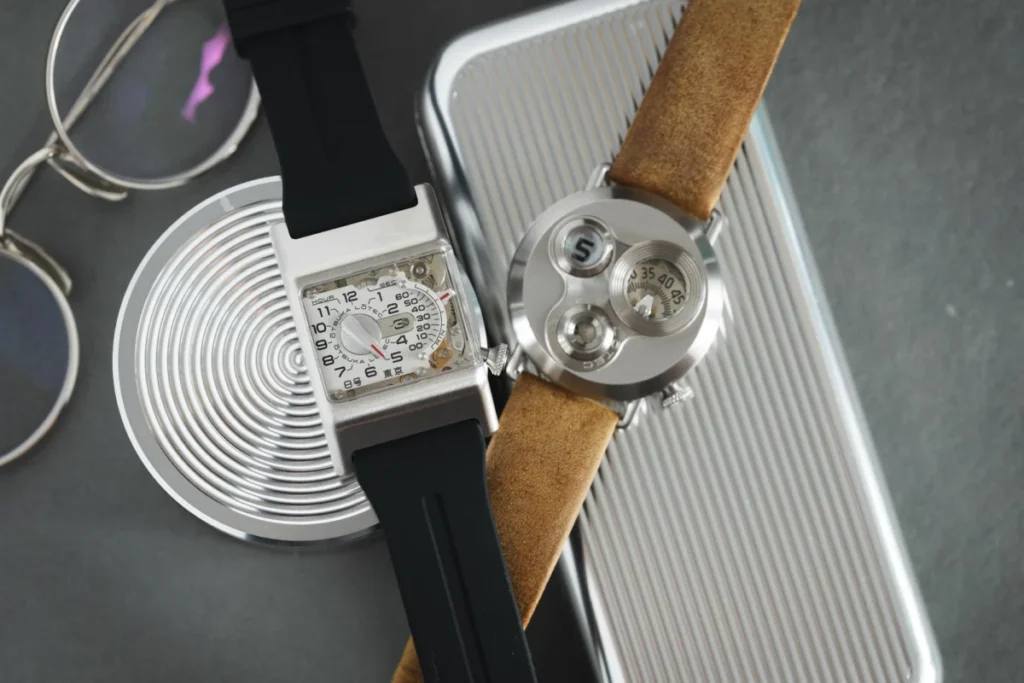
The case of the No. 8 is a significant departure from traditional watchmaking norms. Measuring 31mm in width and 47.7mm from lug to lug, with a slim profile of 10.8mm, it presents a long, flat, yet relatively narrow rectangular form when viewed from above. The true character of the case is revealed in its profile: the upper and lower sections taper gracefully towards the wrist, creating substantial, solid metal surfaces that culminate in compact lugs. The entire case is finished with a vertical brushing, lending a consistent and refined sheen.
While rectangular watches have seen a resurgence, they often lean towards a more traditional, dressy aesthetic. The No. 8, however, exudes a blunt, purposeful character, directly evoking the industrial machinery that inspired its design. The top edges of the case are softened with a generous radius, giving the impression of sheet metal expertly molded over a form.

A Crystal Like No Other: Engineering and Aesthetics Combined
Perhaps the most arresting feature of the No. 8’s case is its intricately shaped sapphire crystal. This expansive, rectangular crystal dominates the top surface of the case. On the left side, it meets the case edge conventionally. However, on the right, the crystal takes an unexpected turn. It follows the radiused corner of the case before dropping several millimeters down the side, ending approximately 40% of the way down the case’s flank.
This complex, multi-faceted crystal is a remarkable feat of engineering. Milled from a single block of sapphire, its unconventional shape presents a significant sealing challenge, contributing to the watch’s 30-meter water resistance rating. Visually, however, it is a triumph, imbuing the No. 8 with an exotic and distinctive appeal.

The Crown: Functional Industrialism
The crown of the No. 8 is positioned at an angle on the right side of the case, integrated into a tube that passes through the watch’s structure. Its design is unmistakably industrial, featuring a knurled edge for enhanced grip and an undercut that facilitates easy manipulation while maintaining clearance from the case. While undeniably functional, its angular placement and protrusion from the case’s clean lines introduce a slight visual dissonance. However, for a brand like Otsuka Lotec, where "jarring" can often be interpreted as intentional and characteristic, this element contributes to the watch’s overall unconventional charm.
Dial Space: A Three-Dimensional Mechanical Landscape
The term "dial space" becomes particularly relevant when examining the Otsuka Lotec No. 8. This is not a watch with a conventional dial; instead, it presents a three-dimensional realm where the movement and display elements are intricately integrated. Approximately 75% of this space is occupied by a surface that feels less like a separate dial and more like an integral part of the underlying mechanism.

A Partial Dial That Integrates with the Movement
Several factors contribute to this integrated feel. The primary surface connects to only one edge of the opening, leaving significant portions of the module beneath exposed. The top and bottom edges of this surface are set back a few millimeters, revealing gears, screws, and other mechanical components. Four substantial screws not only secure this surface but also act as standoffs, further emphasizing its connection to the movement. On the right side, a semicircular element, positioned at a higher level and secured by additional screws, houses the minute track.
This arrangement creates a pronounced gauge-like appearance, not as a mere aesthetic choice but as a direct functional output of the mechanism. The surface itself, a neutral gray tone reminiscent of primer, is densely populated with numerals, lines, and characters in both Kanji and English. This deliberate visual clutter embodies Katayama’s "unintentional" aesthetic – chaotic and busy, yet perfectly in character for the watch’s industrial inspiration.

Exposed Mechanics: An Industrial Cityscape
The exposed module forms the remainder of the dial space, presenting a dense, industrial cityscape of plates, gears, and mechanical elements. Unlike in many watches where such components are meticulously finished to conceal their raw form, on the No. 8, they are left intentionally raw, bearing visible tooling marks. The unique crystal design allows light to enter from the side, further illuminating these components and offering rare glimpses of their edges.
Telling Time in a New Language: Jump Hour, Retrograde Minutes, and Sub-Seconds
The No. 8 employs a regulator-style display, separating the hours, minutes, and seconds. However, each is presented in a distinct and unconventional manner. The hours are indicated by a large, oversized "knob" hand, a direct homage to the controls on vintage audio equipment. This hand, a substantial sculpted metal form, doesn’t sweep; it jumps precisely to the next hour at the top of the hour. This "jump hour" complication, while appearing simple, is a key element of the watch’s narrative and design coherence.

The minutes are displayed on the right side via a "fader" selector on a retrograde track. This indicator moves along a relatively small 120-degree arc, making it most readable to the nearest five-minute interval, with estimations for finer precision. While novel and functional enough, it lacks the absolute precision of the jump hour.
A small seconds disk is visible through a notch at the top of the gray surface. This disk, with its black lines on a silver background, is challenging to read, its primary purpose being to confirm the watch’s operation. Intriguingly, this seconds disk runs counterclockwise and completes a rotation every 90 seconds, an almost imperceptible detail that adds to the watch’s unique character.

The Flywheel and Micro Bearings: Details that Define
Further enhancing the watch’s mechanical narrative is a flywheel in the upper-right quadrant of the module, deliberately evoking a tape reel. This component is integral to the retrograde complication. As the retrograde mechanism builds energy throughout the hour, the reel turns subtly, culminating in a dramatic rotation as the minutes reset. Like the hour hand, this flywheel can be interpreted either as a direct reference to audio equipment or as a purely unique design element.
Adding another layer of meticulous detail is a micro bearing, measuring a mere 1.5mm, which cuts through the "3" numeral on the dial. This is believed to be the pivot point for the minute hand. While only observable with magnification, its inclusion underscores the extraordinary attention to detail in the No. 8’s construction. A slightly larger bearing is also present at the center of the flywheel. These elements coalesce to create a module that, rather than being an aesthetic overlay, defines the layout and ultimately shapes the watch’s distinctive aesthetic.

Movement: The Synergy of Miyota and Otsuka Lotec Innovation
The heart of the Otsuka Lotec No. 8 lies in its ingenious integration of a custom-made module onto a base Miyota movement. This is where Otsuka Lotec’s "special sauce" truly shines. Jiro Katayama designs and engineers these modules in his Tokyo workshop. For their manufacturing, Katayama collaborates with Precision Watch Tokyo, a company founded by the renowned Japanese watchmaker Hajime Asaoka. This partnership between Katayama’s innovative spirit and Asaoka’s established pedigree imbues Otsuka Lotec watches with a horological X-factor that is exceptionally rare at their price points.
The No. 8 utilizes the Miyota 90S5, a relatively slim automatic movement, as its foundation. The in-house module comprises 62 components, including the aforementioned micro bearings. In practical use, the watch has demonstrated reliable timekeeping. While the precise reading of minutes is less critical with the No. 8’s display, the accuracy of the base movement is essential.

The complexity of the module does impact the power reserve, which is rated at 32 hours, a reduction from the typical 42 hours of the base 90S5 caliber. Complications such as jumping and retrograde mechanisms demand additional power, and their energy management can influence amplitude and accuracy. This is why more complex timepieces from established brands often incorporate technologies like remontoirs or constant-force escapements to regulate power delivery.
Operationally, setting the time on the No. 8 requires adherence to a common caveat for watches with jump or retrograde complications: only set the time forward. While not a significant hurdle, it can be inconvenient if the time is set incorrectly by an hour or two, necessitating a full rotation of the movement. Given the reduced power reserve, frequent resetting might be necessary, and the perceived fragility of the intricate module can instill a sense of caution in the wearer.

The Ownership Experience: A Unique Relationship with Time
Wearing a watch with jumping or retrograde indicators creates a peculiar dynamic with timekeeping. These watches often appear remarkably still, building a subtle tension that draws the wearer’s attention not just to the time, but to the impending mechanical animation. The experience is a cycle of anticipation and mild disappointment when the precise moment of mechanical release is missed.
With the No. 8, the retrograde minute indicator offers the most visible sign of elapsed time as it traverses its arc. While the subtle rotation of the flywheel is technically present, it is difficult to perceive in real-time. The most dramatic display occurs hourly: the hour hand jumps, the minute indicator resets, and the flywheel performs its quick spin. This synchronized event is often challenging to fully appreciate due to its speed and the individual focus it demands. In quiet environments, the subtle "slide-and-click" of the retrograde minutes can serve as an auditory cue that the hour has changed.

Wearability and Proportions: A Rectangular Revelation
The experience of wearing the No. 8 has been a pleasant surprise. As a rectangular watch, its dimensions do not translate directly to the perception of a round watch. Measuring 31mm wide and 47.7mm lug-to-lug with 24mm lugs, the latter dimension initially raised concerns about proportionality. However, on a 6.75-inch wrist, the watch wears exceptionally well. The 31mm width, while seemingly modest, presents a substantial presence for a rectangle. The 24mm lug width, often a point of contention for the author due to perceived imbalance on smaller watches, works harmoniously with the 31mm case, contributing to an appealing visual line around the wrist. This balance is further enhanced by the watch’s industrial aesthetic.
The included 24mm rubber strap, tapering to 20mm, complements the case’s materiality and industrial ruggedness. While leather is typically preferred for comfort, the rubber strap proves functional and aesthetically fitting.

Classification: Beyond Conventional Categories
Otsuka Lotec watches defy easy categorization. Their materials and finishes align them closely with sports watches, yet they are not designed for rugged outdoor activities. They are certainly not dress watches, though wearing one would undoubtedly make a bold statement. Aesthetically, they bear a closer resemblance to vintage timepieces, their rawness and unique style lending themselves to a more casual, utilitarian wardrobe.
Conclusion: A Work of Art Valued Beyond Its Components
The Otsuka Lotec No. 8 is priced at ¥990,000 (approximately $6,200 USD), making it the most expensive model in the current catalog, excluding the six-figure No. 9. This price point positions it as one of the most expensive watches powered by a Miyota movement, a fact that might initially seem incongruous given the base caliber’s modest cost and the absence of traditional artisanal finishing.

However, to evaluate the No. 8 solely on its component parts would be to miss its fundamental value proposition. This is not a watch for those solely focused on specifications or conventional value metrics. Instead, the Otsuka Lotec No. 8 must be viewed as a work of art. Its price reflects its groundbreaking design, intricate engineering, profound uniqueness, and the sheer ingenuity of its creator. Purchasing such a watch is an act of patronage, supporting an "outsider indie" culture that prioritizes creative vision over mass-market appeal.
The striking nature of Otsuka Lotec watches stems from their deliberate detachment from mainstream horological trends. They do not reference mid-century designs, embrace neoclassical aesthetics, or adhere to established measurement techniques. They are the singular creations of a self-taught artisan who has forged his own path. While it is conceivable that future watchmakers may draw inspiration from Katayama’s groundbreaking approach, the Otsuka Lotec No. 8, in its current form, remains a truly distinct and compelling testament to unconventional horological artistry.