The long-held scientific assumption regarding the active centers for partial oxidation of methane (POM), a critical industrial process for producing syngas, has been definitively challenged by a groundbreaking study. For decades, metallic nickel (Ni) nanoparticles were widely believed to be the primary catalysts driving this essential reaction, which yields a mixture of carbon monoxide (CO) and hydrogen (H₂) — the foundational building blocks for a vast array of fuels and chemicals. However, a significant ambiguity persisted: the metallic nickel observed after a reaction could have simply been a byproduct, formed through the reduction of nickel oxide by syngas at high temperatures, rather than the species actively performing the catalysis. This unresolved question has now been addressed, revealing that a dynamically reconstructed nickel oxide surface, rather than metallic nickel, serves as the true catalytic powerhouse under realistic reaction conditions. This discovery, published in the prestigious journal Nature Catalysis, promises to reshape the rational design of catalysts, paving the way for more efficient and resource-conscious industrial processes.
The Global Significance of Syngas and Methane Utilization
Syngas, or synthesis gas, is an indispensable intermediate in the global chemical and energy industries. Its versatility stems from its ability to be converted into a diverse range of products, including methanol, ammonia, acetic acid, and liquid hydrocarbons via the Fischer-Tropsch process. With the increasing global demand for energy and a growing emphasis on sustainable chemical production, efficient syngas generation from abundant feedstocks like methane has become a paramount goal. Methane, the primary component of natural gas, shale gas, and biogas, represents a vast, underutilized carbon resource. Its conversion into higher-value products like syngas not only adds economic value but also offers a pathway to mitigate methane’s potent greenhouse gas effects by capturing and transforming it.
Partial oxidation of methane (POM) stands out as a particularly attractive method for syngas production compared to other reforming technologies like steam methane reforming (SMR) or dry methane reforming (DMR). POM reactions typically operate at lower temperatures and pressures than SMR, reducing energy input and associated operational costs. Furthermore, POM can achieve an H₂/CO molar ratio close to 2:1, which is ideal for many downstream applications, including methanol synthesis and Fischer-Tropsch reactions. Despite its advantages, challenges such as maintaining catalyst stability, preventing carbon deposition (coking), and achieving high selectivity towards syngas over complete oxidation products (CO₂ and H₂O) have historically hindered its widespread industrial implementation. Nickel-based catalysts have long been favored for POM due to their relatively low cost and high activity compared to precious metals like platinum or rhodium, but a fundamental understanding of their precise active sites has remained elusive.
Decades of Assumptions and the Unseen Dynamics
For many years, the catalytic community relied on a working hypothesis that metallic nickel nanoparticles were the primary active species in methane reforming reactions, including POM. This assumption was largely based on the observation that metallic nickel was often detected on the catalyst surface after the reaction had proceeded. Nickel’s well-documented activity in various hydrogenation and dehydrogenation reactions further reinforced this view. However, the high-temperature, redox-rich environment characteristic of POM reactions introduces significant complexity. Under these conditions, nickel can undergo rapid transformations, changing both its oxidation state and atomic arrangement. Specifically, nickel oxide (NiO) can be reduced to metallic nickel (Ni) by hydrogen or carbon monoxide components of syngas at elevated temperatures, leading to the chicken-and-egg dilemma: was metallic Ni present before or after the catalysis, and was it truly driving the reaction?
The inherent difficulty in observing catalysts in situ – that is, while they are actively performing under realistic, high-temperature, and often corrosive reaction environments – has been a major impediment to resolving this question. Traditional ex situ characterization techniques, which analyze catalysts after the reaction has ceased and they have been cooled and exposed to ambient air, often provide a static snapshot that may not accurately represent the dynamic, active state. This limitation has long obscured the true atomic-scale events occurring on the catalyst surface, preventing a clear understanding of the genuine active sites and the mechanisms governing these crucial industrial reactions.
A Collaborative Breakthrough from East to West
The new study, a testament to international scientific collaboration, was spearheaded by a team of researchers from the Dalian Institute of Chemical Physics (DICP) of the Chinese Academy of Sciences (CAS), specifically Profs. Tao Zhang, Aiqin Wang, and Xiaoyan Liu. They were joined by Prof. Wei Liu from DICP, Prof. Tao Yang from Xi’an Jiaotong University, and Prof. Graham J. Hutchings from Cardiff University in the UK. This multi-institutional and multinational effort brought together expertise in materials science, catalysis, and theoretical chemistry, enabling a comprehensive investigation into the intricate nature of nickel catalysis. Their work represents a significant leap forward in understanding the fundamental principles governing POM, offering a new perspective that challenges long-standing paradigms in heterogeneous catalysis.
Unveiling the Hidden Active Structure Through In Situ Analysis
To circumvent the limitations of ex situ analysis, the research team employed a meticulous approach focusing on in situ characterization techniques, allowing them to monitor the catalyst’s state directly during the POM reaction. Their innovative methodology began with the synthesis of a unique Ni/Al₂O₃ catalyst containing an exceptionally low nickel content of only 0.8 wt%. This was achieved using a microemulsion method, a sophisticated chemical synthesis technique known for producing highly dispersed nanoparticles with precise control over size and morphology. The choice of a low nickel loading was strategic, as it reduced the likelihood of bulk metallic nickel formation, thereby allowing for a clearer observation of surface phenomena.
Despite its remarkably low nickel content, this catalyst demonstrated exceptional performance in POM. It achieved a methane conversion rate of 92%, with impressive CO and H₂ selectivities reaching 87.0%. Crucially, the H₂/CO molar ratio remained stable at approximately 2.0, an optimal ratio for downstream chemical synthesis. This high performance immediately raised questions, as it contradicted the expectation that higher metallic nickel content would correlate with superior activity.
One of the most striking and counter-intuitive findings was the near absence of detectable metallic nickel in the catalyst after the reaction. This observation starkly contrasted with the prevailing assumption that metallic Ni was the active species. To further underscore the efficiency of their low-loading catalyst, the team compared its performance to that of a conventional 8.0 wt% Ni/Al₂O₃ catalyst prepared via the traditional impregnation method. Astonishingly, their 0.8 wt% Ni catalyst, containing only one-tenth the amount of nickel, achieved comparable overall performance. This finding carries immense economic and environmental implications, suggesting that highly efficient syngas production could be achieved with significantly less reliance on expensive metal loadings.
The researchers also performed critical control experiments. They compared their microemulsion-derived 0.8 wt% Ni/Al₂O₃ catalyst with another 0.8 wt% Ni/Al₂O₃ material prepared using the same impregnation method as the 8.0 wt% catalyst. Under identical conditions, the impregnation-prepared low-loading catalyst failed to effectively carry out POM, instead showing only methane combustion activity. This demonstrated that the synthesis method, and the resulting specific structure of the nickel species, was paramount to achieving high POM activity. Furthermore, a pre-formed pure-phase NiO catalyst was tested and exhibited no POM activity whatsoever, catalyzing only the complete oxidation of methane. This definitively ruled out bulk NiO as the static active site.
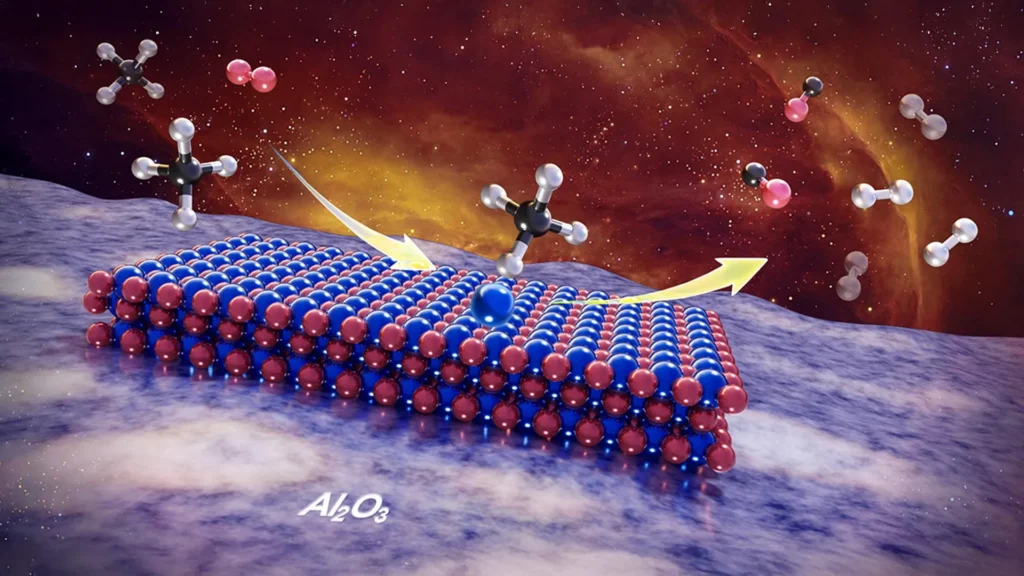
The critical insight emerged when the team utilized advanced in situ characterization techniques, likely including techniques such as in situ X-ray absorption spectroscopy (XAS) or ambient pressure X-ray photoelectron spectroscopy (AP-XPS), which allow for atomic-level observation under reaction conditions. These sophisticated tools revealed that any metallic Ni nanoparticles present at the beginning of the reaction were quickly oxidized into the NiO phase under the operating POM conditions. The breakthrough came with the in situ capture of the dynamic formation of a reconstructed [Ni₁O₄Ni₄] structural unit on the NiO(100) surface during the reaction. This specific, complex atomic arrangement, not simple metallic Ni or static NiO, was found to be the true active site.
Theoretical Validation: The Kinetic Advantage of Reconstruction
To corroborate their experimental findings, the research team employed Density Functional Theory (DFT) calculations, a powerful computational method used to model and understand chemical reactions at the quantum mechanical level. DFT calculations provided a detailed atomic-scale understanding of how the newly identified reconstructed [Ni₁O₄Ni₄] motif facilitates the POM reaction. The calculations focused on the activation barrier for the initial and often rate-limiting step of methane activation: the breaking of the C-H bonds in the methane molecule.
The results were compelling. The calculated activation barrier for C-H bond breaking on the reconstructed [Ni₁O₄Ni₄] structural unit was strikingly low, only 12.5 kcal·mol⁻¹. This value presented a substantial kinetic advantage when compared to other potential active sites. For instance, the activation barrier calculated for the intact, unreconstructed NiO(100) surface was significantly higher at 38.5 kcal·mol⁻¹. Even more notably, the barrier for the metallic Ni(111) surface, previously assumed to be the active site, was also higher at 15.7 kcal·mol⁻¹. This pronounced difference in activation energies provides robust theoretical support for the conclusion that the dynamically formed reconstructed structure is indeed the true active center responsible for the high efficiency observed in the POM reaction. The unique electronic and structural properties of this reconstructed surface facilitate the crucial initial C-H bond cleavage, a step that is otherwise kinetically hindered on other nickel species.
Official Responses and Broader Implications
The combined weight of experimental observations and theoretical calculations paints a clear picture: catalytic activity in POM does not originate from a static metallic nickel surface or an ordinary nickel oxide structure. Instead, it arises from a specific, dynamically forming atomic reconstruction that emerges and evolves while the reaction is actively underway. This revelation signifies a paradigm shift in our understanding of heterogeneous catalysis, moving beyond the traditional view of fixed active sites to embrace the dynamic nature of catalyst surfaces under working conditions.
Professor Xiaoyan Liu, one of the lead researchers from DICP, emphasized the critical importance of their methodology. "Our study highlights the critical role of in situ characterization in identifying dynamic active structures under reaction conditions," stated Prof. Liu. "Dynamic reconstruction enables low-loading catalysts to achieve high performance, offering new opportunities for the rational design of efficient catalysts while reducing reliance on high metal loadings." This statement underscores not only the scientific breakthrough but also its practical implications for sustainable chemistry and industrial economics.
The implications of this research are far-reaching. From a fundamental science perspective, it reinforces the growing recognition that catalysts are not static entities but rather dynamic systems that undergo significant structural and electronic changes during reactions. This dynamic behavior can be crucial for achieving optimal catalytic performance. For the chemical industry, the ability to achieve high performance with significantly lower metal loadings represents a major economic advantage. Nickel, while abundant, is still a finite resource, and reducing its consumption aligns with global sustainability goals. Furthermore, this understanding paves the way for the rational design of next-generation catalysts, moving from trial-and-error approaches to more predictive and efficient development strategies. Engineers and material scientists can now focus on synthesizing catalysts that specifically promote the formation and stabilization of these dynamic reconstructed surfaces, rather than simply trying to maximize metallic nickel content.
Looking ahead, this study opens new avenues for research. Scientists can now investigate whether similar dynamic reconstructions occur in other catalytic systems, particularly those involving redox-active transition metals. Developing even more advanced in situ characterization techniques that can probe these dynamic changes with greater spatial and temporal resolution will be crucial. Furthermore, research will likely focus on strategies to stabilize these reconstructed surfaces for prolonged operation and to scale up the microemulsion synthesis methods for industrial application. The findings from this international collaboration represent a significant milestone, not only in the field of methane activation but also in the broader pursuit of designing more efficient, sustainable, and economically viable catalytic processes for a cleaner and more prosperous future.