The landscape of the watch enthusiast community is in a state of dynamic evolution. As the fervent interest in robust dive watches and aggressive sports timepieces begins to temper, a discernible shift is occurring, guiding collectors and brands alike toward more nuanced and classically inspired designs. This resurgence in appreciation for refined aesthetics is manifesting in various forms, with the Bernhardt Captain collection emerging as a notable contender, drawing parallels to the enduring elegance of Patek Philippe’s Calatrava line. While the allure of the traditional dress watch is experiencing a renaissance, the challenge for brands lies in crafting timepieces that authentically embody the genre’s specific tenets, rather than merely producing a more subdued iteration of a daily wear watch.
The concept of a "dress watch" itself is a subject of ongoing discourse among horological aficionados. Historically, a true dress watch, particularly a mechanical one, often signified manual winding, a minimalist dial devoid of a prominent seconds hand, and an exceptionally slim profile. The ideal was a discreet, elegant companion for formal occasions, often rendered in precious metals to underscore its exclusivity. While such stringent definitions might seem elitist today, they highlight the inherent stylistic cues that have long characterized this category. The Bernhardt Captain, while not adhering strictly to every historical nuance, positions itself as a contemporary interpretation, bridging the gap between traditional dress watch sensibilities and the practical demands of modern wear.

The Bernhardt Captain: A Closer Examination
Bernhardt, a brand recognized for its robust and tool-oriented designs, has ventured into the more refined territory with its Captain collection. This new range of dress watches represents a deliberate departure from their established identity, signaling a willingness to explore diverse horological expressions. The collection offers three distinct dial variations: Fog (silver), Cove (blue), and Cypress (green). Notably absent at launch is a black dial, a color traditionally synonymous with dress watches, suggesting Bernhardt’s intent to embrace a broader interpretation of the genre rather than strictly adhering to established conventions.
Dial Design: A Symphony of Refinement and Legibility

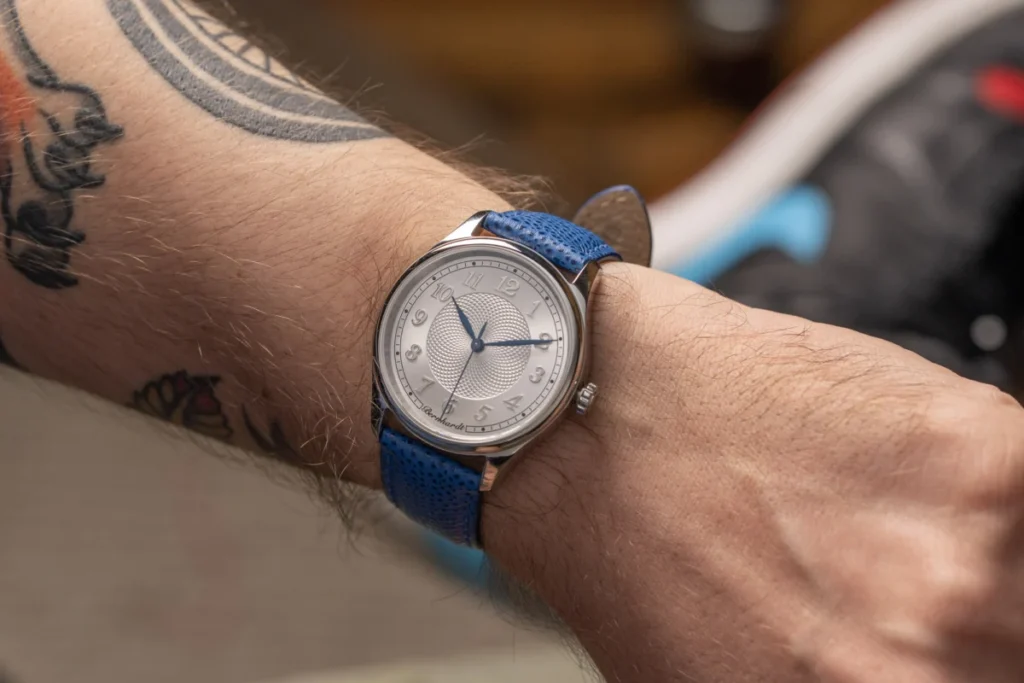
The dial serves as the focal point of the Captain collection, a canvas where Bernhardt aims to capture attention and appreciation. The "Fog" variant, under review, features a silver dial characterized by an interior sector adorned with stamped guilloché, radiating outwards to a polished ring. Applied Breguet-style numerals, meticulously crafted with a pleasing substance, lend depth and sophistication to the dial. Their polished finish interacts beautifully with light, creating a subtle shimmer that complements the satin-finished silver base. This interplay of finishes ensures ample contrast, preventing the monochromatic palette from becoming monotonous.
However, the inclusion of an outer railroad minute track, delineated in black with five-minute intervals, introduces an element that leans towards everyday utility rather than strict formal wear. While this enhances legibility—a crucial aspect for any functional timepiece—it subtly shifts the Captain away from the purist’s definition of a dress watch. This detail, along with the long, slender heat-blued hands, which are elegantly executed, contributes to the watch’s overall versatility. The "Bernhardt" wordmark, rendered in an attractive cursive script beneath the 6 o’clock marker, stands as a second favored detail, complementing the allure of the applied numerals.
Case Construction: Understated Elegance and Practical Dimensions

The Captain’s case is fashioned from polished stainless steel, measuring a well-proportioned 38mm in diameter, a height of 9.55mm, and a lug-to-lug distance of 45mm. These dimensions contribute to a comfortable wear, even on a wrist of approximately 7.25 inches. The case features a simple, knurled crown positioned at 3 o’clock, facilitating manual winding—a nod to traditional watchmaking. The construction is straightforward, with a gently curved, polished bezel that flows seamlessly into the midcase.
While the case design can be described as relatively generic, its primary function is to act as a refined frame for the meticulously crafted dial. This understated approach is entirely appropriate for a watch aiming for classic appeal. The polished finish across all surfaces is a deliberate design choice that aligns with the dial’s aesthetic and offers a departure from Bernhardt’s typical tool-watch ethos. This commitment to a fully polished exterior imbues the Captain with a distinct dressier character, though it may slightly temper its versatility for more rugged applications.
Movement: Reliability and Efficiency with the Miyota 9039

At the heart of the Bernhardt Captain beats the Miyota 9039 automatic movement. This caliber is a familiar and respected presence within the microbrand watch community, known for its slim profile, which allows for versatile case designs, and its inherent reliability. The thinness of the 9039 is particularly advantageous in watchmaking, enabling brands to achieve slimmer profiles for dress watches or to maximize space for complications in other watch types. Its robustness ensures consistent performance, a critical factor for any daily wear timepiece.
Furthermore, the relative affordability of the Miyota 9039 contributes significantly to the Captain’s competitive pricing. This cost-effectiveness allows Bernhardt to offer a well-executed watch without compromising on essential functionality. The movement is housed within a solid caseback, adorned with an engraving of a ship’s wheel—a subtle yet consistent nod to Bernhardt’s nautical heritage that subtly permeates many of their designs, including the Captain. The decision to opt for a solid caseback is pragmatic; the Miyota caliber, while reliable, is not typically a visual spectacle that warrants an exhibition case. Moreover, incorporating an exhibition caseback often necessitates a trade-off in case height or water resistance, compromises that Bernhardt has wisely avoided here.
Straps and Wearability: Versatility and Personal Expression

The Bernhardt Captain is presented on various straps, with the review sample featuring a blue leather strap. While personal preference dictates taste, the strap is described as comfortable and possessing a pleasant pebbled texture. The versatility of the Captain’s dial design is such that it readily accepts straps of virtually any color, allowing for significant personalization and adaptation to different occasions. For a more formal presentation, a simple black leather strap or a Milanese mesh bracelet with straight endlinks would be ideal. Conversely, a suede strap can lend a more casual demeanor. The bright blue strap accompanying the review unit, while stylish, leans towards the more casual end of the spectrum, further reinforcing the notion that the Captain is an exploration of the dress watch genre rather than a strict adherence to its most traditional interpretations.
Value Proposition: Navigating the Sub-$1000 Market
The Bernhardt Captain retails for $749. In the current watch market of 2026, a price point under $1,000 for a reasonably well-executed timepiece is generally well-received. However, a retrospective analysis reveals a subtle shift in pricing trends. A watch with similar specifications and movement caliber would likely have been priced considerably lower, perhaps around $500 or less, just a few years prior.

This observation invites a broader discussion on the evolving value proposition within the sub-$1,000 watch segment. The Captain’s dial, with its intricate stamped guilloché, may contribute to its $100 premium over comparable models like the Kiwame Tokyo or Baltic MR watches, which hover around the $600-$650 mark. The question arises: is this justification sufficient, or are we witnessing a broader recalibration of pricing in this category?
The under-$1,000 market has become a fertile ground for brands seeking to offer accessible yet quality timepieces. For seasoned collectors, the $1,000 threshold may now represent what $500 or less did in previous years. This incremental increase in price point, while potentially causing some consternation, is also a reflection of the hobby’s growth. An expanding market, with increased brand participation and collector engagement, naturally leads to higher entry prices.
With these rising price points, the expectation for enhanced quality in finishing, timekeeping accuracy, and ergonomic design naturally follows. While the Bernhardt Captain may not possess groundbreaking finishing or exceptional timekeeping that will astonish seasoned collectors, it undeniably presents as a serviceable and aesthetically pleasing watch. Its visual appeal is subjective; for those who find themselves drawn to its design, the $749 price tag is a justifiable investment. However, it does not represent a paradigm-shifting value proposition or a deeply impressive offering that redefines the market segment. It is, rather, a solid contender in a maturing category, offering a contemporary take on classic design principles for the discerning enthusiast.

Broader Implications and Market Trends
The emergence of watches like the Bernhardt Captain underscores a significant trend in the contemporary watch market: the democratization of refined aesthetics. As the dominance of overtly sporty watches begins to wane, brands are recognizing the latent demand for more elegant and versatile timepieces. This shift is not merely a fleeting fad but a more profound evolution in consumer preferences, influenced by a wider demographic of watch enthusiasts who appreciate both form and function.
The accessibility of well-crafted timepieces under the $1,000 mark is crucial for fostering new collectors. Historically, the allure of prestigious dress watches from established Swiss manufacturers was often out of reach for many. Microbrands and independent watchmakers have played a pivotal role in bridging this gap, offering attractive designs and reliable movements at attainable price points. The Bernhardt Captain, by offering a blend of classic design cues and modern sensibilities, contributes to this growing ecosystem.

The analysis of price points, particularly in the sub-$1,000 segment, reveals the intricate balance brands must strike between perceived value and production costs. Factors such as dial complexity, case finishing, movement choice, and brand positioning all contribute to the final retail price. While some price increases may seem steep in isolation, they often reflect broader economic factors, including rising material costs and the increasing sophistication of manufacturing processes.
The Bernhardt Captain exemplifies a brand’s strategic response to evolving market demands. By introducing a collection that departs from its established identity, Bernhardt demonstrates an understanding of horological trends and a commitment to catering to a broader audience. The success of such ventures hinges on the brand’s ability to execute its vision effectively, delivering watches that not only meet but exceed the expectations of consumers in this increasingly competitive segment. The long-term implications of this trend suggest a continued diversification of the watch market, with greater emphasis placed on design versatility and accessible luxury.