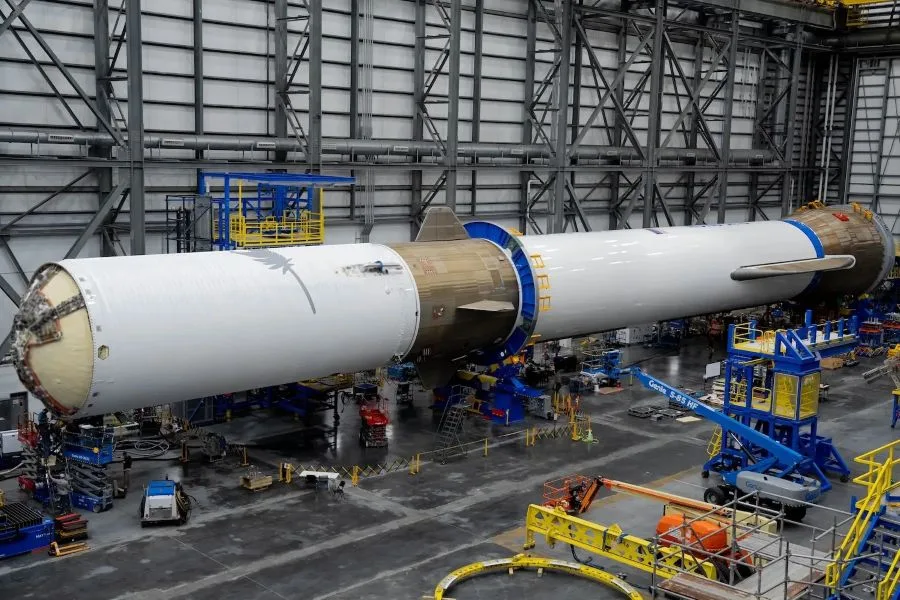
Blue Origin LLC, the aerospace company founded by Amazon executive chairman Jeff Bezos, has unveiled plans to construct a colossal 1.3-million-square-foot manufacturing campus in Hutto, Texas, to be known as Constellation Park. This ambitious multi-facility operation is poised to become a central production hub for several of the company’s critical satellite and communications programs, marking a significant expansion of Blue Origin’s terrestrial footprint and strategic capabilities in the burgeoning commercial space sector. The sheer scale of the investment and the advanced nature of the manufacturing slated for the facility underscore a concerted effort by Blue Origin to ramp up its satellite production capacity, crucial for its long-term vision of enabling millions of people to live and work in space.
Constellation Park is specifically designed to support the manufacturing infrastructure for TeraWave, Blue Origin’s nascent satellite communications network, signaling a direct entry or significant expansion into the highly competitive satellite internet market. Furthermore, the campus will substantially expand production capabilities for Quartz, a global ground communications network. Quartz is characterized by its reliance on 3.7-meter aperture antennas, engineered to facilitate S-band and X-band connectivity for an array of low Earth orbit (LEO) missions. Beyond these dedicated network initiatives, the state-of-the-art campus will also integrate the manufacturing of essential Blue Origin subsystems, including advanced solar arrays, sophisticated avionics packages, telecommunications hardware, and various other critical satellite components. This vertical integration strategy is expected to streamline production, enhance quality control, and fortify supply chain resilience.
Dave Limp, CEO of Blue Origin, articulated the strategic rationale behind selecting Texas for this monumental investment. "Texas has long understood what it takes to lead in space exploration," Limp stated. "We’re proud to grow our footprint here in Texas, tap into the world-class talent this state has to offer and help ensure America remains the leader in space innovation." His remarks highlight both the historical legacy of space exploration deeply embedded in the Texan identity and the state’s contemporary role as a vibrant ecosystem for aerospace innovation and skilled labor.
A Deeper Dive into Blue Origin’s Strategic Imperatives
The announcement of Constellation Park represents more than just a new facility; it signifies a pivotal acceleration in Blue Origin’s overarching strategy. While the company is widely recognized for its New Shepard suborbital tourism flights and the development of the powerful New Glenn orbital rocket, its long-term vision, often articulated by Jeff Bezos, extends far beyond launch services. Bezos envisions a future where humanity expands into space, leveraging its vast resources to solve Earth’s challenges and enable widespread space settlement. Achieving this vision necessitates robust space infrastructure, and satellite constellations, particularly those focused on communication and Earth observation, are foundational elements of such infrastructure.
TeraWave, though details remain largely proprietary, is poised to be Blue Origin’s answer to the rapidly expanding demand for global satellite broadband. In an era dominated by mega-constellations like SpaceX’s Starlink and Amazon’s Project Kuiper (which, interestingly, also has significant ties to Bezos), Blue Origin’s entry suggests a strategic play for market share in this critical sector. A high-throughput, low-latency satellite network could support a wide array of applications, from rural internet access to advanced military communications and future in-space data relay for lunar and Martian missions.
Quartz, with its emphasis on S-band and X-band connectivity, points towards a different, yet equally vital, segment of the satellite market. S-band is commonly used for telemetry, tracking, and command (TT&C) for satellites, as well as for some remote sensing applications. X-band, conversely, is favored for high-resolution radar imaging, military communications, and certain types of scientific data downlink due to its higher data rates and resistance to atmospheric interference. By manufacturing ground station components for these bands, Blue Origin is positioning itself to support a diverse range of LEO missions, including earth observation, scientific research, and secure communications, potentially serving both governmental and commercial clients.
The decision to vertically integrate the manufacturing of key subsystems like solar arrays, avionics, and telecommunications hardware within Constellation Park is a calculated move. In the highly complex and often bottlenecked aerospace supply chain, in-house production offers several distinct advantages. It provides greater control over quality and intellectual property, reduces reliance on external suppliers, mitigates supply chain disruptions, and can ultimately lead to cost efficiencies through economies of scale. For a company like Blue Origin, which aims for rapid innovation and high production volumes for its ambitious space programs, such control is paramount.
Hutto, Texas: A Burgeoning Hub for Aerospace and Advanced Manufacturing
The selection of Hutto, a city in Williamson County just northeast of Austin, is strategically significant for several reasons. Texas boasts a rich legacy in aerospace, from the iconic NASA Johnson Space Center in Houston to SpaceX’s formidable Starbase facility in Boca Chica. This established ecosystem provides a skilled workforce, a network of suppliers, and a favorable regulatory environment.

Williamson County, in particular, has experienced explosive growth in recent years, fueled by its proximity to Austin’s thriving tech scene and its proactive approach to economic development. The region offers a growing pool of engineering talent graduating from institutions like the University of Texas at Austin and Texas A&M University, as well as a skilled manufacturing workforce. The presence of major transportation arteries, including Interstate 35 and State Highway 130, ensures robust logistical capabilities for material ingress and egress of finished products.
While specific incentive packages offered by Hutto or Williamson County were not detailed in the initial announcement, it is standard practice for projects of this magnitude to involve significant local and state tax abatements, grants, or other economic development agreements. These incentives often hinge on commitments for job creation and capital investment. Constellation Park, with its 1.3-million-square-foot footprint, represents a massive capital injection into the local economy and is expected to generate hundreds, if not thousands, of high-skilled manufacturing, engineering, and administrative jobs. This influx of employment opportunities will undoubtedly boost the local tax base, stimulate housing development, and support ancillary businesses, contributing to the continued economic diversification of the region.
Local officials are anticipated to express profound enthusiasm for Blue Origin’s investment. Mayors and city councils in fast-growing communities like Hutto actively seek to attract high-tech, high-wage industries to solidify their economic future and provide opportunities for their residents. The presence of a globally recognized aerospace leader like Blue Origin elevates Hutto’s profile on the national and international stage, potentially attracting further investment from related industries.
The Broader Landscape of the New Space Economy
Blue Origin’s Constellation Park arrives at a time of unprecedented growth and transformation in the global space industry, often referred to as the "New Space" era. This era is characterized by the increasing commercialization of space activities, driven by private companies, reduced launch costs, and innovative technologies. The global space economy, valued at over $400 billion currently, is projected to reach well over $1 trillion in the next decade, with satellite manufacturing and services forming a substantial portion of this growth.
The demand for satellites, particularly smallsats and CubeSats for LEO constellations, has skyrocketed. Companies are launching thousands of satellites to provide global internet, enhance Earth observation capabilities, and support a myriad of scientific and commercial applications. This shift from bespoke, large government satellites to mass-produced, smaller, and more agile spacecraft necessitates advanced manufacturing techniques, automation, and economies of scale that facilities like Constellation Park are designed to provide. The campus is expected to leverage cutting-edge manufacturing processes, potentially incorporating robotics, artificial intelligence for quality control, and additive manufacturing (3D printing) to optimize production efficiency and reduce costs.
The strategic implications of Constellation Park extend beyond economic benefits. It underscores America’s commitment to maintaining leadership in space innovation and technology. By establishing domestic manufacturing capabilities for critical satellite components and systems, Blue Origin contributes to national security by reducing reliance on foreign supply chains, ensuring resilience in the face of geopolitical shifts, and safeguarding sensitive space technology. The ability to rapidly produce and deploy advanced satellite constellations is increasingly viewed as a strategic imperative for both commercial competitiveness and national defense.
Timeline, Development, and Future Outlook
While specific construction timelines were not immediately released, a project of Constellation Park’s magnitude typically involves a multi-year development cycle. Following zoning approvals and environmental assessments, groundbreaking could commence within the next 12-18 months. Construction of a 1.3-million-square-foot facility, especially one housing complex aerospace manufacturing, could take anywhere from two to four years, suggesting initial operations might begin in the mid-to-late 2020s. The facility is likely to be developed in phases, allowing Blue Origin to scale production as its TeraWave and Quartz programs mature and market demand dictates.
The long-term impact of Constellation Park on Blue Origin’s overall mission is profound. By securing a dedicated, high-volume manufacturing base for its satellite and ground communication assets, the company solidifies a critical pillar of its space infrastructure strategy. These communication networks are not only valuable as standalone commercial ventures but also serve as foundational elements for Blue Origin’s broader ambitions, including supporting future lunar missions with its Blue Moon lander, enabling the Orbital Reef commercial space station project, and facilitating communication for future human settlements beyond Earth.
As the New Space race intensifies, the ability to rapidly innovate, manufacture at scale, and control key aspects of the supply chain will be crucial determinants of success. Constellation Park positions Blue Origin as a formidable player in this evolving landscape, demonstrating a tangible commitment to its expansive vision for the future of space. The facility represents not just a building, but a strategic asset designed to propel Blue Origin, Texas, and the United States forward in the next era of space exploration and utilization.