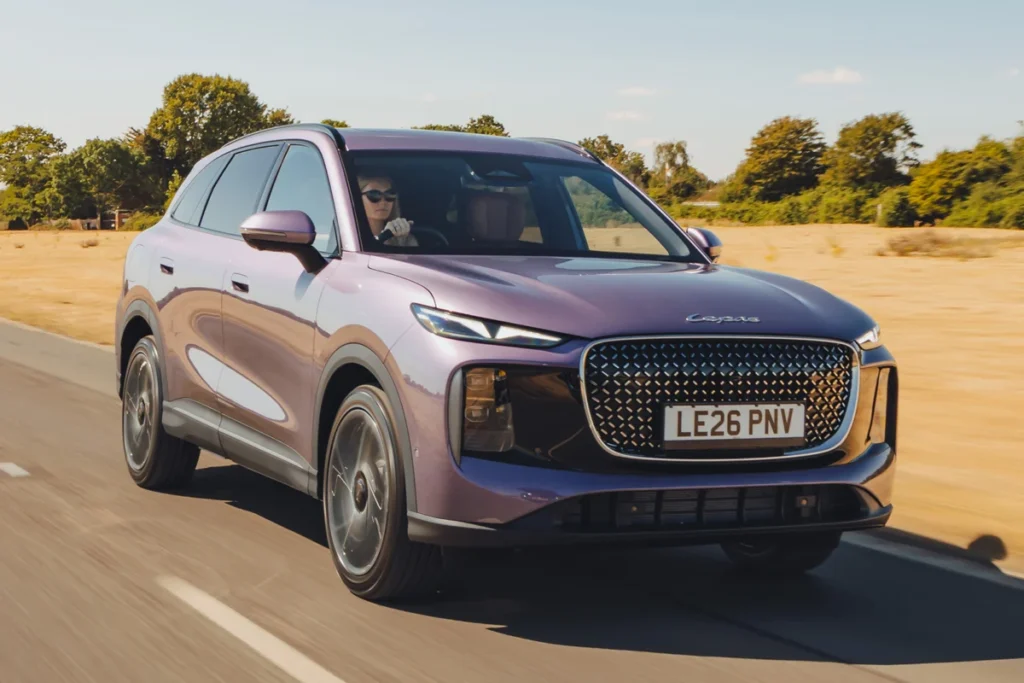
The interior of the Chery Lepas L8 presents a design philosophy deeply rooted in Chery’s commitment to minimalism, a characteristic that pervades its recent vehicle offerings. This approach is immediately evident upon entering the cabin, where a prominent, large, portrait-oriented touchscreen dominates the dashboard. Complementing this central display is a compact digital driver’s instrument cluster, and the physical switchgear for secondary controls has been pared down to a bare minimum. This deliberate reduction in buttons aims to create a cleaner, more streamlined aesthetic, a trend increasingly embraced by automotive manufacturers seeking a modern and sophisticated cabin environment.
The 13.2-inch central touchscreen, which gracefully sweeps down into the centre console, and the bright, eye-catching speaker grilles, evoke a distinct sense of familiarity, drawing clear parallels with the interior design language of premium marques such as Mercedes-Benz. While the stylistic inspiration is discernible, the execution in the Lepas L8 results in a pleasant and inviting passenger environment. The cabin is appointed with tactile, faux-leather and soft-touch materials across the dashboard, contributing to an upmarket feel. Furthermore, the L8 offers a generous amount of storage solutions, enhancing its practicality for everyday use. The specific colour combination of our test vehicle, a sophisticated tan paired with black accents, further elevated the interior atmosphere, imbuing it with a sense of warmth and refinement.
However, the minimalist aesthetic, while visually appealing, introduces certain functional challenges, a recurring theme observed in other vehicles within Chery’s extensive brand portfolio. The L8’s touchscreen interface, despite its prominent size, proves to be frustratingly unintuitive in operation. Adjusting various vehicle functions necessitates frequent and often circuitous menu hopping, a process made more arduous by the diminutive size of the on-screen icons. This lack of immediate accessibility to critical functions can detract from the driving experience, particularly when quick adjustments are required.
A more significant concern highlighted by early reviews is the current absence of a dedicated shortcut button to deactivate the Advanced Driver-Assistance Systems (ADAS). While Chery has acknowledged this feedback and has pledged to incorporate a readily accessible deactivation option within the touchscreen’s swipe-down menu through a future over-the-air (OTA) software update, the current implementation requires drivers to navigate through multiple menus. This is a point of contention for safety-conscious drivers or those who prefer manual control in certain driving scenarios, especially given the increasing complexity and pervasiveness of ADAS features in modern vehicles. The promise of an OTA update offers a solution, but its absence at launch represents a missed opportunity for immediate user satisfaction and ease of use.
Despite the criticisms directed at the touchscreen’s interface, there is a notable exception that deserves commendation: the strip of physical buttons positioned directly below the central touchscreen. These tactile controls, dedicated to managing the climate control system, including temperature and fan speed, represent a welcome and practical addition. Their physical nature allows for immediate and unambiguous adjustments without the need to divert visual attention to the screen, a crucial advantage for maintaining focus on the road. This thoughtful inclusion demonstrates an understanding that while touchscreens offer a modern aesthetic, physical controls retain their utility for frequently accessed functions.
The development of the Chery Lepas L8 clearly prioritized rear passenger space, an area where the manufacturer has demonstrated an unwillingness to compromise. The legroom offered to rear occupants is exceptionally generous, falling just short of being class-leading but still providing ample space for even taller adults to stretch out comfortably. The design cleverly allows passengers to tuck their feet beneath the seats in front, further maximizing the sense of space and comfort. This attention to detail extends to the panoramic sunroof, which has been cleverly integrated to avoid encroaching on head clearance, ensuring that the airy cabin feel is maintained for all occupants. Overall, the rear accommodation is more than sufficient to cater to the needs of adults on longer journeys, a crucial consideration for family-oriented vehicles.
Practicality continues to be a strong suit for the Lepas L8, with its boot space being a particular highlight. With a substantial capacity of 507 litres, the L8’s cargo area comfortably outperforms its plug-in hybrid (PHEV) rivals, such as the Volkswagen Tiguan, which offers 490 litres, and the Toyota RAV4, with its 446 litres. This generous volume makes the L8 a compelling option for those who require significant luggage-carrying capability. Furthermore, the inclusion of underfloor storage provides a convenient and discreet location for stowing the vehicle’s charging cable, a practical consideration for PHEV owners who frequently utilize electric power. This thoughtful integration of storage solutions underscores Chery’s focus on everyday usability.
Chery’s Expanding Global Footprint and the L8’s Market Positioning
The introduction of the Lepas L8 into various global markets is part of a broader, ambitious expansion strategy by Chery Automobile Co., Ltd., a Chinese automotive manufacturer that has been steadily increasing its international presence over the past decade. Established in 1997, Chery has evolved from a domestic player into a significant global exporter, particularly in emerging markets. The company has strategically leveraged its expertise in various vehicle segments, including sedans, SUVs, and MPVs, to build a diverse product portfolio.
The L8, positioned as a mid-size PHEV SUV, aims to capture a segment of the market that is increasingly drawn to electrified powertrains and the versatility of the SUV body style. This segment is highly competitive, with established global players offering a range of compelling options. Chery’s strategy appears to be one of offering a compelling combination of features, technology, and competitive pricing to attract buyers. The L8’s emphasis on a modern, minimalist interior, coupled with practical considerations like generous passenger and cargo space, are key selling points designed to resonate with a discerning consumer base.
The company’s recent performance indicators suggest a growing momentum. For instance, in the first quarter of 2023, Chery reported significant year-on-year sales growth, with a substantial portion of these sales attributed to its export markets. This trend underscores the increasing acceptance of Chery vehicles internationally and provides a strong foundation for the L8’s market entry. The L8, in particular, is expected to play a crucial role in bolstering Chery’s presence in regions where demand for PHEVs is on the rise, driven by environmental regulations and consumer interest in fuel efficiency.
Technological Integration and User Experience Analysis
The L8’s interior technology suite, centered around its large central touchscreen, reflects a design philosophy that prioritizes a clean and uncluttered dashboard. This approach is not unique to Chery; many manufacturers are moving towards reducing the number of physical buttons in favour of integrated digital interfaces. The goal is to provide a more futuristic and seamless user experience, while also allowing for greater flexibility in software updates and feature additions.
However, as noted, the effectiveness of such systems hinges on their intuitiveness and ease of use. The criticisms regarding the L8’s touchscreen, specifically the need for extensive menu hopping and the small icon sizes, point to potential usability challenges. In a competitive market, where driver distraction is a significant safety concern, a complex or counterintuitive infotainment system can be a deterrent. The effectiveness of the upcoming OTA update in addressing these issues will be a critical factor in the L8’s long-term user satisfaction.
The integration of ADAS is another area where user experience is paramount. While these systems are designed to enhance safety, their operation needs to be straightforward and controllable by the driver. The lack of a quick deactivation method for ADAS in the L8, though slated for an update, highlights a common challenge in balancing advanced safety features with driver autonomy. Future iterations of such systems will likely focus on more user-friendly interfaces and customizable settings.
The inclusion of physical climate controls, as mentioned, serves as a practical counterpoint to the all-encompassing touchscreen. This hybrid approach, where frequently used functions retain physical controls while less frequently accessed ones are managed digitally, is often seen as a balanced solution. It acknowledges the user preference for tactile feedback and immediate access for critical functions like temperature adjustment, while still embracing the modern aesthetic of digital interfaces.
Practicality and Utility: A Key Selling Proposition
Beyond the technological aspects, the Chery Lepas L8 demonstrates a strong focus on practical considerations, particularly in terms of interior space and cargo capacity. The generous legroom in the rear, coupled with ample headroom, ensures that the L8 is well-suited for families or individuals who frequently transport multiple passengers. This commitment to passenger comfort is a vital differentiator in the crowded SUV market.
The boot space figures are particularly impressive and provide a tangible advantage over key competitors. A 507-litre boot offers significant utility for everyday tasks, from grocery shopping to carrying luggage for family holidays. The ability to comfortably accommodate charging cables within dedicated underfloor storage is a small but significant detail that enhances the overall user experience for PHEV owners. Such thoughtful design elements contribute to the L8’s appeal as a practical and versatile vehicle.
The competitive landscape for PHEV SUVs is intensifying, with manufacturers continually striving to balance efficiency, performance, and practicality. The L8’s focus on maximizing interior space and cargo volume positions it competitively within this segment. As consumers become more environmentally conscious and the adoption of electrified vehicles accelerates, the practical advantages of models like the L8 are likely to become increasingly important factors in purchasing decisions.
Future Outlook and Potential Implications
The Chery Lepas L8 represents a significant step in Chery’s global expansion strategy, showcasing the brand’s evolving design language and technological capabilities. The success of the L8 will depend on several factors, including its ability to address the usability concerns of its infotainment system, its performance in real-world driving conditions, and its competitive pricing strategy.
The company’s commitment to addressing feedback through OTA updates is a positive sign, indicating a willingness to adapt and improve its products post-launch. This approach is becoming increasingly standard in the automotive industry, allowing manufacturers to refine vehicle software and introduce new features throughout the vehicle’s lifecycle.
The broader implications of Chery’s growing market share extend to the global automotive industry. As Chinese manufacturers like Chery continue to produce increasingly sophisticated and competitive vehicles, they are challenging established players and reshaping market dynamics. The L8, with its blend of minimalist design, practical features, and a focus on electrification, is a prime example of this trend. Its reception in various international markets will be closely watched as an indicator of Chery’s long-term potential and its ability to compete effectively on a global scale. The ongoing evolution of Chery’s product offerings and its strategic market entries will undoubtedly continue to be a significant narrative within the automotive sector for years to come.