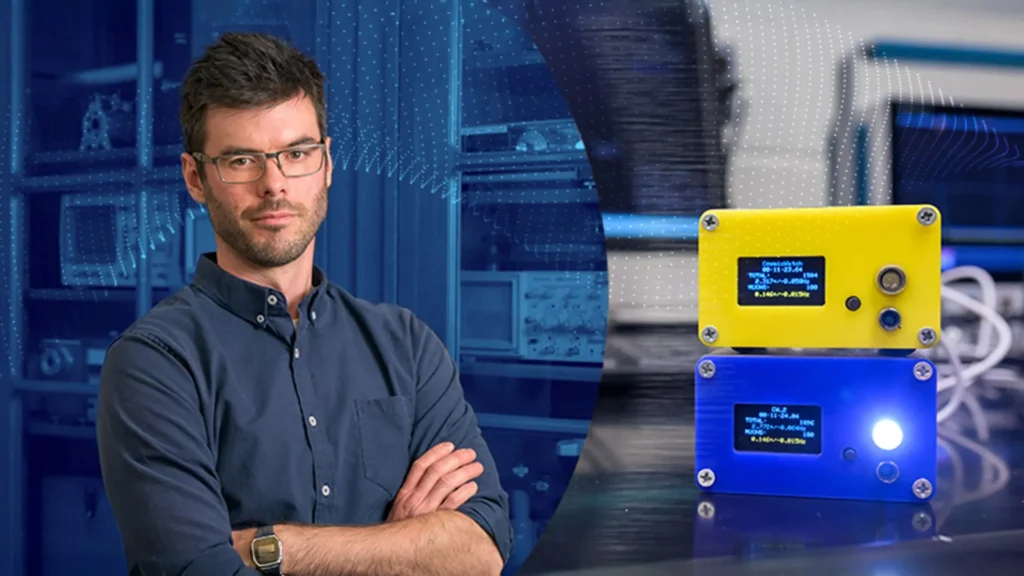
Every second of every day, Earth is bathed in a silent, invisible rain of subatomic particles. They pass through our bodies, our homes, and the very ground beneath our feet at nearly the speed of light. These particles, known as muons, are the ghostly remnants of violent cosmic events occurring millions of light-years away. For decades, detecting these particles required massive, expensive laboratory equipment accessible only to elite research institutions. However, a technological breakthrough led by Spencer Axani, a physics professor at the University of Delaware, is changing that reality. Through a project called CosmicWatch, a high-tech muon detector the size of a box of animal crackers can now be built for roughly $100, opening the door for students, hobbyists, and professional researchers to explore the subatomic world.
The Nature of the Invisible: Understanding Muons and Cosmic Rays
To appreciate the significance of the CosmicWatch device, one must first understand the "cosmic rain" it is designed to measure. The story begins deep in space, where cataclysmic events such as supernovae (exploding stars), gamma-ray bursts, and the activity of blazars (supermassive black holes at the centers of galaxies) accelerate protons and atomic nuclei to incredible speeds. These are primary cosmic rays.
When these high-energy primary cosmic rays collide with gas molecules in Earth’s upper atmosphere—typically about 10 to 15 kilometers above the surface—they trigger a "particle shower." This collision shatters the atmospheric atoms, creating a cascade of secondary particles. Among these secondary particles are muons.
Muons are often described as the "heavy cousins" of electrons. They carry the same negative charge but are approximately 207 times more massive. Because they are so heavy and travel so fast, they do not interact strongly with matter in the same way electrons do. This allows them to penetrate through kilometers of rock, thick layers of metal, and the human body without causing damage or being easily stopped. However, muons are unstable; they typically exist for only 2.2 microseconds before decaying into electrons and neutrinos.
A Brief History of Muon Discovery and Special Relativity
The study of muons is not merely a modern pursuit but a cornerstone of 20th-century physics. In the early 1940s, muons provided one of the first and most compelling experimental proofs of Albert Einstein’s theory of special relativity. According to classical physics, a muon decaying in 2.2 microseconds should only be able to travel about 660 meters, even at the speed of light. Given that they are created high in the atmosphere, they should never reach the ground.
However, because muons travel at nearly 99.9% of the speed of light, "time dilation" occurs. From our perspective on Earth, the muon’s internal clock slows down, allowing it to survive long enough to reach the surface. The detection of these particles at sea level was a landmark confirmation that time and space are relative to the observer’s velocity. Despite their historical importance, the tools to detect them remained "bulky and expensive," according to Axani. A standard undergraduate lab setup traditionally required a "rack of electronics about the size of a small bookshelf," costing thousands of dollars.
The Genesis of CosmicWatch: From MIT to the University of Delaware
The CosmicWatch project began in 2017 while Spencer Axani was a graduate student at the Massachusetts Institute of Technology (MIT). His primary research involved the IceCube Neutrino Observatory, a massive detector buried under the Antarctic ice. IceCube looks for neutrinos—particles even more elusive than muons—but it is constantly bombarded by atmospheric muons that can interfere with data.
Axani’s original goal was to develop a compact, low-power muon detector that could help researchers at IceCube distinguish between the background noise of muons and the high-energy neutrinos they were actually seeking. During the development process, Axani realized that the technology he was refining—specifically the use of Silicon Photomultipliers (SiPMs) and plastic scintillators—could be miniaturized and produced at a fraction of the cost of traditional photomultiplier tubes.
Upon joining the University of Delaware faculty in 2022, Axani continued to iterate on the design. The project has since evolved through three major versions. The latest iteration, Version 3, was detailed in the Journal of Instrumentation in October 2024. This new version is not only more durable but includes advanced features such as the ability to monitor environmental conditions, tolerate higher radiation levels, and process data at significantly higher speeds.
Technical Specifications: How a $100 Detector Works
The brilliance of CosmicWatch lies in its simplicity and efficiency. Each unit consists of several key components:
- Plastic Scintillator: A small slab of specialized plastic that emits a tiny flash of light (photons) when a charged particle like a muon passes through it.
- Silicon Photomultiplier (SiPM): A sensitive light sensor that detects those few photons and converts them into an electrical signal.
- Printed Circuit Board (PCB): An affordable, custom-designed board that amplifies the signal and filters out electronic noise.
- Microcontroller (Arduino-based): This processes the signal, triggers a LED flash for visual confirmation, and records the "count" or timestamp of the event.
Whenever a muon pierces the device, the detector flashes and an onboard screen displays the cumulative count. Users can connect the device to a computer to download a spreadsheet of every "hit," including the exact millisecond it occurred. This data allows for sophisticated analysis of muon flux—the rate at which particles hit a specific area over time.
Bridging the Gap: Education and "Real Science"
While CosmicWatch has found a home in professional laboratories, its most profound impact may be in the classroom. Traditionally, particle physics is taught through textbooks and abstract equations because the equipment is too expensive for most high schools or even many small colleges.
Natasha Holmes, the Ann S. Bowers Associate Professor of Physics at Cornell University, has integrated CosmicWatch into her introductory courses. She notes that the hands-on nature of the device transforms the student experience. "The students seem really excited about doing this thing that is more like what particle physicists and experimental physicists actually do," Holmes said. By building the detectors themselves, students learn about soldering, circuit design, coding, and data analysis.
At the University of Delaware, doctoral students like Masooma Sarfraz and Musarate Shams are pushing the boundaries of what the device can do. Sarfraz, the primary author of the recent journal article, noted that the project allowed her to bridge the gap between theoretical physics and experimental hardware. Shams took his CosmicWatch detector 100,000 feet into the air via a high-altitude balloon, mapping how muon counts increase as the atmosphere thins—a direct observation of the "particle shower" effect.
Professional Research and Industrial Applications
Beyond the classroom, the Version 3 CosmicWatch is being deployed in serious scientific endeavors. It is currently being used to calibrate large-scale detectors such as the NuDot experiment at the University of Delaware and the Coherent CAPTAIN-Mills (CCM) dark matter detector at Los Alamos National Laboratory in New Mexico. Because these detectors are searching for incredibly rare events, they need precise, localized "veto" systems to identify and ignore incoming muons.
The potential applications extend into the field of "muography." Because muons are absorbed more by dense materials (like lead or stone) than by less dense materials (like air or wood), they can be used to take "X-rays" of massive structures.
- Archaeology: In 2016, a team using muon detectors discovered a previously unknown corridor inside the Great Pyramid of Giza.
- Volcanology: Researchers use muon flux to "see" inside volcanoes to monitor magma movement and predict eruptions.
- National Security: Muon detectors are being explored as a way to scan shipping containers for shielded nuclear materials that X-rays cannot penetrate.
CosmicWatch provides a low-cost entry point for these types of muography experiments, which were previously cost-prohibitive for smaller research teams.
The Future: A Global Network and Satellite Safety
Spencer Axani’s vision for CosmicWatch extends to a global scale. With thousands of detectors already in circulation, he envisions a "citizen science" network where users across the globe upload their data to a central server. This would create a real-time map of cosmic ray activity across the planet, allowing scientists to track how solar activity and atmospheric changes affect particle flux on a global scale.
Furthermore, Axani is developing a specialized version of the detector for spaceflight. These units could be mounted on small satellites (CubeSats) to monitor the radiation environment in orbit. By communicating with one another, a constellation of CosmicWatch-equipped satellites could provide an early warning system for solar flares. When a spike in high-energy particles is detected, the system could signal nearby satellites to enter "safe mode," powering down sensitive electronics to prevent permanent damage from radiation.
Conclusion: A New Era of Accessibility
The transition of CosmicWatch from a niche laboratory tool to a $100 educational and research powerhouse represents a shift in how we approach the "big science" of particle physics. By making the invisible visible and the expensive affordable, Spencer Axani and his team at the University of Delaware are not just teaching students about the universe—they are giving them the tools to measure it.
As Axani himself reflects, the project has exceeded all original expectations. "Although it started as an educational program, it’s found a use in a lot of different areas of physics," he said. In an era where scientific instruments often cost billions of dollars and take decades to build, CosmicWatch serves as a reminder that profound discovery can sometimes fit in the palm of your hand.