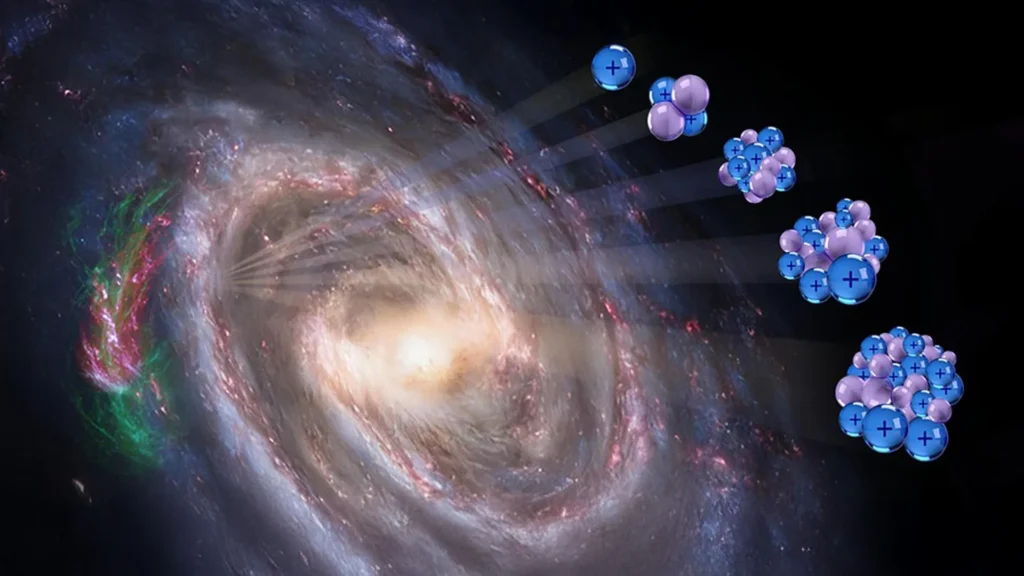
For more than a century, scientists have grappled with the profound mystery of cosmic rays—incredibly powerful particles that traverse the universe at energies far exceeding anything achievable in terrestrial laboratories. Despite relentless pursuit spanning decades, fundamental questions concerning their precise origins, the mechanisms by which they are accelerated to such extreme velocities, and their journey through the cosmos have largely remained elusive. A significant breakthrough, however, has now emerged from the collaborative efforts of researchers utilizing the Dark Matter Particle Explorer (DAMPE) space telescope. Their groundbreaking findings, meticulously detailed in the prestigious scientific journal Nature, unveil a previously unrecognized common feature shared by these enigmatic particles, offering a crucial new clue that promises to profoundly reshape scientific understanding of their genesis and propagation.
Unveiling the Cosmic Ray Mystery: A Century-Long Quest
Cosmic rays represent the most energetic particles ever observed in nature, dwarfing the power of particles generated by even the most sophisticated accelerators on Earth, such as the Large Hadron Collider. These subatomic projectiles—primarily atomic nuclei, with a smaller fraction of electrons and positrons—bombard our planet continuously, carrying immense kinetic energy. Their existence has been known since the early 20th century, when Victor Hess’s pioneering balloon experiments in 1912 demonstrated an increase in ionization radiation with altitude, indicating an extraterrestrial source. This discovery, for which Hess was awarded the Nobel Prize in Physics in 1936, marked the dawn of cosmic ray research.
Since then, the quest to understand cosmic rays has been a central pillar of high-energy astrophysics. Scientists hypothesize that these ultra-energetic particles are forged in some of the universe’s most violent and extreme phenomena. Candidate cosmic accelerators include the cataclysmic explosions of supernovae, the powerful jets emanating from supermassive black holes at the centers of galaxies, and the rapidly spinning, highly magnetized remnants of massive stars known as pulsars. Pinpointing the exact contributions of these different sources, and understanding the intricate physics of how they accelerate particles to such colossal energies—often involving magnetic fields acting as colossal slingshots—has remained a formidable challenge.
The cosmic ray spectrum, which plots the number of particles observed at different energies, spans an astonishing range, from megaelectron-volts (MeV) to beyond 10^20 electron-volts (eV). This spectrum is not smooth but exhibits distinct features, notably the "knee" around 10^15 eV and the "ankle" around 10^18 eV, suggesting transitions in either the sources of cosmic rays or their propagation mechanisms through the galaxy. Understanding these features is critical to building a complete picture of cosmic ray physics. Furthermore, the highest-energy cosmic rays, known as ultra-high-energy cosmic rays (UHECRs), pose a particular puzzle. Beyond approximately 5 x 10^19 eV, interactions with the cosmic microwave background radiation should severely limit their propagation distance, a phenomenon known as the Greisen-Zatsepin-Kuzmin (GZK) limit. Yet, UHECRs are observed, implying either nearby sources or exotic physics.
The DAMPE Mission: A Sentinel in Space
To address these profound questions, the Dark Matter Particle Explorer (DAMPE), affectionately known as "Wukong" after the mythical Monkey King, was launched on December 17, 2015, from the Jiuquan Satellite Launch Center in China. Developed by the Chinese Academy of Sciences, DAMPE is a cutting-edge space telescope specifically engineered to investigate the nature of cosmic rays across a wide energy range and to search for potential signatures of dark matter annihilation or decay—a secondary, yet equally compelling, objective. Its orbit, a sun-synchronous one at an altitude of approximately 500 km, allows it to survey the entire sky over time, free from the distorting effects of Earth’s atmosphere.
The DAMPE instrument is a sophisticated stack of detectors designed for precise measurement of high-energy electrons, photons, and cosmic ray nuclei. It comprises four main subsystems:
- Plastic Scintillator Detector (PSD): This top layer helps identify incoming charged particles and reject albedo particles from Earth.
- Silicon-Tungsten Tracker (STK): Crucial for tracing the path of incoming particles and determining their charge. Its precise tracking capabilities are vital for separating different types of cosmic ray nuclei.
- Bismuth Germanate (BGO) Calorimeter: The heart of DAMPE, this detector measures the energy of electrons and gamma rays with unprecedented resolution, crucial for identifying faint signals from potential dark matter interactions and for accurately measuring the energy of cosmic ray nuclei.
- Neutron Detector (ND): Located at the bottom, it helps to distinguish between hadronic and electromagnetic showers, improving particle identification.
The mission represents a significant international collaboration, with major contributions from various institutions. Notably, the astrophysics group at the Department of Nuclear and Particle Physics (DPNC) at the University of Geneva (UNIGE) played a pivotal role in the instrument development and data analysis, underscoring the global nature of modern scientific inquiry. DAMPE’s exceptional energy resolution and its ability to distinguish between different types of particles (e.g., protons from helium, or electrons from protons) set it apart, making it uniquely suited for the detailed spectral measurements that led to this latest discovery.
The Breakthrough: A Universal Pattern in the Cosmos
Through painstaking analysis of highly precise data meticulously collected by DAMPE over several years of operation, researchers uncovered a remarkable and seemingly universal pattern embedded within the energy spectra of primary cosmic ray nuclei. This pattern was observed across a wide range of nuclei, from the lightest (protons) to much heavier species, such as helium, carbon, oxygen, and iron nuclei.
"Cosmic rays are primarily composed of protons, but also of helium, carbon, oxygen, and iron nuclei," explains Andrii Tykhonov, associate professor at the DPNC in the Faculty of Science at UNIGE, and a co-author of the seminal study. "These particles are also categorised according to their energy: low, up to a few billion electron-volts; intermediate, from a few billion to several hundred billion electron-volts; and high, from 1,000 billion electron-volts and beyond."
The core finding of the research is that for every type of nucleus studied, the number of observed particles—their flux—begins to diminish much more rapidly after reaching a specific energy threshold. Scientists refer to this pronounced and consistent effect as "spectral softening." While it is a general characteristic of cosmic rays that their abundance decreases as their energy increases, the DAMPE observations revealed a dramatic and abrupt steepening of this decline beyond a rigidity of approximately 15 teravolts (TV).
Rigidity, a key concept in cosmic ray physics, describes how strongly a charged particle’s trajectory resists being bent by magnetic fields. It is defined as a particle’s momentum per unit charge (p/Z). In essence, higher rigidity means the particle is less susceptible to deflection by the interstellar magnetic fields it encounters on its journey. The fact that this "spectral softening" occurred at the same rigidity for all observed nuclei—protons, helium, carbon, oxygen, and iron—is the profound aspect of this discovery. This consistency across different charges and masses suggests a universal mechanism at play.
Rigidity vs. Energy Per Nucleon: A Decisive Ruling
The discovery of this shared spectral softening feature, occurring at a constant rigidity for all particle types, carries immense implications for theoretical models of cosmic ray acceleration and propagation. For decades, two primary theoretical frameworks have competed to explain the behavior of cosmic rays:
- Rigidity-dependent models: These theories posit that the acceleration mechanisms in astrophysical sources, or the subsequent diffusion and escape from the galaxy, are primarily governed by a particle’s rigidity. Magnetic fields are central to both acceleration and propagation, and the rigidity dictates how strongly a particle interacts with these fields.
- Energy-per-nucleon-dependent models: These alternative explanations suggest that the acceleration and propagation might instead depend on the energy per nucleon (E/A), where E is the total energy and A is the mass number (number of protons and neutrons) of the nucleus.
The DAMPE findings provide compelling and statistically robust evidence that strongly favors the rigidity-dependent framework. Because the identical spectral softening appears across many different types of particles, irrespective of their individual mass but linked by their rigidity, the data unequivocally support theories where cosmic ray acceleration and their movement through the complex magnetic fields of interstellar space are fundamentally controlled by rigidity.
Conversely, the data largely rule out competing explanations based on energy per nucleon. The consistency of the softening across different nuclei at the same rigidity would be highly improbable if the underlying physics were tied to energy per nucleon, as different nuclei would have vastly different energies per nucleon at the same rigidity. According to the researchers, the statistical confidence level against these alternative models reaches an astounding 99.999%. This exceptionally high confidence level signifies that the probability of the observed pattern occurring by random chance, if energy-per-nucleon models were correct, is infinitesimally small. Such a strong statistical rejection represents a definitive step forward in astrophysical understanding.
Geneva’s Crucial Contribution: AI and Advanced Detection
The successful execution of this intricate research and the subsequent breakthrough owe much to significant contributions from the University of Geneva. Researchers from Geneva played a major, multi-faceted role in the DAMPE mission, from instrumentation to advanced data analysis.
One of their key contributions was the development of sophisticated artificial intelligence (AI) methods designed to reconstruct particle events detected by the telescope. High-energy particle physics experiments generate enormous volumes of raw data, which must be meticulously processed to identify particle types, measure their energies, and trace their trajectories. The complexity of these tasks necessitates advanced computational techniques. The Geneva team employed machine learning algorithms to sift through the data, accurately distinguish between different particle species (such as protons, helium, electrons, and photons), and precisely reconstruct the paths of incoming cosmic rays. These AI-driven methods significantly enhanced the precision and reliability of the measurements, which were critical for discerning the subtle patterns in the cosmic ray spectra.
Furthermore, the Geneva group was instrumental in critical measurements involving proton and helium fluxes, providing foundational data for the study. They also played a key role in analyzing data related to carbon nuclei, extending the reach of the discovery across a broader range of elements.
Beyond data analysis, the Geneva team led the development and construction of one of DAMPE’s most vital instruments: the Silicon-Tungsten Tracker (STK). This state-of-the-art detector is absolutely essential for the mission’s objectives. The STK is composed of multiple layers of silicon microstrip sensors interspersed with tungsten converters. Its primary function is to accurately trace the paths of incoming cosmic rays with high spatial resolution. By tracking the particle’s trajectory, scientists can determine its direction of arrival. Crucially, the STK also measures the electrical charge of the incoming cosmic rays. As a charged particle passes through the silicon sensors, it leaves an ionization trail, and the amount of ionization is proportional to the square of its charge. This capability allows researchers to precisely identify the atomic number (Z) of the cosmic ray nuclei (e.g., Z=1 for protons, Z=2 for helium, Z=6 for carbon, Z=26 for iron), a prerequisite for observing the rigidity-dependent softening across different elements. The STK’s precision was a cornerstone of the spectral measurements that underpinned the Nature publication.
Implications for Astrophysical Accelerators and Galactic Propagation
The findings from DAMPE mark an exceptionally important advance in understanding both how cosmic rays are created and how they journey through the galaxy. The identification of a universal spectral softening at a specific rigidity provides crucial constraints on existing theoretical models.
For particle acceleration mechanisms, this discovery strongly suggests that the processes occurring within cosmic ray sources—be they supernovae remnants, pulsars, or other extreme environments—are primarily governed by the magnetic properties of the accelerating region. Models like Diffusive Shock Acceleration (DSA), often invoked for supernova remnants, will need to incorporate this rigidity dependence more explicitly. It implies that the "maximum energy" to which a particle can be accelerated might be limited not by its total energy, but by its rigidity in relation to the magnetic field strength and the size of the acceleration region. This places tighter limits on the parameters of these cosmic accelerators. For instance, if a supernova remnant accelerates particles up to a certain rigidity, then heavier nuclei (with higher mass-to-charge ratios) would reach lower total energies than lighter nuclei at that same rigidity limit.
For cosmic ray propagation through the interstellar medium (ISM), the rigidity dependence also has profound implications. Cosmic rays do not travel in straight lines through the galaxy; they are continuously scattered and diffused by the turbulent magnetic fields pervading interstellar space. The rate at which they diffuse, and the probability of their escape from the galaxy, are thought to be dependent on their rigidity. The DAMPE results corroborate this picture, indicating that particles with higher rigidity are less effectively confined by galactic magnetic fields and therefore escape the galaxy more readily, leading to the observed spectral softening. This refined understanding of propagation will help scientists build more accurate models of the cosmic ray "reservoir" in our galaxy and how it exchanges particles with extragalactic space.
Looking Ahead: The Ongoing Quest
This discovery by the DAMPE collaboration represents a pivotal moment in high-energy astrophysics. By definitively establishing a rigidity-dependent spectral softening across multiple cosmic ray species, it provides a powerful new tool for dissecting the complex interplay between cosmic accelerators and galactic propagation.
The DAMPE mission’s secondary objective, the search for dark matter, also indirectly benefits from these findings. A clearer understanding of the "background" of ordinary cosmic rays—their sources, acceleration, and propagation—is essential for identifying any anomalous signals that could point to dark matter annihilation or decay. If dark matter particles were to produce an excess of electrons, positrons, or gamma rays, it would be much easier to distinguish such a signal from the astrophysical background with a more precise model of cosmic ray behavior.
Future research will undoubtedly build upon these findings. Upcoming observatories and experiments, both space-based and ground-based, such as the Cherenkov Telescope Array (CTA), the Large High Altitude Air Shower Observatory (LHAASO), and upgrades to facilities like IceCube, will aim to extend these measurements to even higher energies and refine our understanding of the sources and propagation mechanisms. The DAMPE results will serve as a critical benchmark for these next-generation experiments.
In conclusion, the DAMPE space telescope has not only provided an important new clue but has arguably delivered a cornerstone piece of the puzzle that has confounded astrophysicists for over a century. By revealing a universal, rigidity-dependent spectral softening in cosmic ray nuclei, the collaboration has placed tighter limits on existing models of particle acceleration in astrophysical sources and significantly improved our understanding of how these extraordinarily energetic particles navigate the vastness of interstellar space. This breakthrough marks a testament to international scientific collaboration and the power of advanced space-borne instrumentation in unraveling the universe’s most profound secrets.