For more than a century, scientists have been grappling with the profound mystery of cosmic rays—incredibly powerful particles that traverse the cosmos at extreme energies, far surpassing anything achievable in terrestrial laboratories. Despite decades of dedicated research and numerous sophisticated experiments, fundamental questions regarding their precise origins and the mechanisms by which they are accelerated to such astounding energies have largely remained unanswered. Now, an international collaboration of researchers, leveraging data from the Dark Matter Particle Explorer (DAMPE) space telescope, has unearthed a pivotal new clue. Their groundbreaking findings, meticulously detailed in the prestigious scientific journal Nature, reveal a hitherto unrecognized common feature shared by these enigmatic particles, a discovery poised to significantly advance humanity’s understanding of their ultimate genesis.
The Enduring Enigma of Cosmic Rays
Cosmic rays represent the highest energy particles ever observed in nature, carrying kinetic energies that dwarf those produced by even the most advanced particle accelerators on Earth, such as the Large Hadron Collider (LHC). While the LHC can accelerate protons to approximately 6.5 teraelectronvolts (TeV), cosmic rays routinely reach energies of Petaelectronvolts (PeV) and, in rare instances, even Exaelectronvolts (EeV)—energies millions to billions of times higher. Scientists hypothesize that these ultra-energetic particles are born from some of the universe’s most violent and cataclysmic events, including the spectacular explosions of supernovae, the powerful relativistic jets emanating from supermassive black holes at the hearts of galaxies, and the rapidly spinning, highly magnetized remnants of collapsed stars known as pulsars. However, pinpointing the exact dominant sources and the precise physics of their acceleration has proven to be an immense challenge due to their diffuse nature, the vast distances they travel, and the magnetic fields that scramble their trajectories, obscuring their origins.
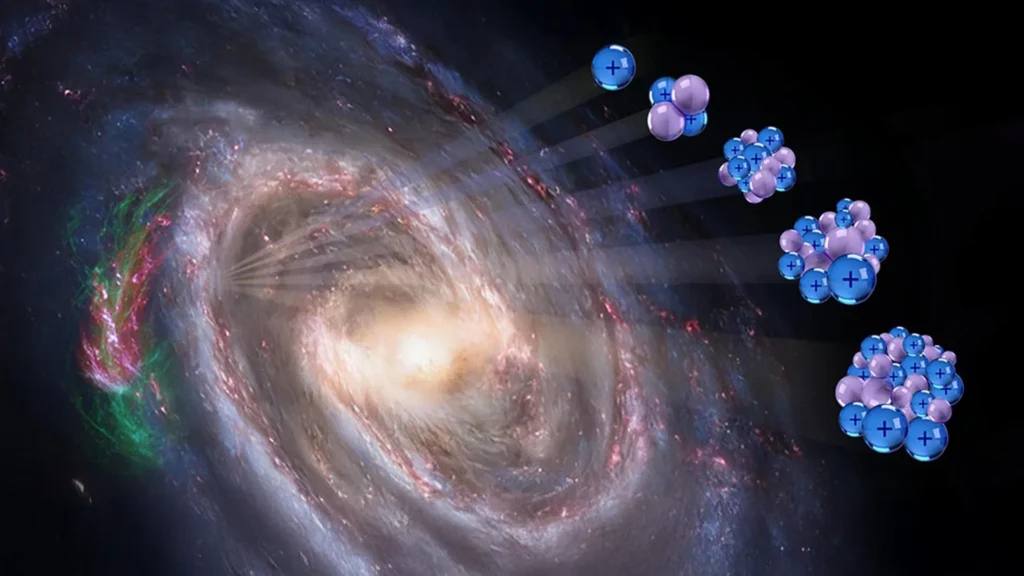
The composition of primary cosmic rays—those arriving from space before interacting with Earth’s atmosphere—is predominantly protons (approximately 90%), with about 9% consisting of helium nuclei and the remaining 1% comprising heavier atomic nuclei, electrons, and positrons. These particles span a vast energy spectrum, typically categorized into low-energy (up to a few billion electron-volts, or GeV), intermediate-energy (from a few GeV to several hundred GeV), and high-energy (from 1,000 GeV, or 1 TeV, and beyond). Understanding the distribution of these particles across different energies, known as their energy spectrum, is crucial for deciphering their creation and propagation mechanisms.
A Century of Cosmic Exploration: A Brief Chronology
The journey to understand cosmic rays began over a century ago.
- 1912: Austrian physicist Victor Hess made the pioneering discovery of "penetrating radiation" originating from space during a series of balloon flights, for which he later received the Nobel Prize in Physics in 1936. This marked the birth of cosmic ray research.
- 1930s-1950s: Early theoretical models, notably Enrico Fermi’s mechanism of stochastic acceleration, began to emerge, proposing how charged particles could gain energy by repeatedly interacting with moving magnetic scattering centers in astrophysical environments.
- Mid-20th Century onwards: Numerous ground-based and balloon-borne experiments, such as those employing cloud chambers and later sophisticated detectors, sought to characterize cosmic ray properties, including their composition and energy spectrum.
- Late 20th Century – Early 21st Century: The advent of space-based observatories like the High-Energy Antimatter Telescope (HEAT), the Advanced Thin Ionization Calorimeter (ATIC), and the Payload for Antimatter Matter Exploration and Light-nuclei Astrophysics (PAMELA) provided increasingly precise measurements, particularly for electron, positron, and light nuclei fluxes, revealing unexpected anomalies that fueled new theories, including those related to dark matter.
- December 2015: The Chinese Academy of Sciences (CAS) successfully launched the Dark Matter Particle Explorer (DAMPE) satellite, nicknamed "Wukong" after the mythical Monkey King, from the Jiuquan Satellite Launch Center. This mission was specifically designed to investigate the nature of cosmic rays and to explore potential connections to dark matter, with a projected operational lifespan of at least three years, which it has since surpassed.
- 2016-Present: DAMPE began collecting high-precision data, systematically observing the fluxes of electrons, positrons, protons, and various atomic nuclei across a wide energy range.
- Late 2023 / Early 2024: The collaborative research team publishes its seminal findings in Nature, marking a significant milestone in cosmic ray physics.
The DAMPE Mission: A Global Scientific Endeavor
The DAMPE space telescope is a collaborative effort, predominantly led by China, but with significant international contributions, including those from European institutions. Its primary scientific objectives are dual-fold: to precisely measure the energy spectra of electrons and positrons up to 10 TeV to search for signatures of dark matter annihilation or decay, and to conduct high-precision measurements of the spectra of cosmic ray protons and nuclei up to 100 TeV to understand their origin and acceleration mechanisms.
The mission’s instrumentation is state-of-the-art, comprising four main detectors:
- Plastic Scintillator Detector (PSD): Used to determine the charge of incoming particles and as an anti-coincidence detector to veto background events.
- Silicon-Tungsten Tracker (STK): Crucial for precisely tracking the path of charged particles and determining their charge, a critical component developed with substantial input from the University of Geneva.
- Bismuth Germanate (BGO) Calorimeter: The core instrument, designed to measure the energy of high-energy electrons, photons, and nuclei with excellent energy resolution.
- Neutron Detector (ND): Used to identify hadron showers (produced by protons and nuclei) and help distinguish them from electron showers.
DAMPE orbits at an altitude of approximately 500 km, providing an unobstructed view of cosmic radiation, free from the attenuating and distorting effects of Earth’s atmosphere. This orbital vantage point allows for direct measurements of primary cosmic rays, offering a level of precision unattainable by ground-based observatories.
The Discovery: A Shared Cosmic Ray Pattern
By meticulously analyzing the highly precise data gathered by DAMPE, the international research team, including significant contributions from the astrophysics group at the Department of Nuclear and Particle Physics (DPNC) at the University of Geneva (UNIGE), uncovered a universal pattern embedded within the energy spectra of primary cosmic ray nuclei. This pattern was observed across a wide range of nuclei, from the lightest protons to much heavier iron nuclei.
"Cosmic rays are primarily composed of protons, but also of helium, carbon, oxygen, and iron nuclei," explained Andrii Tykhonov, an associate professor at the DPNC in the Faculty of Science at UNIGE and a co-author of the study. "These particles are also categorized according to their energy: low, up to a few billion electron-volts; intermediate, from a few billion to several hundred billion electron-volts; and high, from 1,000 billion electron-volts (1 TeV) and beyond."
The core finding is that for every type of nucleus studied, the number of particles detected begins to drop significantly faster after reaching a specific energy threshold. Scientists refer to this pronounced effect as "spectral softening." While it is generally expected that higher-energy cosmic rays are less common as energy increases (a phenomenon described by a power-law spectrum), the DAMPE observations revealed that this decline becomes dramatically steeper beyond a critical "rigidity" of approximately 15 TV (teraelectron-volts).
Rigidity vs. Energy per Nucleon: A Crucial Distinction
To fully appreciate the significance of this discovery, it is essential to understand the concept of "rigidity." In astrophysics, rigidity (R) is defined as a particle’s momentum per unit charge (R = pc/Ze, where p is momentum, c is the speed of light, Z is the atomic number, and e is the elementary charge). It describes how strongly a charged particle’s path resists being bent by magnetic fields. Particles with higher rigidity are less deflected by interstellar magnetic fields and thus tend to travel in straighter lines. This is a critical parameter for understanding particle propagation in the galactic environment.
The fact that this identical spectral softening feature appears consistently across many different types of particles (protons, helium, carbon, oxygen, iron) and is correlated with rigidity provides exceptionally strong support for theories positing that both cosmic ray acceleration mechanisms and their subsequent movement through interstellar space are primarily controlled by rigidity. This universality strongly implies a common acceleration and propagation process for all types of nuclei, at least up to these energies.
Concurrently, this robust data largely rules out competing explanations based on "energy per nucleon" (the total energy of the particle divided by the number of nucleons—protons and neutrons—in its nucleus). Models based on energy per nucleon would predict different softening thresholds for different nuclei, which is not what DAMPE observed. According to the researchers, the statistical confidence level against these alternative models reaches an astounding 99.999%, which in scientific parlance is often referred to as a 5-sigma significance, a benchmark for a robust discovery. This level of certainty effectively eliminates energy-per-nucleon-dependent scenarios for the observed spectral softening.
Geneva’s Pivotal Role: AI and Detector Innovation
Researchers from the University of Geneva played a significant and multifaceted role in this groundbreaking achievement. The UNIGE team was instrumental in developing sophisticated artificial intelligence (AI) methods designed to reconstruct particle events detected by the telescope. Such advanced AI algorithms are vital for accurately identifying particle types, determining their energies, and filtering out background noise from the immense volume of raw data collected by DAMPE. These computational tools are at the forefront of modern experimental astrophysics, enabling unprecedented levels of data analysis precision.
Beyond AI development, the Geneva group made substantial contributions to critical measurements involving proton and helium fluxes, providing foundational data for the study. They also played a key role in the analysis of carbon nuclei data, further strengthening the universality of the observed spectral softening.
Furthermore, the Geneva group led the development of one of DAMPE’s key instruments: the Silicon-Tungsten Tracker (STK). This detector is absolutely essential for accurately tracing the paths of incoming cosmic ray particles and for precisely determining their electrical charge. The STK’s high spatial resolution and excellent charge resolution are paramount for distinguishing between different types of nuclei and for ensuring the accuracy of the rigidity measurements, thereby underpinning the entire discovery.
Expert Perspectives and Future Directions
The publication of these findings in Nature has been met with considerable enthusiasm within the astrophysics community. The discovery marks an important advance in understanding how cosmic rays are created and how they propagate through the vast expanse of the Milky Way galaxy.
Andrii Tykhonov highlighted the significance of the universal pattern: "The fact that this spectral softening occurs at the same rigidity for all cosmic ray nuclei suggests a common origin or a common propagation mechanism that is sensitive to rigidity rather than energy per nucleon. This is a powerful constraint on theoretical models."
Experts suggest that these new results place much tighter limits on existing models of particle acceleration in astrophysical sources. For instance, models describing shock acceleration in supernova remnants will need to incorporate this rigidity-dependent cutoff. It also refines our understanding of how high-energy particles interact with and move through the complex magnetic fields of interstellar space, shedding light on diffusion processes and galactic magnetic field structures.
The implications are far-reaching. This discovery provides crucial empirical data that will guide the development of the next generation of theoretical models for cosmic ray acceleration and transport. It helps to differentiate between competing astrophysical scenarios and to refine our understanding of the extreme physics at play in the most energetic corners of the universe.
Broader Scientific Impact
The DAMPE findings not only illuminate the mysteries of cosmic rays but also have broader implications for other areas of astrophysics and particle physics. A precise understanding of conventional cosmic ray backgrounds is absolutely essential for the ongoing search for dark matter. Anomalies in electron and positron spectra, for instance, have sometimes been interpreted as potential signatures of dark matter annihilation or decay. However, without a robust model of astrophysical cosmic ray sources and propagation, it is impossible to definitively distinguish a dark matter signal from a mundane astrophysical phenomenon. By providing a clearer picture of "normal" cosmic ray behavior, DAMPE’s data helps to reduce the astrophysical uncertainties in dark matter searches, potentially allowing future experiments to more confidently identify or rule out exotic particle signals.
Moreover, this research underscores the power of international scientific collaboration and the synergistic relationship between cutting-edge detector technology, advanced data analysis techniques (including AI), and theoretical physics. As space-based observatories like DAMPE continue to push the boundaries of precision measurement, they provide the empirical bedrock upon which our understanding of the universe’s most extreme phenomena is built. The next steps will involve further refining these measurements, extending observations to even higher energies, and integrating these findings into comprehensive, predictive models that can finally solve the century-old enigma of cosmic ray origins.