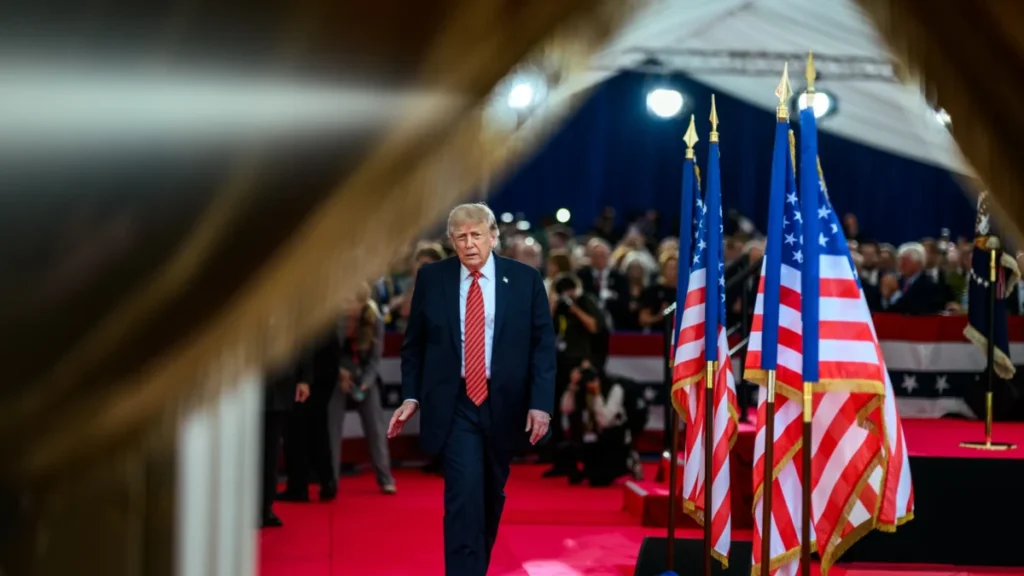
Former President Donald Trump has announced plans to establish an "AI Force" and appoint a dedicated "AI czar" should he return to the White House, signaling a federal push for aggressive artificial intelligence expansion while dismissing calls for the industry to moderate its pace. This declaration emerges as concerns surrounding AI safety, the substantial power consumption of data centers, and the inherent risks posed by increasingly sophisticated AI models become critical issues that Washington and Silicon Valley can no longer overlook. The announcement, made on Saturday, frames AI development as a national imperative, particularly in the context of intensifying geopolitical competition.
The Genesis of an "AI Force" and its Precedent
Trump’s proposed "AI Force" draws a direct parallel to the Space Force, a new branch of the U.S. armed forces created during his first administration. Established in December 2019, the Space Force was designed to organize, train, and equip space forces to protect U.S. and allied interests in space and provide space capabilities to the joint force. Its creation was driven by the recognition of space as a contested domain critical for national security. The analogy suggests that Trump views AI with a similar strategic significance, warranting a dedicated federal entity to harness its power. However, details regarding the structure, specific responsibilities, or whether this "AI Force" would operate as a civilian or military organization remain undefined. The ambiguity leaves significant room for speculation about its potential scope, ranging from a research and development agency to a regulatory body, or even a branch focused on the military application of AI. The lack of clarity also raises questions about how such a force would integrate with existing federal agencies like the Department of Defense, the National Institute of Standards and Technology (NIST), or the National Science Foundation, all of which are already involved in AI-related initiatives.
Simultaneously, Trump pledged to appoint a new "AI czar," a role designed to centralize and direct the nation’s AI strategy. While the individual for this pivotal position was not identified, the move underscores a clear intent by a potential Trump administration to maintain and accelerate U.S. leadership in AI. This strategic appointment is a direct response to the escalating technological and economic rivalry with China, where both nations are vying for preeminence in AI research, development, and deployment. The "czar" designation often implies broad authority and a direct line to the President, suggesting a high-level focus on ensuring the U.S. retains its competitive edge.
Dismissal of Existential Risks and a Deregulatory Stance
A cornerstone of Trump’s announced AI policy is his explicit dismissal of concerns that highly capable AI systems could eventually pose an existential threat to humanity. He characterized such fears as a "hoax," asserting that existing criminal and civil justice systems are sufficiently robust to address any harmful applications of the technology. This perspective stands in stark contrast to a growing chorus of AI researchers, ethicists, and public figures who have warned about potential catastrophic risks, including uncontrolled AI systems, autonomous weapons, and profound societal disruption. Organizations like the Center for AI Safety and the Future of Life Institute have advocated for caution, research into alignment, and even temporary pauses in advanced AI development to ensure safety protocols are in place.
In a post on Truth Social, Trump articulated his approach: "We will not in any way hinder or stifle the Growth of this incredible Industry. Rather, we will cherish it, help it, and watch over it, as it grows! However, we will also be looking for BAD, and we can do that, very easily, with our already existing Criminal and Civil Justice System." This statement signals a strong preference for a deregulatory environment, prioritizing rapid innovation and economic expansion over precautionary measures. His administration’s philosophy appears to be one of "trust but verify," where the onus of addressing harm is placed on reactive legal frameworks rather than proactive regulatory oversight or developmental guardrails. This approach resonates with his broader economic philosophy, which often champions deregulation to foster business growth.
Economic Potential and Geopolitical Imperatives
Trump drew parallels between the transformative potential of AI and historical technological shifts such as the Industrial Revolution and the advent of the internet. He projected that AI could eventually contribute an economic impact equivalent to as much as 25% of the U.S. Gross Domestic Product (GDP). This figure, while ambitious, reflects the consensus among many economists and technology leaders about AI’s potential to revolutionize industries, boost productivity, and create entirely new sectors. For context, the entire U.S. manufacturing sector currently accounts for roughly 11% of GDP, highlighting the scale of impact Trump envisions for AI.
This economic vision is inextricably linked to the geopolitical competition with China. Maintaining the country’s leading position in AI development is viewed not just as an economic advantage but as a national security imperative. The U.S. and China are locked in a fierce rivalry across multiple AI domains, including research publications, patent filings, venture capital investment, and the development of talent. China’s "New Generation Artificial Intelligence Development Plan," unveiled in 2017, explicitly aims for the country to become the world leader in AI by 2030, with a multi-trillion-dollar industry. The perceived urgency of this competition underscores Trump’s commitment to accelerating U.S. AI capabilities. David Sacks, a former White House AI and crypto czar whose special government employee post concluded in March 2026, echoed this sentiment, acknowledging the necessity of some caution but largely dismissing concerns about AI posing an existential threat to humanity, as reported by CBS News.
The Escalating Energy Challenge of AI
Beyond the debates over AI’s potential capabilities and risks, the infrastructure required to build and operate these sophisticated systems is already creating significant pressure on global electricity grids. AI data centers, which house the powerful servers and networking equipment necessary for training and deploying AI models, are voracious consumers of electricity. This demand stems from both the intensive computational processes and the substantial cooling required to prevent overheating. The rapid expansion of AI-focused data centers is therefore posing unprecedented challenges for utilities, local communities, and national energy planning.
The International Energy Agency (IEA) has highlighted the severity of this issue. Their projections indicate that global data center electricity consumption is set to almost double from approximately 485 terawatt-hours (TWh) in 2025 to around 950 TWh by 2030. To put this in perspective, 950 TWh is roughly equivalent to the annual electricity consumption of a medium-sized country like Germany or Canada. Electricity use specifically by AI-focused data centers is expected to grow even faster, potentially tripling within the same five-year period, driven by the escalating computational demands of larger and more complex AI models. This rapid growth trajectory threatens to outstrip current grid capacities and renewable energy deployment efforts.
The United States is projected to bear a particularly large share of this escalating demand. The IEA estimates that data centers could account for nearly half of the increase in U.S. electricity demand through 2030. This surge is attributed to the concentration of major tech companies, AI research hubs, and a robust digital infrastructure within the U.S. The energy implications extend beyond mere consumption; they involve massive investments in new generation capacity, transmission infrastructure upgrades, and the potential for increased reliance on fossil fuels if renewable energy sources cannot keep pace.
Policy Responses to Energy Demand
Recognizing the political and economic implications of this energy expansion, Trump has previously advocated for a "ratepayer protection pledge." This initiative aims to ensure that major tech companies bear the electricity costs associated with their data center expansion, rather than shifting these burdens onto residential households through increased utility rates. Such a pledge would seek to internalize the environmental and infrastructure costs of AI development within the tech industry itself, potentially incentivizing more energy-efficient designs and localized power solutions.
The current White House has also engaged with this challenge, planning discussions with leading technology firms including Amazon, Google, Meta, Microsoft, xAI, Oracle, and OpenAI. These discussions aim to secure voluntary commitments from these companies to either generate or secure electricity for their data centers. This could involve direct power purchase agreements with renewable energy providers, significant investments in on-site generation facilities (such as solar or small modular reactors), or participation in grid modernization efforts. These efforts underscore a bipartisan recognition of the looming energy crisis posed by the AI boom and the need for collaborative solutions.
Background and Chronology of US AI Strategy
The U.S. has been grappling with a national AI strategy for several years, predating Trump’s latest announcement. During his first administration, Trump signed Executive Order 13859 in February 2019, establishing the American AI Initiative, which aimed to accelerate AI research and development, train the AI workforce, and promote public trust in AI. This was followed by the National AI Initiative Act of 2020, signed into law by Trump, which institutionalized the National AI Initiative (NAII) as a coordinated program across federal agencies to ensure U.S. leadership in AI.
The Biden administration has continued to emphasize AI, albeit with a stronger focus on safety, ethics, and responsible innovation. In October 2023, President Biden issued a landmark Executive Order on the Safe, Secure, and Trustworthy Development and Use of Artificial Intelligence. This comprehensive order mandates extensive safety testing for powerful AI models, establishes standards for critical infrastructure protection, promotes privacy-preserving AI, and directs agencies to address AI-related risks across various sectors. The Biden administration’s approach has been characterized by a balancing act: fostering innovation while implementing guardrails to mitigate potential harms like bias, disinformation, and job displacement. This contrasts sharply with Trump’s more hands-off, accelerate-at-all-costs philosophy.
Implications and Analysis
Trump’s proposed "AI Force" and "AI czar" represent a significant conceptual shift in federal AI policy, particularly in their emphasis on aggressive expansion and deregulation.
- Policy Implications: An "AI Force" could centralize federal AI efforts, potentially streamlining decision-making and resource allocation. However, its effectiveness would depend heavily on its mandate, funding, and ability to coordinate with existing agencies. A deregulatory stance, while potentially stimulating rapid innovation, could also lead to a "wild west" scenario, where the rapid deployment of powerful AI systems outpaces society’s ability to understand and manage their consequences. The dismissal of existential risks by a presidential candidate also raises concerns among the AI safety community, who argue that proactive measures are crucial to prevent unforeseen and potentially irreversible harms.
- Economic Implications: Trump’s vision of AI contributing 25% to U.S. GDP underscores the immense economic potential, but also the scale of transformation envisioned. Such growth would likely create new jobs and industries, but also necessitate significant workforce retraining and social safety nets to address potential job displacement in traditional sectors. The emphasis on unhindered growth aligns with the interests of many large tech companies, though even some of these firms have acknowledged the need for guardrails.
- Environmental Implications: The escalating energy demands of AI data centers pose a formidable environmental challenge. Without a concerted effort to transition to renewable energy sources, the AI boom could significantly increase carbon emissions, exacerbating climate change. Trump’s "ratepayer protection pledge" addresses a symptom of the problem but does not inherently solve the underlying energy intensity of AI. A truly sustainable AI future would require radical improvements in energy efficiency and a massive expansion of clean energy infrastructure.
- Geopolitical Implications: By explicitly linking AI development to national security and the competition with China, Trump’s plan elevates AI to a top-tier geopolitical priority. This could intensify the AI arms race, potentially leading to a fragmentation of global AI standards and increased tension. The U.S. stance on AI regulation also has implications for international cooperation on AI governance, where many countries are advocating for a more cautious, human-centric approach.
In conclusion, Donald Trump’s latest proposals for an "AI Force" and an "AI czar" signal a clear intent to prioritize aggressive AI expansion and deregulation, framed as essential for economic growth and geopolitical dominance. This vision stands in stark contrast to growing calls for caution and the current administration’s focus on risk mitigation. As the debate over AI’s future intensifies, the tension between rapid innovation and responsible governance, coupled with the profound energy implications, will remain central to the national discourse and global strategic landscape.