Tucked away beside a verdant forest on the outskirts of Amsterdam, a seemingly ordinary white shipping container houses a pivotal new facility for the European Space Agency (ESA). Bearing the distinctive navy ESA logo, this unassuming structure, situated on the Netherlands Aerospace Centre (NLR) site, is in fact the agency’s brand-new Chemical Propulsion Laboratory (CPL). Far from mere storage, this compact yet sophisticated laboratory marks a significant step forward in ESA’s commitment to fostering European leadership in space propulsion technology, particularly for the burgeoning small satellite and academic sectors. The laboratory’s commissioning test, featuring a robust "battleship" design thruster, signifies its readiness to tackle the complex challenges of developing and testing advanced chemical propulsion systems.
A New Era for Propulsion Testing
The CPL’s primary function is to provide a dedicated, safe, and expert-supported environment for the testing of small-scale chemical propulsion technologies. This initiative directly addresses a critical bottleneck in the European space ecosystem: the limited availability of propulsion testing facilities. Existing centres are often heavily booked, leading to lengthy waiting lists that can stretch for years. For small and medium-sized enterprises (SMEs) and academic institutions operating under tight deadlines and financial constraints, such delays can be detrimental, potentially hindering innovation and stifling growth.
The CPL aims to rectify this situation by offering a rapid, regulated, and expertly guided testing service. This is particularly crucial when dealing with hazardous propellants and intricate combustion systems, where safety and precision are paramount. The laboratory’s design and operational protocols are meticulously crafted to ensure the highest standards of safety, while its accessible location and operational model are geared towards enabling swift iteration and development cycles, essential for startups striving to survive and thrive in the competitive global space market.
Behind the Scenes: The Commissioning Test
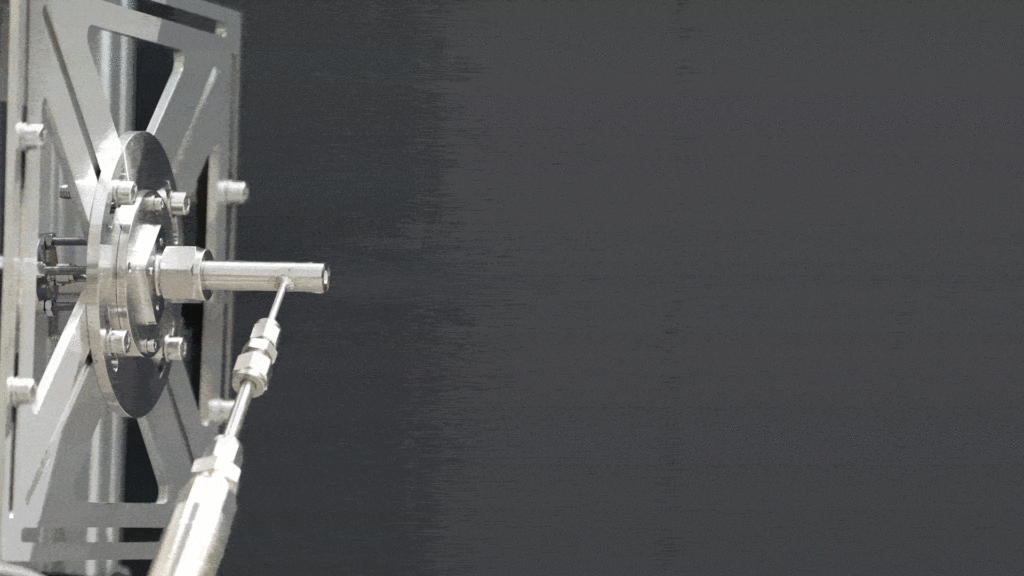
The initial commissioning test, witnessed through footage showcasing the laboratory’s capabilities, involved a robust thruster designed purely for testing purposes, not for actual spaceflight. This "battleship" design allows engineers to push the limits of the equipment and rigorously calibrate the laboratory’s instrumentation without risking flight hardware.
The thruster under test utilizes a high-concentration hydrogen peroxide (98%) as its propellant. This chemical reacts with a catalyst housed within a component known as the combustion chamber. The initial moments of the test footage reveal faint wisps of smoke, a deliberate and necessary precursor to the main firing. These are generated by ten short pulses of propellant, strategically employed to pre-heat the catalyst. As Sebastian Klein, one of the ESA engineers overseeing the CPL, explained, "If the catalyst is heated, the reaction works better." This pre-heating phase is critical for ensuring an efficient and stable combustion process.
Following the successful heating of the catalyst, the team proceeded to a continuous firing phase. "Once the catalyst is heated, a few seconds later we push the propellant through continuously to get a few seconds of static firing," Klein elaborated. "This continuous operation was the goal that we wanted to achieve." This sustained firing period is essential for gathering comprehensive data on the thruster’s performance and the laboratory’s ability to manage the reaction. However, Klein emphasized the overarching objective of the test: "Of course, the whole test is not primarily on the thruster but to verify and ensure safe operation of the test bench itself." This underscores the laboratory’s priority on establishing a secure and reliable testing infrastructure.
A Collaborative Endeavor
The establishment of the CPL is a testament to the collaborative spirit within the European space community. The laboratory is a product of a strategic partnership between ESA and the Netherlands Aerospace Centre (NLR). This collaboration leverages ESA’s extensive expertise in space engineering and technology with NLR’s established infrastructure and operational capabilities.
The symbolic opening event for the CPL was held on 3 July 2026, marking the official commencement of its operations. This new facility is designed to complement ESA’s existing, more extensive Propulsion Laboratory. By creating a specialized hub for smaller-scale propulsion testing, ESA is strategically expanding its testing capacity and providing a more tailored service for a wider range of stakeholders.
Addressing a Critical Industry Need
The demand for propulsion testing services has surged in recent years, driven by several key trends in the space industry:
- The Rise of Small Satellites (SmallSats) and CubeSats: These miniaturized satellites, often developed by universities and startups, require compact and efficient propulsion systems for orbit maneuvering, station-keeping, and de-orbiting. Their smaller scale necessitates different testing approaches compared to traditional large satellites.
- Increased Commercial Space Activity: A growing number of private companies are entering the space sector, developing innovative propulsion technologies for a variety of applications, from satellite constellations to space debris removal.
- Focus on Sustainable Space Operations: There is a growing emphasis on developing propulsion systems that are more environmentally friendly, utilizing less toxic propellants and contributing to the long-term sustainability of the space environment.
- Academic Research and Development: Universities and research institutions are at the forefront of exploring novel propulsion concepts. They require access to specialized facilities to validate their theoretical work and develop practical prototypes.
The existing propulsion test facilities, while highly capable, are often geared towards larger, more complex systems. This leaves a gap for smaller, more agile organizations that need to test less conventional or lower-thrust propulsion systems. The CPL, with its focus on chemical propulsion and its accessible operational model, is perfectly positioned to fill this void.
Supporting Data and Context
The global space economy is experiencing unprecedented growth. According to various industry reports, the market is projected to reach hundreds of billions of dollars in the coming decade. A significant portion of this growth is attributed to the commercial space sector, including satellite services, launch services, and downstream applications. Propulsion systems are a fundamental component of virtually all space missions, and advancements in this area are critical for enabling new capabilities and reducing mission costs.
The development of chemical propulsion systems remains a cornerstone of space exploration and utilization. While electric propulsion technologies have gained traction for their efficiency, chemical propulsion continues to be vital for applications requiring high thrust, rapid maneuverability, and rapid acceleration, such as orbital insertion, de-orbit burns, and rapid trajectory corrections. The CPL’s focus on chemical propulsion ensures that Europe remains competitive in this critical domain.
The specific choice of hydrogen peroxide as a propellant for the initial tests is significant. Hydrogen peroxide is a relatively safe and versatile monopropellant, meaning it decomposes when passed over a catalyst without requiring a separate oxidizer. This makes it an attractive option for smaller spacecraft where simplicity and safety are key considerations. The ability to safely and efficiently test such propellants is a vital step in their maturation and eventual deployment in space missions.
Broader Impact and Implications
The opening of the Chemical Propulsion Laboratory has far-reaching implications for the European space industry:
- Enhanced Innovation Ecosystem: By providing accessible testing capabilities, the CPL will foster a more dynamic and innovative space ecosystem in Europe. Startups and academic researchers will be empowered to experiment with new ideas and bring them to fruition more quickly.
- Reduced Time-to-Market: The ability to conduct rapid testing will significantly shorten the development cycles for new propulsion technologies, enabling companies to bring their products to market faster and gain a competitive edge.
- Strengthened European Competitiveness: A robust domestic propulsion testing capability reduces reliance on external facilities and strengthens Europe’s independent capacity in a strategically important sector. This is crucial for maintaining European sovereignty in space.
- Talent Development: The CPL will serve as a training ground for the next generation of space engineers and technicians, providing hands-on experience with cutting-edge propulsion systems and testing methodologies. This contributes to building a skilled workforce essential for the future of the European space industry.
- Safety and Reliability Standards: The laboratory’s emphasis on safe and regulated testing will help to elevate the overall safety and reliability standards of European propulsion systems, ultimately benefiting the entire space sector.
The CPL represents a strategic investment by ESA, underscoring its commitment to supporting the entire spectrum of space innovation, from fundamental research to commercial application. By de-risking the development of new propulsion technologies and accelerating their path to flight, this facility is poised to play a crucial role in shaping the future of European space endeavors. The seemingly modest shipping container in the Dutch countryside is, in reality, a launchpad for groundbreaking advancements, promising to propel European ambitions further into the cosmos.