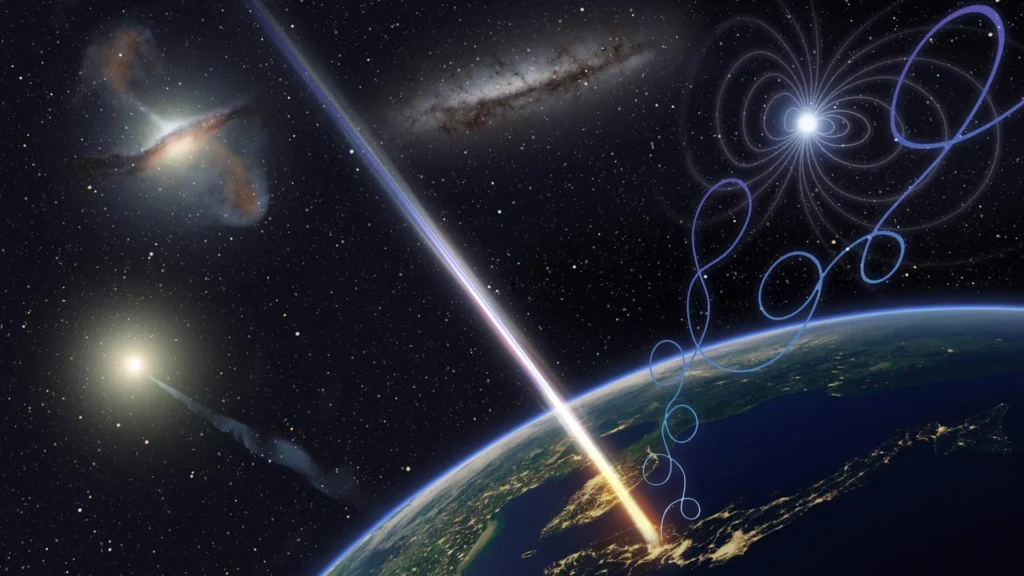
The discovery of the Amaterasu particle in 2021 sent shockwaves through the global astrophysical community, presenting a challenge to established models of particle acceleration and propagation. Detected by the Telescope Array experiment in the high deserts of Utah, this single subatomic particle carried an energy of approximately 244 exa-electron volts (EeV), a level of power so vast it rivals the most energetic cosmic ray ever recorded, the 1991 "Oh-My-God" particle. However, the Amaterasu particle presented a unique paradox: its trajectory suggested it originated from the Local Void, a desolate region of space devoid of any known galaxies or high-energy phenomena. New research led by scientists at Pennsylvania State University, recently published in the journal Physical Review Letters, suggests that the solution to this mystery may lie in the identity of the particle itself. The team proposes that these ultrahigh-energy cosmic rays (UHECRs) are not protons, as traditionally assumed, but ultraheavy atomic nuclei heavier than iron, which possess the unique physical properties required to survive vast intergalactic journeys.
The Detection of the Amaterasu Particle
In May 2021, the Telescope Array, an international collaboration involving research institutions from the United States, Japan, Korea, Russia, and Belgium, triggered a significant detection event. The array, which consists of 507 surface detector stations covering 700 square kilometers, captured a shower of secondary particles created when a single high-energy cosmic ray struck the Earth’s atmosphere. Following a rigorous analysis of the data, the team named the event the "Amaterasu particle," after the sun goddess in Japanese mythology, reflecting the particle’s extraordinary brilliance and power.
The Amaterasu particle’s energy of 244 EeV is nearly 10 million times greater than the maximum energy achievable by the Large Hadron Collider (LHC), the world’s most powerful human-made accelerator. To put this in perspective, a single subatomic particle possessed the kinetic energy of a professional tennis ball served at 100 miles per hour. Despite the precision of the Telescope Array, the particle’s point of origin remained a cipher. When researchers traced its path backward, they found no blazars, active galactic nuclei, or starburst galaxies. Instead, the path pointed directly toward a "cosmic void," a region largely empty of the matter required to fuel the universe’s most violent accelerators.
The Problem of the GZK Limit and Intergalactic Travel
The existence of particles like Amaterasu challenges the Greisen-Zatsepin-Kuzmin (GZK) limit, a theoretical upper bound on the energy of cosmic rays traveling long distances. According to the GZK limit, high-energy protons should interact with the cosmic microwave background (CMB)—the afterglow of the Big Bang—causing them to lose energy rapidly. This interaction suggests that any UHECR detected with energy above 60 EeV must originate from a relatively "local" source, within approximately 50 to 100 megaparsecs (roughly 160 to 320 million light-years).
The fact that the Amaterasu particle arrived from a void suggests two possibilities: either the magnetic fields of the universe deflected a proton so severely that its true origin is hidden, or the particle is not a proton at all. The Penn State research team, led by Kohta Murase, a professor of physics and of astronomy and astrophysics, focused on the latter possibility. Their study investigated whether heavier atomic nuclei—the dense cores of atoms containing numerous protons and neutrons—could better withstand the rigors of deep-space travel.
The Ultraheavy Nuclei Hypothesis
The central finding of the Penn State study is that ultraheavy nuclei, specifically those with a mass greater than iron (which has an atomic mass of 56), may lose energy more slowly than lighter particles at extreme energy scales. While lighter nuclei are easily broken apart by cosmic radiation through a process known as photodisintegration, ultraheavy nuclei exhibit a different energy-loss profile.
"Ultrahigh-energy cosmic rays can only be accelerated by some of the most powerful sources in the universe," explained Professor Murase. "When we detect individual cosmic-ray particles such as the Amaterasu particle here on Earth, we can often use their energies, arrival directions and expected magnetic deflections to infer their possible cosmic sources."
Through complex computer simulations, the team modeled the propagation of various nuclei through the intergalactic medium. They found that at energies exceeding 200 EeV, ultraheavy nuclei are more "durable" than protons or intermediate nuclei like helium or carbon. This durability allows them to travel further without losing their extreme kinetic energy. Furthermore, because these nuclei have a higher electric charge than protons, they are more susceptible to deflection by galactic and extragalactic magnetic fields. This high degree of deflection could explain why the Amaterasu particle appeared to come from a void; its actual source might be a powerful galaxy located in a completely different part of the sky, with the particle following a curved, "zigzag" path to Earth.
Identifying Cosmic Engines: From Neutron Stars to Black Holes
If ultraheavy nuclei are indeed the primary components of the highest-energy cosmic rays, it drastically narrows the list of potential "cosmic engines" capable of producing them. The energy required to accelerate a nucleus to 240 EeV is astronomical, requiring environments with immense magnetic fields and explosive shockwaves.
The research points toward three primary candidates for these accelerators:
- Binary Neutron Star Mergers: The collision of two neutron stars—incredibly dense remnants of massive stars—creates conditions ripe for the r-process (rapid neutron capture), which synthesizes heavy elements. These mergers, also known as kilonovae, are powerful emitters of gravitational waves and could potentially launch ultraheavy nuclei at relativistic speeds.
- Tidal Disruption Events (TDEs): When a star wanders too close to a supermassive black hole, it is shredded by gravitational forces. The resulting accretion disk and relativistic jets could serve as a natural particle accelerator.
- Magnetars and Collapsars: The death of a massive star resulting in a black hole or a highly magnetized neutron star (a magnetar) can produce gamma-ray bursts (GRBs). These are among the most energetic explosions in the universe and are capable of accelerating heavy nuclei to the EeV scale.
Professor Murase noted that the contribution from these sources could also help explain the observed differences between the northern and southern skies. The Pierre Auger Observatory in Argentina (Southern Hemisphere) and the Telescope Array in Utah (Northern Hemisphere) have reported slight variations in the energy spectrum and arrival directions of UHECRs. A significant presence of ultraheavy nuclei would account for these statistical anomalies.
Computational Modeling and Simulation Data
To validate their hypothesis, the researchers utilized the Yukawa Institute for Theoretical Physics’ computational resources to run state-of-the-art simulations. These simulations accounted for the expansion of the universe, the density of the cosmic microwave background, and the strength of intergalactic magnetic fields.
The data indicated that if the composition of UHECRs shifts toward heavier elements at the highest energies, the "cutoff" seen in the cosmic ray spectrum would be less abrupt than predicted by the GZK limit for protons. The team’s calculations set new constraints on the "source density" of these particles—essentially how many of these violent cosmic events must occur per cubic gigaparsec to account for the number of particles detected on Earth. Their results suggest that a rare but extremely powerful population of sources is more likely than a common population of weaker sources.
Future Observatories and the Path Forward
The Penn State study provides a theoretical framework that future experiments will attempt to verify. Currently, the Pierre Auger Observatory is undergoing a significant upgrade known as AugerPrime. This upgrade includes the installation of plastic scintillator detectors designed to better distinguish between different types of primary particles (protons vs. heavy nuclei) based on the structure of the resulting air showers.
Additionally, the proposed Global Cosmic Ray Observatory (GCOS) aims to create a next-generation facility with unprecedented sensitivity. By capturing a larger sample size of particles in the 100+ EeV range, scientists hope to create a "chemical map" of the high-energy sky.
"If ultraheavy nuclei contribute significantly at the highest energies, future data should indicate a composition heavier than iron," Murase stated. This would not only solve the Amaterasu mystery but also provide a new window into the most violent processes in the cosmos, linking particle physics to the birth of black holes and the collisions of stars.
Conclusion
The Amaterasu particle remains one of the most significant astrophysical detections of the 21st century. While its origin in a cosmic void initially suggested a breakdown in our understanding of physics, the Penn State research offers a compelling, data-driven explanation. By shifting the focus from simple protons to ultraheavy atomic nuclei, the study bridges the gap between the particle’s extreme energy and its mysterious arrival direction. As next-generation observatories come online, the scientific community moves closer to identifying the specific cosmic furnaces that forge these "sun goddess" particles, potentially revealing the ultimate limits of energy in our universe.
The research team included B. Theodore Zhang (Kyoto University), Mukul Bhattacharya (Penn State), and Nick Ekanger and Shunsaku Horiuchi (Virginia Tech). Their collaborative effort underscores the interdisciplinary nature of modern astrophysics, combining theoretical particle physics with advanced computational modeling and observational data.