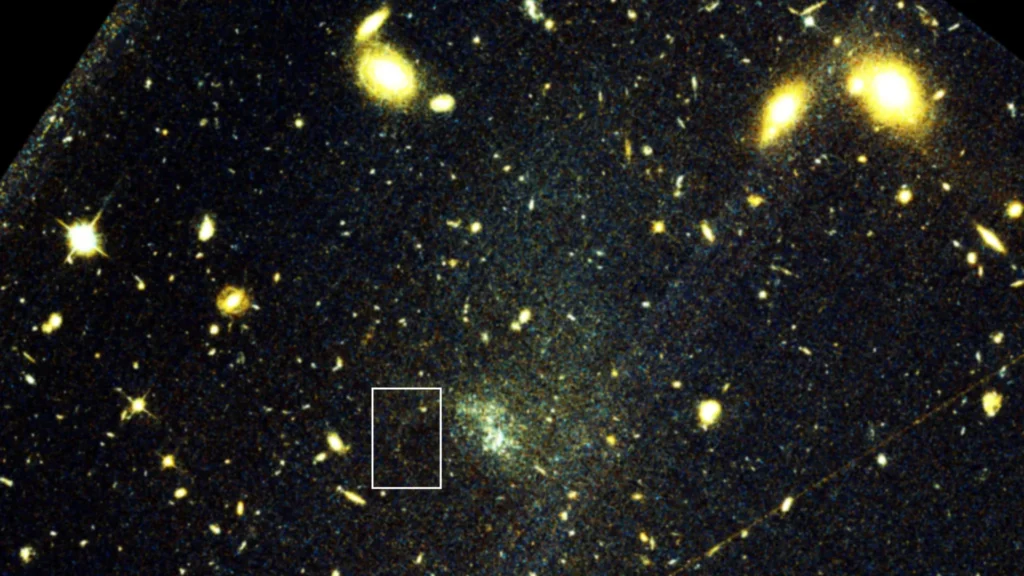
For billions of years, an ancient cluster of stars has been gradually coming apart, shedding stars that now form a faint, narrow ribbon across space. That delicate structure is offering astronomers a new way to investigate one of the universe’s biggest mysteries. An international research team, including an astrophysicist from Northwestern University, has identified the first stellar stream of this type ever observed outside the Milky Way. Astronomers have long predicted that such streams should exist around other galaxies, but their extreme faintness has made them difficult to detect.
The newly discovered stream also offers scientists an unusual tool for studying dark matter, which remains one of the major unanswered questions in astrophysics. By analyzing the stream’s shape, researchers reconstructed the gravitational field of its host galaxy and used that information to determine how unseen dark matter influenced the stars’ paths. The findings could eventually help scientists investigate how dark matter is distributed across many different galaxies and throughout the universe. The study was published Aug. 12 in the journal Nature.
"The stars in a stellar stream all travel along nearly the same orbit, and that orbit is shaped by the galaxy’s gravity," said Northwestern’s Tjitske Starkenburg, who coauthored the study. "By modeling that gravity, we can estimate the galaxy’s total mass. We already know roughly how much of that mass comes from visible matter like stars, so the rest must be dark matter."
Starkenburg, an expert in extragalactic astronomy, is a research assistant professor at Northwestern’s Center for Interdisciplinary Exploration and Research in Astrophysics. The study was co-led by Julie Kiel Holm of the University of Copenhagen and Sarah Pearson of the Technical University of Denmark.
The Genesis of Stellar Streams
Stellar streams are celestial remnants born from the slow disintegration of globular clusters, which are densely packed collections of stars bound together by gravity. As these ancient stellar cities orbit their host galaxies, the immense gravitational pull of the larger galaxy begins to exert its influence. Over eons, this tidal force can gradually tug stars away from the cluster’s core.
Crucially, these liberated stars do not disperse randomly. Instead, they tend to follow very similar orbital paths, mirroring the trajectory of their parent cluster. This collective movement creates elongated, filamentary structures that stretch across vast cosmic distances – the stellar streams. These streams act as cosmic archives, carrying imprinted information about the gravitational landscape they have traversed, including the presence and distribution of both visible and invisible matter within their host galaxy.
Astronomers have identified dozens of these stellar streams within our own Milky Way galaxy, providing invaluable insights into its formation history and the distribution of its mass. However, detecting similar structures in other galaxies has proven to be a formidable challenge. The inherent faintness of these streams, often diluted against the overwhelming brilliance of their host galaxies, has rendered them largely invisible to even the most powerful telescopes until now.
A Faint Whisper in the Cosmic Dark
The breakthrough observation occurred when astronomers David Sand and Catherine Fielder of the University of Arizona, while examining archival data from NASA’s Hubble Space Telescope, noticed an anomalous feature. Study coauthor David Hendel was scrutinizing images of an ultra-diffuse galaxy known as UGC 9050-Dw1. Amidst the faint starlight of this distant galaxy, he detected a subtle, narrow arc that bore a striking resemblance to a predicted stellar stream.
UGC 9050-Dw1, located approximately 115 million light-years from Earth, presented an unusually advantageous environment for this discovery. Its sparse stellar population meant that the background light was significantly dimmer than in more luminous galaxies, allowing the faint signature of the stellar stream to emerge from the cosmic noise. This unique confluence of a diffuse host galaxy and the detailed resolution of the Hubble Space Telescope paved the way for the first definitive detection of a globular cluster stellar stream beyond the Milky Way.
The initial identification of this faint arc marked a significant milestone. However, the true scientific potential of the discovery lay in its application to understanding one of the most profound enigmas in modern physics: dark matter.
Unlocking Dark Matter’s Secrets
The significance of this discovery extends far beyond the mere identification of a new celestial structure. Researchers have now demonstrated, for the first time, that a stellar stream originating from a globular cluster can serve as a potent tool for probing the distribution of dark matter in galaxies beyond our own.
Dark matter, an invisible and enigmatic substance, is estimated to constitute approximately 85% of the total matter content of the universe. Its existence is inferred solely through its gravitational influence on visible matter. It does not emit, absorb, or reflect light, rendering it undetectable by conventional astronomical instruments. This invisible scaffolding plays a crucial role in the formation and evolution of galaxies, dictating their structure and dynamics.
To harness the information encoded within the newly discovered stellar stream, the research team embarked on an intensive computational campaign. They conducted thousands of sophisticated simulations, meticulously testing various combinations of globular cluster properties and hypothetical dark matter distributions. The objective was to determine which simulated scenarios could accurately reproduce the observed shape and characteristics of the stellar stream around UGC 9050-Dw1.
Quantitative Insights from Gravitational Echoes
The simulations that most closely mirrored the observed stream provided crucial quantitative insights into the gravitational field of UGC 9050-Dw1. By modeling the gravitational forces at play, the researchers were able to estimate the galaxy’s total mass and, importantly, infer how this mass is distributed.
The results of these simulations indicated that UGC 9050-Dw1 harbors a substantial amount of dark matter. This finding aligns with existing theoretical expectations for ultra-diffuse galaxies, which are generally predicted to be embedded within significant dark matter halos.
"Our results are consistent with previous studies and what they have shown about dark matter in this ultra-diffuse galaxy," stated Julie Kiel Holm, one of the study’s co-leaders. "We are measuring it with a completely new tool for this type of galaxy, demonstrating that this method also works beyond our own galaxy." This validation underscores the power of stellar streams as a novel probe for dark matter studies in extragalactic environments.
The Promise of Stellar Streams as Dark Matter Detectors
The implications of this discovery are far-reaching. While the current analysis is focused on a single galaxy, it opens the door to a new era of astronomical investigation. The identification of this first extragalactic stellar stream suggests that similar structures may be present around a vast number of galaxies, waiting to be detected.
The meticulous study of these streams could revolutionize our understanding of dark matter’s distribution across the cosmos. Thin stellar streams, in particular, are hypothesized to be exceptionally sensitive to the gravitational perturbations caused by even small concentrations of dark matter. When a pocket of dark matter passes through a stellar stream, it can leave behind detectable signatures, such as gaps or localized clumps in the stellar distribution.
"Thin stellar streams can develop gaps or clumps when small concentrations of dark matter pass through them," explained Tjitske Starkenburg. "Astronomers have long debated whether we’ve seen this happen in streams within the Milky Way. If we can confirm that’s what’s causing these features, that will give us an entirely new way to test how dark matter is distributed — and ultimately learn more about its fundamental nature." The potential to directly observe the subtle interactions between dark matter and stellar streams offers an unprecedented opportunity to map the invisible architecture of galaxies.
A New Generation of Telescopes to Illuminate the Dark
The future of stellar stream detection appears exceptionally bright, thanks to the advent of next-generation astronomical observatories. These powerful new instruments are designed to survey much larger areas of the sky with unprecedented depth and resolution, significantly increasing the probability of discovering more of these elusive structures.
The European Space Agency’s Euclid mission and NASA’s Nancy Grace Roman Space Telescope are at the forefront of this revolution. These missions are specifically engineered to conduct wide-field surveys, enabling astronomers to scan vast cosmic territories and identify faint objects like stellar streams with far greater efficiency than was previously possible.
"It’s exciting that we discovered a thin stellar stream around a galaxy other than our own with already-existing Hubble Space Telescope data and confirmed it with ground-based telescope data," Starkenburg remarked. "That makes it very promising for the new telescopes becoming available, including the Roman Space Telescope, which can see an area 100-times larger than that of the Hubble." The increased survey capability of these upcoming telescopes is expected to lead to the discovery of numerous additional stellar streams, providing a statistically significant sample for detailed analysis. This will allow astronomers to move beyond single-galaxy studies and begin to discern broader patterns in dark matter distribution across diverse galactic environments.
The study, titled "Evidence for the First Globular Cluster Stellar Stream beyond the Milky Way," was made possible through the generous support of VILLUM FONDEN (award number VIL53081) and the European Union (BeyondSTREAMS award number 101115754). Tjitske Starkenburg also expressed gratitude for funding from the National Science Foundation (NSF) under grant number AST-2510183, and from NASA through grants 22-ROMAN22-0055 and 22-ROMAN22-0013. This collaborative international effort, spanning multiple institutions and funded by various agencies, highlights the global pursuit of understanding the universe’s deepest mysteries.