What began as an ambitious academic exercise within the hallowed halls of the Massachusetts Institute of Technology (MIT) has taken flight as a significant industrial venture. Electra, a pioneering aerospace company, is poised to reshape the landscape of regional air travel with its innovative hybrid aircraft, backed by an impressive $850 million investment dedicated to establishing large-scale manufacturing operations in Ohio. This burgeoning enterprise, rooted in a sophisticated blend of traditional aerodynamics and advanced electric propulsion, promises to bridge the gap between current ground transportation limitations and the speed of commercial aviation, particularly for journeys within the 50 to 250-mile range.
The genesis of Electra lies in a 2017 project within MIT’s Air Transportation Systems Architecting course (16.886). At a time when Vertical Takeoff and Landing (VTOL) electric aircraft were capturing significant attention, a group of graduate students, including Chris Courtin, who would become a central figure in Electra’s technological development, sought to explore alternative solutions. Their research led them to a compelling conclusion: while eVTOLs offered vertical capability, Short Takeoff and Landing (STOL) aircraft, enhanced with modern electric propulsion, presented a more efficient and practical pathway for many regional travel needs. This realization marked the inception of what is now termed an ultra-short takeoff and landing (USOTL) aircraft.
The Hybrid Advantage: Bridging Range and Accessibility
Electra’s flagship aircraft is meticulously designed to address the inherent inefficiencies and limitations of existing transportation modes. Unlike conventional airliners that require extensive and costly airport infrastructure, Electra’s fixed-wing design boasts a remarkable ability to operate from runways as short as 1,000 feet, and potentially even less under optimal conditions. This capability is achieved through a sophisticated hybrid-electric propulsion system.
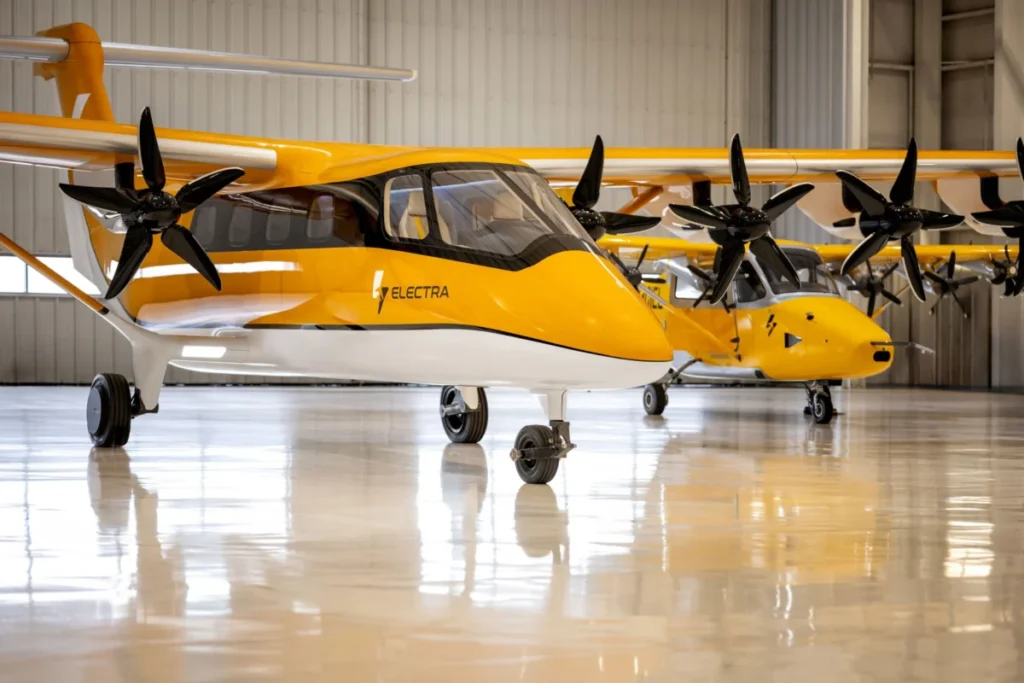
At its core, the aircraft features a highly efficient, smaller-than-average gas turbine engine. However, this engine’s primary role is not to directly power the propellers, but rather to act as an electrical generator. This electricity, along with power stored in onboard batteries, fuels multiple electric motors distributed along the wing. During takeoff and landing, when maximum power is crucial, the generator and batteries work in tandem, providing a significant boost to the propellers. This “blown lift” effect, where the propellers direct airflow over the wings, dramatically increases lift, enabling the aircraft to ascend and descend with minimal ground roll.
Once airborne and at cruising altitude, the aircraft transitions to a more efficient mode. The gas generator continues to supply power, but it can also be used to recharge the batteries, ensuring sustained range and operational flexibility. This hybrid approach allows engineers to optimize the generator for cruising efficiency, rather than being constrained by the high power demands of takeoff and landing, as is the case with conventional jet engines.
The result is an aircraft with a projected range of approximately 1,200 miles and a cruising speed of around 200 miles per hour. This combination offers a compelling alternative for travelers who currently face the inconvenience of long drives or the time-consuming process of reaching and navigating major airports for relatively short distances.
Chris Courtin, Director of Technology Development at Electra and a key figure from its MIT origins, elaborated on the strategic positioning of this technology. "Helping people travel between 50 and 250 miles is the sweet spot for this technology," Courtin stated. "This can be a better option than driving or commercial airlines for many kinds of trips. There’s a lot of people traveling in that range and a huge amount of friction in existing ground and air transport systems. This could be a big benefit to those people.”
A Legacy of Innovation: MIT’s Enduring Influence
The journey from a theoretical concept to a tangible manufacturing endeavor is deeply intertwined with the academic rigor and entrepreneurial spirit fostered at MIT. John Langford, a distinguished alumnus with a rich history in aerospace innovation, including founding Aurora Flight Sciences before its acquisition by Boeing, is credited with co-founding Electra. The company also benefits from the foundational technical guidance of MIT professors Mark Drela and John Hansman, both renowned experts in aerodynamics and aviation systems.
Courtin’s personal involvement exemplifies this deep MIT connection. His work on the hybrid plane concept spanned from his time as a graduate student and teaching assistant to its integration into his doctoral research. This sustained engagement allowed for the iterative development and validation of the core technologies.
"The company has really benefited from a strong collaboration with MIT," Courtin remarked. "One of the compelling things about MIT is it gives people space to marry the theoretical side with the practical side – to actually go build the airplane and see if people will buy it.”
This philosophy of integrating academic exploration with practical application was further evidenced through senior design classes co-taught by Drela and Hansman. During these courses, students collaborated to build and rigorously test subscale models of the aircraft. These tests were conducted in the prestigious Wright Brothers Wind Tunnel at MIT and involved actual flight trials, providing crucial empirical data to validate the design’s efficacy.
From Prototype to Production: The Ohio Expansion
Electra has already achieved a significant milestone by successfully building and flying a two-seated prototype of its aircraft, designated the EL2. This demonstrator aircraft has completed over 200 flights since its first test flights in 2023, validating the functionality and performance of its hybrid-electric propulsion system. The successful flight testing of the EL2 has paved the way for scaling up production to a nine-passenger variant.
The recent $850 million investment signals a monumental leap forward for Electra. This capital infusion is earmarked for the construction of a state-of-the-art manufacturing facility in Springfield and Clark County, Ohio. The facility is expected to span 96 acres and, in its initial phase, will be capable of producing 400 of the nine-seat aircraft annually. Subsequent expansion plans aim to increase this capacity to approximately 800 aircraft per year.
This strategic decision to establish manufacturing in Ohio is particularly resonant. Ohio holds a unique place in aviation history as the birthplace of powered human flight. By choosing to build the next chapter of aviation in the Buckeye State, Electra is tapping into a rich legacy and a skilled workforce. The investment is projected to create a substantial 1,975 new jobs, injecting significant economic vitality into the region.
The Broader Implications: Transforming Regional Mobility
The implications of Electra’s technology extend far beyond mere incremental improvements in air travel. The aircraft’s ability to utilize significantly shorter runways opens up possibilities for accessing a much wider array of locations. This could include smaller regional airports, repurposed industrial sites, or even areas where traditional infrastructure is lacking. The potential to bypass congested major hubs and land closer to final destinations could drastically reduce overall travel time and complexity.
Furthermore, the reduced noise footprint compared to conventional aircraft is a critical factor. The distributed nature of the eight electric motors, each spinning at a relatively lower speed than a large turbofan, contributes to a quieter operation. This characteristic is vital for gaining community acceptance and expanding operational flexibility, particularly in urban or environmentally sensitive areas where noise pollution is a significant concern.
"The large number of propellers means you can make them much quieter than if you only had one or two," Courtin explained. "That’s important because helicopters are restricted from operating in places they otherwise could because of the noise.”
A Vision for Accessible Aviation
Beyond passenger transport, Electra is actively exploring other applications for its versatile aircraft. These include military logistics, where rapid deployment and access to austere environments are paramount, as well as cargo transport and humanitarian missions, where the ability to deliver supplies to remote or disaster-stricken areas is critical.
The company’s long-term vision centers on making this advanced form of air travel accessible to a broad segment of the population. By maintaining the inherent simplicity of a fixed-wing design and scaling production effectively, Electra aims to drive down the per-seat cost of travel.
"If we can keep the fixed-wing design simplicity and make this large enough, then the per-seat cost could get to a range where a lot of people would have access to this," Courtin stated. "It wouldn’t just be a luxury product, so it could help a lot of people.”
The success of Electra’s ambitious undertaking could herald a new era of regional air mobility, one characterized by greater convenience, reduced environmental impact, and enhanced accessibility, all stemming from an idea that first took root as a class project at MIT. As the company gears up for full-scale production in Ohio, the aviation industry will be closely watching to see if this innovative hybrid design can truly deliver on its promise to revolutionize how people connect and traverse distances.