The study of the fundamental building blocks of the universe has taken a significant leap forward as a research team led by physicists from Fudan University has successfully mapped the internal acceleration of quark-gluon plasma (QGP). This exotic state of matter, which existed only for a few microseconds after the Big Bang, is created today in high-energy particle accelerators. While previous research has focused heavily on the plasma’s temperature and its "vorticity"—the intense swirling motion within the fluid—this new investigation highlights acceleration as a critical, yet previously overlooked, factor in the evolution of the primordial fireball. Led by Professor Yu-Gang Ma and Professor Xu-Guang Huang, the team’s findings suggest that acceleration may serve as a fundamental control parameter in the phase structure of matter governed by the strong nuclear force.
The Nature of the Primordial Fireball
To understand the significance of this research, one must first look at the conditions of the early universe. Approximately 13.8 billion years ago, the universe was an unimaginably hot and dense soup of subatomic particles. In this environment, temperatures were so high that protons and neutrons could not exist. Instead, their constituents—quarks and gluons—moved freely in a state known as quark-gluon plasma. As the universe expanded and cooled, these particles became "confined" into the hadrons that make up the world we see today.
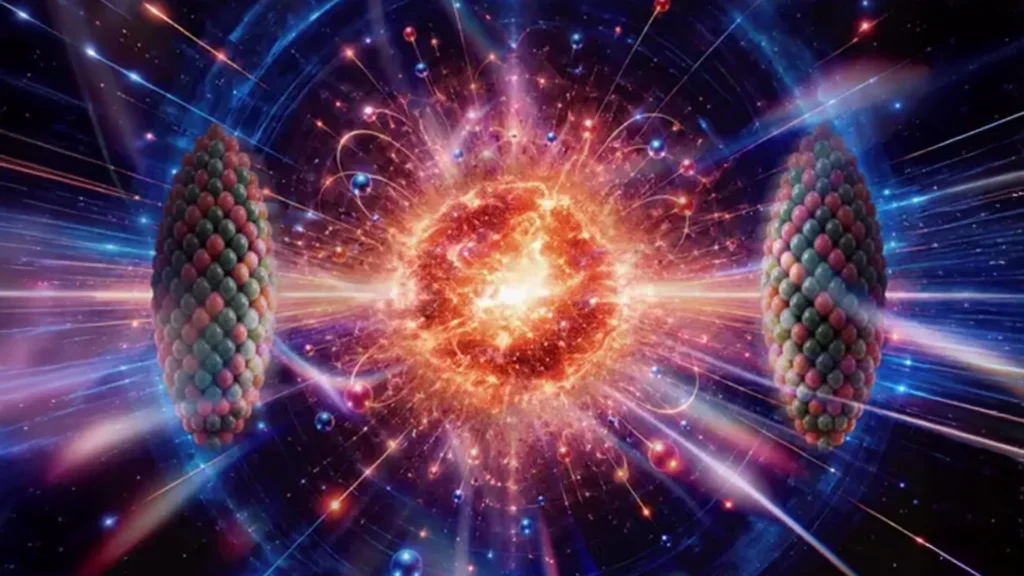
For decades, physicists have sought to recreate these conditions using heavy-ion colliders, such as the Relativistic Heavy Ion Collider (RHIC) at Brookhaven National Laboratory and the Large Hadron Collider (LHC) at CERN. When gold or lead nuclei are smashed together at nearly the speed of light, they melt into a tiny, short-lived droplet of QGP. This droplet behaves not like a gas, but like a "nearly perfect fluid" with extremely low viscosity. While scientists have successfully measured the temperature and flow patterns of this fluid, the specific role of acceleration in its rapid expansion has remained largely a theoretical mystery until now.
Methodology: Bridging Particle Transport and Fluid Dynamics
The Fudan University team utilized a sophisticated computational approach to bridge the gap between individual particle collisions and large-scale fluid behavior. They integrated two primary particle transport models: A Multi-Phase Transport (AMPT) and Ultra-relativistic Quantum Molecular Dynamics (UrQMD). These models simulate the trajectories and interactions of thousands of particles produced in a single collision.
To extract fluid-like properties from these simulations, the researchers employed a "Gaussian smearing" method. This technique allows for the conversion of discrete particle data—such as position and momentum—into continuous fields of energy density, momentum, and velocity. By treating the collection of particles as a continuous medium, the team could apply the principles of relativistic hydrodynamics to calculate the acceleration fields within the plasma.
The study covered a vast range of collision energies, from the lower-energy regimes of 3.5 GeV (giga-electron volts) used in fixed-target experiments to the ultra-high energies of 2.76 TeV (tera-electron volts) found at the LHC. This comprehensive range allowed the researchers to observe how acceleration patterns evolve as the intensity of the collision increases.
Key Findings: The Edge of Acceleration
The simulations revealed that the most intense acceleration occurs at the very boundaries of the expanding fireball. The peak "proper acceleration"—the acceleration experienced by a particle in its own instantaneous rest frame—was found to reach several hundred MeV (mega-electron volts). In the context of subatomic physics, this is an extraordinary value, indicating forces that dwarf those found in any other natural environment.
This concentration of acceleration at the edge is driven by the sharp gradients in the plasma’s physical properties. According to the relativistic Euler equation, acceleration is determined by the relationship between pressure gradients and enthalpy density. At the outer boundary of the QGP droplet, the internal pressure drops precipitously toward the vacuum of the surrounding space, while the energy density remains relatively low. These two factors work in tandem to create "acceleration hotspots" that propel the plasma outward at relativistic speeds.
The researchers also noted a distinct difference in behavior based on collision energy. At lower energies (3.5 GeV to 19.6 GeV), the incoming nuclei exhibit "nuclear stopping," where they dump a significant portion of their kinetic energy into the collision zone, leading to an initial deceleration of up to 500 MeV. Conversely, at ultrarelativistic energies (2.76 TeV), the nuclei are so energetic that they pass through one another almost instantaneously, creating a vacuum-like "string" between them that snaps and produces a brief, high-intensity pulse of acceleration.
The Unruh Effect and the Acceleration Axis
One of the most provocative aspects of the Fudan study is the link between acceleration and thermodynamics. Professor Xu-Guang Huang points out that through the Unruh effect—a prediction of quantum field theory—an accelerating observer perceives a vacuum as being filled with a thermal bath of particles. In essence, extreme acceleration can mimic the effects of high temperature.
The team calculated that an acceleration of several hundred MeV corresponds to a "thermal temperature" that is remarkably close to the transition temperature of Quantum Chromodynamics (QCD)—the point at which quarks become confined into protons and neutrons. This implies that acceleration is not just a byproduct of the plasma’s expansion, but a potential driver of its phase changes.
"Acceleration is not merely a kinematic detail," Professor Huang explained. "It may act as a thermodynamic control parameter of QCD matter." This leads to the hypothesis of a new "acceleration axis" in the QCD phase diagram. Traditionally, this diagram maps the states of matter based on temperature and baryon density. Adding acceleration as a third dimension could provide a more complete map of how matter transitions from a plasma to a hadronic state, potentially influencing both chiral symmetry breaking and quark confinement.
Chronology of Quark-Gluon Plasma Research
To appreciate the context of this discovery, it is helpful to view the timeline of QGP research:
- 1970s-1980s: Theoretical foundations of QCD are established, leading to the prediction that quarks and gluons could be "deconfined" at extreme temperatures.
- 2000: CERN announces the first indirect evidence of QGP formation at the Super Proton Synchrotron (SPS).
- 2005: Researchers at RHIC announce that QGP behaves like a "perfect liquid" rather than the expected gas, revolutionizing the field of high-energy nuclear physics.
- 2010-Present: The LHC begins heavy-ion runs, allowing for the study of QGP at much higher temperatures and for longer durations.
- 2017: Scientists observe "vorticity" in QGP, finding it to be the most "swirling" fluid ever discovered.
- 2024: The Fudan University team maps the acceleration field, providing the final missing piece of the fluid dynamic puzzle.
Broader Implications and Experimental Signatures
The identification of acceleration as a fundamental force within the QGP has significant implications for how physicists interpret data from collider experiments. One of the most persistent mysteries in the field is the "global polarization" of particles. When quarks and gluons freeze out into hadrons (like Lambda hyperons), their spins tend to align in a specific direction. While vorticity explains much of this alignment, it does not account for all observed patterns.
The Fudan team suggests that acceleration may be the missing link. Just as a rotating fluid can polarize the spins of its constituent particles, a highly accelerating fluid can induce similar quantum effects. By including acceleration in their models, researchers may finally be able to resolve the discrepancies between theoretical predictions and experimental measurements of spin polarization at RHIC and the LHC.
Furthermore, this research opens a new window into "non-inertial quantum effects." Most of our understanding of particle physics is based on inertial frames of reference. By studying matter under extreme acceleration, scientists can probe the limits of the Standard Model and explore how the vacuum itself responds to violent changes in motion.
Future Outlook: From Simulation to Measurement
The next phase for Professor Ma and Professor Huang involves refining their models to include more realistic 3D hydrodynamic evolution. While the current study used transport models to derive acceleration, the researchers hope to transition to full-scale hydrodynamic simulations that can more accurately track the "freeze-out" stage—the moment when the plasma turns back into ordinary matter.
The ultimate goal is to identify "experimental signatures"—specific patterns in the data that could only be caused by acceleration. If these signatures can be detected in the billions of particle collisions recorded at CERN and Brookhaven, it would confirm that acceleration is indeed a fundamental "hidden dimension" of the quark-gluon plasma.
"Just as temperature and density define the phase diagram of matter, acceleration may open a new axis of that diagram," stated Professor Huang. "By mapping this hidden dimension, we hope to turn non-inertial quantum effects into signatures that experiments can actually measure, providing a deeper understanding of the forces that shaped our universe in its first moments."
As the scientific community continues to digest these findings, the Fudan University study stands as a testament to the complexity of the "perfect fluid." By elevating acceleration to the same level of importance as temperature and rotation, physicists are moving closer to a unified description of the most extreme matter in existence.