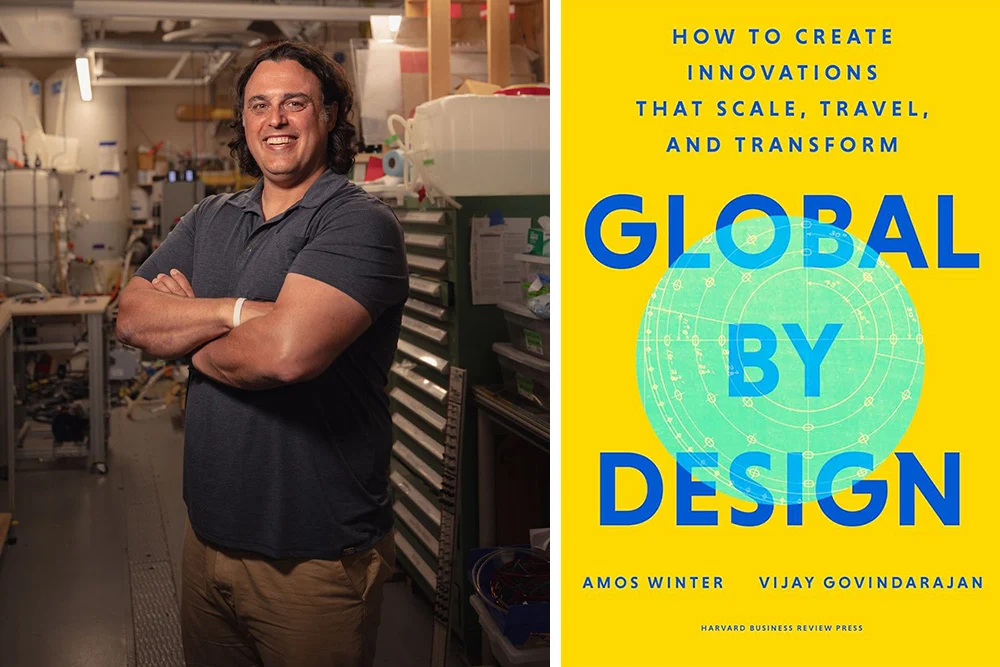
A groundbreaking new book by MIT’s Germeshausen Professor of Mechanical Engineering, Amos Winter, and renowned strategy and innovation expert Vijay Govindarajan, introduces a vital framework for developing innovations capable of thriving across diverse global landscapes. Titled "Global by Design: How to Create Innovations That Scale, Travel, and Transform" (Harvard Business Review Press), the publication posits that true global success hinges on a targeted and thoughtful design process, moving beyond the traditional approach of adapting existing products from affluent markets. The authors contend that the rapidly expanding emerging markets represent the primary frontier for sustained corporate growth, necessitating a paradigm shift in how companies conceive and implement innovation.
The Imperative for Global Innovation: Tapping into Emerging Markets
The core premise of "Global by Design" is rooted in a compelling economic reality: emerging markets are currently experiencing growth rates approximately double those of developed economies like the United States and Europe. As Professor Winter articulates, "If you’re a multinational company that really wants to maximize your growth rate, it’s not going to be in wealthy markets, it has to be in emerging markets." This observation underscores a critical strategic pivot for global enterprises. While established markets offer stability, their mature consumer bases and saturation points often limit exponential expansion. Conversely, economies in Asia, Africa, and Latin America, characterized by burgeoning middle classes, rapid urbanization, and significant infrastructural development, present vast untapped potential.
This dynamic is particularly salient for legacy companies accustomed to success in high-income regions. The traditional model of simply transplanting products designed for Western consumers into these new markets often falters. As Winter explains, such solutions are typically "too expensive [or not meet consumer needs]," failing to account for differing income levels, infrastructural constraints, cultural nuances, and unique local requirements. The book offers a much-needed guide on how to leverage existing knowledge and technological capabilities without resorting to a simplistic "copy and paste" strategy, thereby enabling companies to innovate authentically for these crucial markets.
Beyond Copy-Paste: The Pitfalls of Unadapted Solutions
The history of international business is replete with examples of products that flourished in one market but failed to resonate in another. This failure often stems from a fundamental misunderstanding of the target market’s specific context. In many emerging economies, consumers operate within different purchasing power parity, face distinct environmental challenges, possess varying levels of technological literacy, and have unique cultural preferences. A high-tech medical device designed for a state-of-the-art hospital in New York, for instance, might be prohibitively expensive, require unavailable infrastructure, or be too complex for a rural clinic in India. Similarly, consumer goods like refrigerators or automobiles, while ubiquitous in developed nations, need significant re-engineering to be affordable, energy-efficient, and maintainable in regions with unreliable power grids or limited access to spare parts and service networks.
The "Global by Design" framework directly addresses these challenges by advocating for a process that begins with a deep understanding of the problem space in emerging markets. It encourages innovators to "look at those problems with fresh eyes," rather than viewing them through the lens of solutions already prevalent in wealthy countries. This approach leads to the identification of "unique requirements that must be satisfied," which frequently diverge from those in more affluent settings. The goal is not merely to create low-cost alternatives, but to develop genuinely "high-value solutions" that deliver superior performance, durability, and user experience tailored to the specific constraints and opportunities of the local environment.
Unveiling "Global by Design": A Framework for Scalable Innovation
The book, published by Harvard Business Review Press, delineates a three-phase process designed to shepherd innovators through the entire lifecycle of global product development. This methodical approach guides readers from the initial identification of market opportunities to the meticulous design of viable solutions, culminating in the successful scaling of these innovations both locally and internationally. Winter and Govindarajan move beyond abstract theoretical concepts, offering a practical and disciplined methodology for discerning critical problems, effectively harnessing innovation, and constructing solutions that are simultaneously high in value and low in cost, thereby possessing inherent global appeal.
The first phase emphasizes opportunity identification, urging innovators to immerse themselves in the realities of emerging markets. This involves ethnographic research, understanding unarticulated needs, and recognizing systemic inefficiencies. The second phase, solution design, focuses on translating these insights into tangible product or service specifications. Here, the emphasis is on frugal engineering, modularity, and designing for resilience and maintainability in challenging conditions. The third phase addresses scaling, providing strategies for navigating distribution, pricing, and market acceptance across diverse geographies, ensuring the innovation can achieve widespread adoption and impact.
Solving Unsolved Problems: A Focus on Basic Needs
One of the most profound applications of the "Global by Design" philosophy lies in addressing long-standing, critical problems in the developing world. These include fundamental human needs such as access to clean water, adequate healthcare, and reliable energy. While solutions to these issues exist in wealthy countries, they have often failed to translate effectively to low-resource settings. Professor Winter highlights that these established solutions are frequently "too expensive or they’re not robust enough," leading to the tragic persistence of these problems for generations.
This framework directly aligns with global initiatives like the United Nations Sustainable Development Goals (SDGs), particularly those related to poverty, hunger, health, water, and energy. By focusing on creating high-value, low-cost innovations tailored to these contexts, "Global by Design" offers a pathway to accelerate progress towards these crucial objectives. For instance, innovations in water purification that require minimal energy and maintenance can dramatically reduce waterborne diseases. Similarly, affordable, robust diagnostic tools can revolutionize healthcare access in remote areas, and decentralized renewable energy solutions can empower communities without access to national grids.
Beyond emerging markets, the principles of "Global by Design" offer broader applicability. Solutions initially conceived for resource-constrained environments can often find resonance with more budget-conscious consumers in developed markets. Furthermore, these "globally minded solutions" can paradoxically create "upsell opportunities for wealthy consumers" who might appreciate the simplicity, robustness, or environmental benefits of such innovations. The book also provides guidance on strategic product differentiation to prevent cannibalization of existing product lines, ensuring that new global offerings complement rather than compete destructively with established market segments.
Case Study in Action: The Revolutionary Drip Irrigation Emitter
To illustrate their framework, Winter and Govindarajan incorporate five detailed case studies derived from Winter’s research group, alongside various industry examples. One particularly compelling case study involves a drip irrigation emitter technology developed at MIT, which is on the cusp of commercial production and poised to revolutionize agricultural practices worldwide. This innovation epitomizes the "Global by Design" philosophy, demonstrating how a solution engineered for efficiency and affordability can achieve superior performance across all market tiers.
Professor Winter elaborates on the remarkable capabilities of this technology: "We created new drip irrigation emitter technology that cuts pumping power in half, reduces the price of solar-powered irrigation by about 40 percent, requires less than half the plastic to make, and is an industry leader in clog prevention." Each of these attributes addresses critical pain points in agriculture globally. Reducing pumping power significantly lowers operational costs, a boon for farmers in both developing and developed nations. The substantial reduction in the price of solar-powered irrigation is transformative for regions lacking reliable electricity or seeking sustainable energy alternatives, accelerating the adoption of water-saving techniques. The diminished plastic requirement speaks to environmental sustainability, reducing the ecological footprint of agricultural practices. Finally, superior clog prevention addresses one of the most persistent maintenance challenges in drip irrigation, enhancing system reliability and longevity.
The technology’s robustness and efficiency make it a truly global product. It will enable the expansion of water-saving, renewable-powered irrigation systems in low-resource, water-stressed markets, where efficient water use is not merely an economic advantage but a necessity for survival and food security. Simultaneously, it offers a highly valuable alternative to farmers in wealthy countries who are increasingly grappling with rising energy costs, water scarcity, and environmental regulations. This dual appeal exemplifies the book’s core tenet: designing solutions that are inherently superior and universally applicable, rather than merely adapted.
The commercialization of this innovative drip emitter technology is already underway through a partnership with Toro, a global leader in irrigation and landscaping products. The product is anticipated to hit the market in early 2027, marking a significant milestone in bringing academic research to real-world application. As Winter proudly states, "It is truly a global product that is a better mousetrap, as it meets or exceeds the performance of any other product on the market in every category." The underlying research that informed the development of this drip emitter technology has been rigorously peer-reviewed and published in prestigious scientific journals, Nature Communications and Water, lending further credibility to its innovative claims.
The Authors: Pioneers in Engineering and Strategy
The collaborative expertise behind "Global by Design" is a formidable combination of engineering prowess and strategic acumen. Amos Winter, the Germeshausen Professor of Mechanical Engineering at MIT, is a recognized pioneer in engineering design, particularly for his work on solutions for developing countries. His directorship of the K. Lisa Yang Global Engineering and Research (GEAR) Center at MIT underscores his commitment to tackling complex technical challenges in low-resource communities. The GEAR Center’s portfolio of successful projects includes innovations in water purification, agricultural equipment, and assistive technology, demonstrating a consistent track record of developing impactful, scalable solutions. Winter’s hands-on experience in the field, coupled with rigorous academic research, provides the empirical foundation for the book’s practical framework.
Vijay Govindarajan, his co-author, is an equally prominent figure in the realms of strategy and innovation. A distinguished professor and author, Govindarajan is widely known for his influential work on "reverse innovation" – the idea that innovations developed in emerging markets can successfully flow back to developed markets – and the "three-box solution" framework for managing current business while simultaneously innovating for the future. His strategic insights complement Winter’s engineering expertise, creating a holistic perspective on how to design, implement, and scale innovations within complex global business environments. The synergy between their respective disciplines provides a robust and comprehensive approach to the multifaceted challenges of global innovation.
Broader Implications and Future Outlook
The implications of the "Global by Design" framework extend far beyond corporate growth strategies. On an economic level, fostering innovation specifically for emerging markets can stimulate local economies, create jobs, and build indigenous technological capabilities. This approach supports sustainable economic development, reducing reliance on imported solutions that may not be culturally or economically appropriate.
Socially, the book’s emphasis on solving fundamental problems in areas like water, healthcare, and energy has the potential to dramatically improve the quality of life for millions. By making essential services and technologies more accessible and affordable, these innovations can contribute to poverty reduction, improved public health, and enhanced educational opportunities. The drip irrigation emitter, for example, directly contributes to food security and sustainable agricultural practices, empowering farmers and strengthening local food systems.
Environmentally, the drive for high-value, low-cost solutions often aligns with principles of sustainability. Innovations that use fewer resources (like the plastic reduction in the drip emitter), consume less energy, or are designed for durability and repairability inherently contribute to a more circular and environmentally conscious economy. This approach can lead to significant reductions in carbon footprint and resource depletion globally.
For multinational corporations, "Global by Design" offers a roadmap to navigate the complexities of global markets, moving beyond a one-size-fits-all approach. It encourages a shift from mere localization (adapting existing products) to genuine co-creation and design thinking that originates from the needs of diverse markets. For startups and entrepreneurs, the book provides a powerful methodology to identify unmet needs and build scalable ventures with both financial viability and significant social impact.
Professor Winter expresses a profound hope that "Global by Design" will broaden the horizons of design thinking and equip innovators with the necessary toolsets to tackle meaningful, multifaceted global problems. He envisions a future where innovators are inspired to create solutions that are not only financially viable but also generate tangible positive social impact. Ultimately, the book seeks to empower its readers, demonstrating "how they can apply their unique experience, perspectives, knowledge, and resources to make meaningful change in the world." In an increasingly interconnected yet disparate world, "Global by Design" offers a timely and essential guide for building a more equitable and prosperous future through thoughtful, strategic innovation.