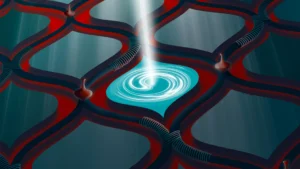
The field of quantum many-body physics has reached a significant milestone as researchers at Heidelberg University’s Institute for Theoretical Physics successfully bridged a decades-old divide between two competing descriptions of quantum behavior. By developing a unified theoretical framework, the team has provided a singular explanation for how an impurity—an external particle such as an atom or electron—interacts with a surrounding "sea" of fermions. This breakthrough resolves a long-standing tension between the model of the "Fermi polaron," where impurities move harmoniously with their environment, and "Anderson’s orthogonality catastrophe," where heavy impurities disrupt the system so fundamentally that coordinated motion becomes impossible.
The research, led by Professor Dr. Richard Schmidt and doctoral candidate Eugen Dizer, represents a shift in how physicists conceptualize the transition between mobile and immobile states in quantum environments. Published recently in the prestigious journal Physical Review Letters, the findings offer a comprehensive toolset for scientists working with ultracold atomic gases, novel semiconductors, and the next generation of quantum materials.
The Dual Nature of Quantum Impurities
To understand the magnitude of this unification, one must first look at the two paradigms that have dominated the study of quantum impurities for more than half a century. At the heart of the matter is the "Fermi sea," a concept derived from the Pauli exclusion principle, which states that no two fermions—particles such as electrons, protons, or neutrons—can occupy the exact same quantum state simultaneously. This creates a dense, high-energy "sea" of particles that dictates the behavior of matter at the atomic and subatomic levels.
The first paradigm is the quasiparticle model, specifically the Fermi polaron. In this scenario, an impurity is introduced into the Fermi sea. As the impurity moves, it interacts with the surrounding fermions, attracting or repelling them. These surrounding particles begin to move in concert with the impurity, effectively "dressing" it in a cloud of excitations. The resulting entity—the impurity plus its cloud—behaves like a single, free particle with a modified mass and energy. This "quasiparticle" has been the bedrock of solid-state physics, explaining how electrons move through crystal lattices in metals and semiconductors.
The second, opposing paradigm is Anderson’s orthogonality catastrophe, first proposed by Nobel laureate Philip W. Anderson in 1967. This theory describes what happens when the impurity is extremely heavy or essentially fixed in space. Instead of a quasiparticle emerging, the impurity acts as a massive disturbance. The surrounding fermions rearrange themselves so drastically that the final quantum state of the system becomes "orthogonal" (mathematically perpendicular) to its original state. In this "catastrophic" shift, the overlap between the old and new wave functions drops to zero, and the quasiparticle description completely breaks down.
Bridging the Theoretical Chasm
For years, these two descriptions existed as separate islands of thought. Physicists could use one to describe light, mobile impurities and the other to describe heavy, stationary ones, but there was no mathematical bridge to explain the transition between the two. The Heidelberg team sought to find the missing link: how does a polaron turn into a catastrophe?
Using advanced analytical techniques and many-body wave function calculations, Dizer and Schmidt discovered that the secret lies in the infinitesimal movements of even the heaviest impurities. In previous models, heavy impurities were often treated as perfectly static objects. However, the Heidelberg researchers found that as the surrounding Fermi sea adjusts to the presence of an impurity, the impurity itself undergoes "tiny motions" or residual fluctuations.
"The theoretical framework we developed explains how quasiparticles emerge in systems with an extremely heavy impurity, connecting two paradigms that have long been treated separately," explained Eugen Dizer. These subtle movements create an energy gap in the system’s spectrum. This gap is the crucial element that allows a quasiparticle to survive even in environments that would otherwise be dominated by Anderson’s orthogonality catastrophe. By accounting for these fluctuations, the researchers were able to show that the polaron and the catastrophe are actually two ends of the same theoretical spectrum.
Chronology of Quantum Impurity Research
The journey to this unified theory spans nearly a century of physical inquiry. The foundation was laid in the 1930s and 40s by Lev Landau and Solomon Pekar, who first introduced the concept of the polaron to describe electrons moving through ionic crystals.
By the late 1960s, the field expanded as Philip Anderson identified the "orthogonality catastrophe" in the context of X-ray spectroscopy in metals, highlighting the limits of the quasiparticle view. Throughout the 1990s and 2000s, the rise of ultracold atom experiments allowed physicists to simulate these systems with unprecedented precision, leading to the experimental observation of Fermi polarons in 2009.
Despite these experimental successes, the mathematical reconciliation of the two theories remained elusive until the current decade. The Heidelberg team’s work, conducted under the auspices of the ISOQUANT Collaborative Research Centre and the STRUCTURES Cluster of Excellence, marks the culmination of this historical trajectory, providing the final piece of the puzzle that links mobile quasiparticles to stationary disturbances.
Technical Analysis: Implications for Material Science
The implications of this unified theory extend far beyond pure mathematics. In the realm of material science, understanding how impurities behave is essential for the development of high-efficiency electronics.
- Semiconductors and 2D Materials: In modern semiconductors and two-dimensional materials like graphene or transition metal dichalcogenides (TMDs), excitons (electron-hole pairs) often act as impurities within a sea of electrons. The Heidelberg framework allows researchers to predict how these excitons will behave as they transition between "polaronic" states and "molecular" states, where the impurity binds more tightly to the surrounding particles.
- Ultracold Atomic Gases: These gases serve as "quantum simulators," allowing scientists to mimic the behavior of solid-state materials in a controlled vacuum. The new theory provides a roadmap for these experiments, telling researchers exactly what to look for when they tune the interaction strength between atoms using Feshbach resonances.
- Superconductivity: The interaction between impurities and fermions is a key component in the formation of Cooper pairs, the basis of superconductivity. A more precise understanding of the many-body background could lead to insights into high-temperature superconductivity, which remains one of the "holy grails" of modern physics.
Official Responses and Collaborative Effort
The success of this research is a testament to the collaborative environment at Heidelberg University. The project was supported by the STRUCTURES Cluster of Excellence, which focuses on the emergence of structure in diverse natural systems, and the ISOQUANT Collaborative Research Centre (CRC 1225), which explores isolated quantum systems and their evolution toward equilibrium.
Professor Dr. Richard Schmidt, who leads the Quantum Matter Theory working group, emphasized the versatility of their findings. "Our research not only advances the theoretical understanding of quantum impurities but is also directly relevant for ongoing experiments across different spatial dimensions and a wide variety of interactions," Schmidt stated.
Colleagues in the global physics community have noted that the Heidelberg framework is particularly timely. As quantum computing efforts move from theoretical models to physical hardware, understanding how "noise" (impurities) interacts with the "qubits" (the quantum system) is vital. The ability to describe these interactions within a single, unified framework reduces the computational complexity of simulating quantum hardware.
Looking Ahead: The Future of Many-Body Physics
The unification of the polaron and the orthogonality catastrophe opens new doors for exploring "strongly correlated" systems—environments where particles are so interconnected that they cannot be described individually. These systems are notoriously difficult to calculate, often requiring the world’s most powerful supercomputers.
By providing an analytical shortcut that connects two major states of matter, Dizer and Schmidt have given the scientific community a more efficient way to probe the limits of quantum mechanics. Future experiments are expected to test the limits of this new framework, particularly in the study of "non-equilibrium" systems, where the impurity is suddenly injected or moved through the Fermi sea at high speeds.
Furthermore, the research highlights the importance of "tiny motions" in the quantum world. It serves as a reminder that in the subatomic realm, nothing is ever truly still. Even the heaviest, most seemingly immobile particles possess a residual kinetic energy that can fundamentally change the nature of the reality surrounding them.
As the findings move from the pages of Physical Review Letters into laboratories worldwide, the Heidelberg theory is set to become a foundational text for the next generation of quantum physicists. It marks the end of a long-standing debate and the beginning of a more cohesive era in the study of the quantum many-body problem.