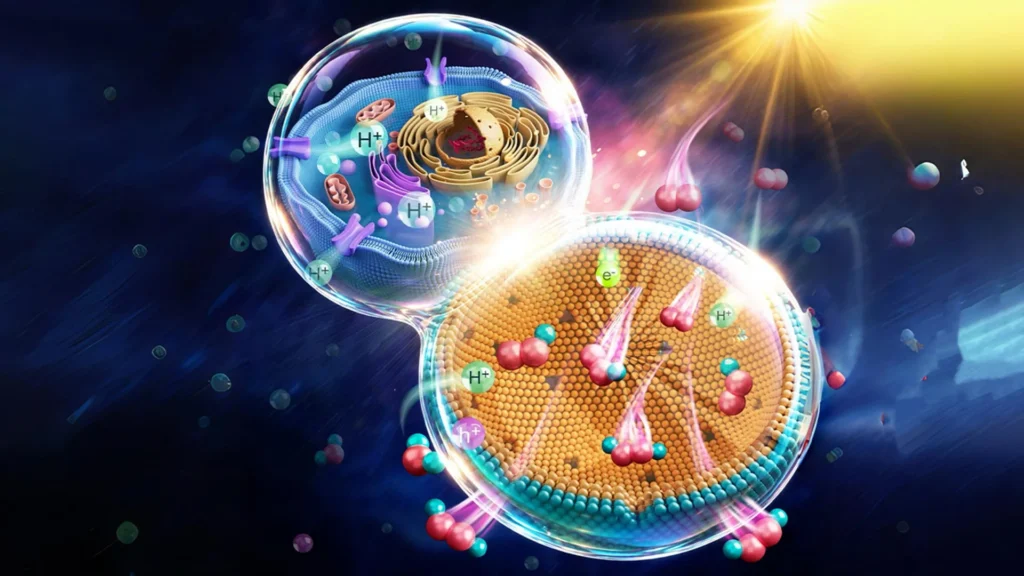
Researchers have created a hollow CdS@polydopamine nanoreactor that imitates two important features of living cells, offering a new way to reproduce some of the highly organized chemical functions of cells inside synthetic nanomaterials. This pioneering work, detailed in the Journal of the American Chemical Society, was spearheaded by Professor LI Can at the Dalian Institute of Chemical Physics (DICP) of the Chinese Academy of Sciences (CAS), in a significant collaboration with Professor Jian Liu’s team at Inner Mongolia University. The breakthrough marks a substantial stride in the burgeoning field of nanocell engineering, pushing the boundaries of artificial photosynthesis and sustainable chemical synthesis.
The Quest for Cellular Mimicry: Why It Matters
Living cells stand as nature’s unparalleled masters of chemical engineering. Within their microscopic confines, they orchestrate a dazzling array of biochemical reactions with extraordinary efficiency, selectivity, and precision. This remarkable capability stems from their intricate internal architecture, which features specialized compartments, precisely positioned enzymes, and dynamic molecular transport systems. These elements work in concert to create highly localized reaction environments, where reactants are channeled, intermediates are processed, and products are efficiently harvested, all under exquisitely controlled conditions.
For decades, scientists have been captivated by the prospect of replicating these cellular principles in synthetic systems. The goal is not merely to copy nature, but to harness its design wisdom to create new materials and devices capable of performing complex chemical transformations with similar levels of sophistication and efficiency. This ambition has given rise to "nanocell engineering," an interdisciplinary field that seeks to design and construct synthetic structures—often termed "nanoreactors"—that mimic the structural and functional attributes of biological cells. Such engineered systems typically feature specialized surfaces, internal pores, or hollow cavities designed to control molecular movement, concentrate reactants, and facilitate catalytic reactions in a highly organized manner. The potential applications span from advanced catalysis and energy conversion to targeted drug delivery and environmental remediation.
Bridging Biology and Nanotechnology: The CdS@Polydopamine Nanoreactor
The core of this new research lies in the development of a novel nanoreactor, specifically a hollow CdS@polydopamine (PDA) structure. Cadmium sulfide (CdS) is a well-known semiconductor photocatalyst, valued for its ability to absorb visible light and generate electron-hole pairs, which are crucial for initiating chemical reactions. Polydopamine, on the other hand, is a synthetic polymer inspired by the adhesive proteins found in mussels. PDA is highly versatile, biocompatible, and possesses inherent redox activity, making it an excellent candidate for surface modification and integration into complex nanostructures. The clever combination of these two materials in a hollow, core-shell architecture is central to the nanoreactor’s biomimetic capabilities. The hollow interior provides a confined reaction space, while the porous PDA shell acts as an intelligent interface, orchestrating molecular interactions and facilitating catalytic processes.
Unpacking Biomimicry: The Proton Relay Mechanism
One of the two primary biomimetic elements integrated into this nanoreactor is a dynamic catechol/o-benzoquinone redox pair embedded within the polydopamine shell. In biological systems, proton pumps are essential for establishing electrochemical gradients across membranes, driving processes like ATP synthesis. However, in this synthetic construct, the catechol/o-benzoquinone pair operates not as an active pump, but as a sophisticated "proton relay."
A proton relay system is critical for accelerating proton-coupled electron transfer (PCET) reactions. PCET is a fundamental process in chemistry and biology where the movement of a proton and an electron are tightly coupled, often occurring in a concerted fashion. Many vital reactions, including photosynthesis, respiration, and enzymatic catalysis, rely on efficient PCET. In the CdS@PDA nanoreactor, the catechol groups within the PDA shell can repeatedly accept and release protons. This dynamic shuttling of protons dramatically lowers the activation energy for electron transfer events, effectively speeding up the overall PCET process. By acting as a transient proton carrier, the polydopamine shell facilitates the smooth and rapid movement of both protons and electrons across the nanoreactor’s interface, mimicking the intricate proton transfer pathways observed in enzyme active sites or cellular membranes, albeit through a different chemical mechanism. This innovative design bypasses the energy-intensive active pumping mechanisms found in cells, opting instead for a passive, yet highly effective, relay system that significantly boosts reaction kinetics.
Compartmentalization: Nature’s Design Principle Reimagined
The second crucial biomimetic feature is the nanoreactor’s meticulously designed compartmentalized structure. Just as organelles within a cell create distinct microenvironments for specific reactions, the hollow CdS@polydopamine nanoreactor features a nanoscale hollow cavity enveloped by a porous shell. This architectural arrangement serves multiple critical functions.
Firstly, the confined hollow cavity acts as a "nanoreactor chamber" where reactants can accumulate at higher local concentrations. This is analogous to how enzymes in cells bring substrates together in their active sites, increasing the effective collision frequency and thus the reaction rate. By creating a spatially restricted environment, the nanoreactor enhances the probability of productive molecular encounters, overcoming the limitations of dilute solutions.
Secondly, the porous shell plays a vital role in controlling molecular diffusion. It selectively allows certain molecules to enter and exit the cavity while retaining others, much like a semi-permeable cell membrane. This regulated diffusion ensures that reactants are delivered efficiently to the active sites within the cavity and that products are released, preventing product inhibition and maintaining optimal reaction conditions.
Thirdly, this unique architecture significantly aids in light harvesting. For light-driven reactions, efficient absorption and utilization of photons are paramount. The hollow structure and the material properties of CdS and PDA are optimized to trap incoming visible light within the nanoreactor, ensuring that a greater proportion of the incident photons are absorbed and utilized to initiate the photocatalytic process. This enhanced light capture directly translates into higher catalytic efficiency, a feature often observed in complex biological light-harvesting complexes.
Towards Sustainable Hydrogen Peroxide Production
The synergistic interplay of these two cell-inspired features—the dynamic proton relay and the compartmentalized architecture—is particularly effective in enhancing the production of hydrogen peroxide (H2O2) through artificial photosynthesis. Hydrogen peroxide is a critical industrial chemical, widely used as a bleaching agent, disinfectant, and oxidant in various sectors, including paper and pulp, textiles, water treatment, and chemical synthesis. Globally, the demand for H2O2 is substantial and growing, with market estimates valuing it in the tens of billions of dollars annually.
Current industrial production methods for H2O2 predominantly rely on the anthraquinone oxidation process. This process is energy-intensive, requires harsh organic solvents, and generates significant waste, posing considerable environmental challenges. The pursuit of sustainable alternatives, particularly those that can directly synthesize H2O2 from readily available resources like water and oxygen using sunlight as the sole energy input, has become a major focus of green chemistry research. This "photosynthesis" of H2O2 offers a cleaner, more environmentally friendly pathway, reducing reliance on fossil fuels and minimizing chemical waste.
The challenge in H2O2 photosynthesis from water and oxygen lies in balancing the kinetics of two half-reactions: the two-electron oxygen reduction reaction (ORR) to H2O2 and the water oxidation reaction (WOR) to supply electrons and protons. Achieving efficient and selective H2O2 production requires a catalyst that can precisely control these reaction pathways, preventing the full reduction of oxygen to water (a four-electron process) and ensuring that the electrons and protons are directed specifically towards H2O2 formation. The biomimetic nanoreactor developed by Prof. Li’s team addresses this delicate balance by providing an optimized environment for these complex electron and proton transfer steps.
Breakthrough Performance: Quantifying the Efficiency
Under visible-light illumination in an aqueous solution, the newly engineered nanoreactor demonstrated remarkable performance in H2O2 photosynthesis. It achieved a hydrogen peroxide photosynthesis rate of 3.24 mmol gcat.-1 h-1. To put this in context, many photocatalytic systems struggle to reach comparable rates, especially under ambient conditions and using only visible light. This rate signifies a highly active and efficient catalyst. Furthermore, the system attained a solar-to-chemical conversion efficiency of 1.2%. While this figure might seem modest compared to the solar-to-electrical efficiencies of photovoltaic cells (which can exceed 20%), it represents a significant achievement for solar-driven chemical synthesis. For complex multi-electron reactions like H2O2 production from water and oxygen, achieving even 1% efficiency is considered a substantial step forward, given the inherent thermodynamic and kinetic hurdles. Typical benchmarks for overall solar-to-chemical conversion in artificial photosynthesis for fuels or valuable chemicals are often in the sub-percent range, making 1.2% competitive and promising for future development.
The Science Behind the Success: Multidisciplinary Approach
To fully comprehend the intricate mechanisms underlying the nanoreactor’s exceptional performance, the research team employed a sophisticated arsenal of analytical techniques. This multidisciplinary approach combined in situ spectroscopy, photochemical analysis, finite element simulations, and theoretical calculations. In situ spectroscopy, for instance, allowed the researchers to observe the chemical species and their transformations directly as the reaction unfolded, providing real-time insights into the proton relay and electron transfer processes. Photochemical analysis quantified the light absorption, charge separation, and electron utilization efficiencies. Finite element simulations were crucial for modeling the diffusion of reactants and products within the confined nanoreactor structure and understanding the light distribution within the material. Finally, theoretical calculations, such as density functional theory (DFT), provided atomic-level insights into the electronic structure of the CdS and polydopamine components, elucidating the energy landscapes for proton and electron transfer and clarifying the Z-scheme heterojunction-based photocatalytic mechanism.
The Z-scheme mechanism, inspired by natural photosynthesis, is particularly important here. It involves the coupling of two different semiconductor photocatalysts (or active sites) with staggered energy levels, allowing for efficient charge separation and enhanced redox capabilities. In this nanoreactor, the CdS likely acts as one component, and the polydopamine shell, with its redox-active catechol/o-benzoquinone pairs, contributes to the overall Z-scheme charge transfer pathway, facilitating the desired two-electron oxygen reduction and water oxidation reactions for H2O2 production.
Practicality and Sustainability: A Recyclable System
Beyond its impressive catalytic activity, the researchers also prioritized the practical applicability and environmental benignity of their system. They successfully embedded the CdS@polydopamine nanoreactors into an environmentally friendly sodium alginate hydrogel matrix. Sodium alginate is a natural polysaccharide derived from brown seaweed, known for its biocompatibility, biodegradability, and ability to form stable hydrogels.
This immobilization strategy yielded solid, recyclable photocatalysts that exhibited continuous H2O2 synthesis under natural sunlight. The hydrogel matrix not only provided structural stability to the nanoreactors, preventing aggregation and leaching, but also facilitated their easy separation from the reaction mixture after use. This recyclability is a critical factor for industrial scalability and cost-effectiveness, as it reduces material waste and operational expenses. The sustained performance under natural sunlight further underscores the system’s potential for real-world applications, offering a pathway to decentralized, on-demand H2O2 production using only renewable energy.
Expert Perspectives and Collaborative Spirit
Professor Li Can, a distinguished figure in catalysis and energy research, emphasized the profound implications of their work: "Our study provides a new strategy for engineering biomimetic nanoreactors that increasingly replicate the sophisticated functions of living cells, opening new opportunities in artificial photosynthesis, energy catalysis, and synthetic chemistry." His statement highlights the foundational nature of this research, suggesting that the design principles established here could be broadly applicable across various chemical processes.
Professor Jian Liu, whose team at Inner Mongolia University was instrumental in the collaboration, likely contributed significant expertise in material synthesis and characterization, particularly concerning the intricate design of the polydopamine shell and the overall nanostructure. While not directly quoted, the collaboration underscores the interdisciplinary nature of modern scientific breakthroughs, where combining diverse specializations leads to more comprehensive and impactful results. An independent expert in sustainable chemistry, Dr. Anya Sharma from the Global Institute for Green Technologies, who was not involved in the study, commented, "This work represents a compelling advancement in biomimetic materials. The integration of a proton relay and compartmentalization in a single nanostructure is incredibly elegant and demonstrates a deep understanding of cellular processes. The practical achievement of recyclable hydrogen peroxide synthesis under sunlight is particularly exciting for industrial adoption, paving the way for a truly green chemical economy."
The Broader Horizon: Implications for Energy, Environment, and Industry
The development of this biomimetic nanoreactor carries far-reaching implications across multiple sectors:
- Artificial Photosynthesis: This research significantly advances the field of artificial photosynthesis, offering a new blueprint for designing highly efficient and selective catalysts for solar fuel production and chemical synthesis. The principles of proton relay and compartmentalization can be applied to other challenging reactions, such as CO2 reduction or nitrogen fixation, where precise control over multi-electron and multi-proton transfers is crucial.
- Energy Catalysis: The ability to convert sunlight directly into valuable chemicals like H2O2 opens new avenues for sustainable energy storage and utilization. Hydrogen peroxide itself can be used as a fuel in certain applications or as a precursor for other energy carriers. The technology could decentralize H2O2 production, making it accessible in remote areas or for smaller-scale industrial needs, reducing transportation costs and environmental impact.
- Green Chemistry and Environment: By replacing the energy-intensive and waste-generating anthraquinone process, this solar-driven method offers a truly green alternative for H2O2 synthesis. This aligns with global efforts to transition towards sustainable chemical manufacturing, reducing greenhouse gas emissions and hazardous waste. Furthermore, efficient H2O2 production could benefit water treatment applications, where it is used as an oxidant to remove pollutants.
- Synthetic Biology and Nanomedicine: The insights gained from engineering synthetic systems that mimic cellular functions could inspire new designs in synthetic biology, leading to the creation of artificial cells with tailored capabilities. In nanomedicine, similar compartmentalized nanoreactors could be developed for targeted drug delivery, controlled release of therapeutic agents, or in situ synthesis of drugs within the body, leveraging the precision and efficiency observed in biological systems.
- Industrial Applications: The demonstrated recyclability and stability of the hydrogel-embedded nanoreactors are key for potential industrial scale-up. Future work will likely focus on optimizing the catalyst loading, reactor design, and long-term stability under continuous operation to translate this laboratory success into viable industrial processes.
Concluding Remarks
The creation of the hollow CdS@polydopamine nanoreactor represents a seminal achievement at the intersection of materials science, catalysis, and biomimicry. By cleverly integrating two fundamental cellular features—a dynamic proton relay and a compartmentalized reaction environment—researchers have engineered a synthetic system capable of performing complex chemical transformations with unprecedented efficiency under visible light. This breakthrough not only provides a cleaner, more sustainable pathway for producing a vital industrial chemical like hydrogen peroxide but also lays a robust foundation for the next generation of artificial photosynthetic systems and advanced catalysts, moving us closer to a future powered by sustainable chemistry and renewable energy. The collaborative spirit and meticulous scientific inquiry behind this work underscore the exciting potential for interdisciplinary research to solve some of humanity’s most pressing challenges.