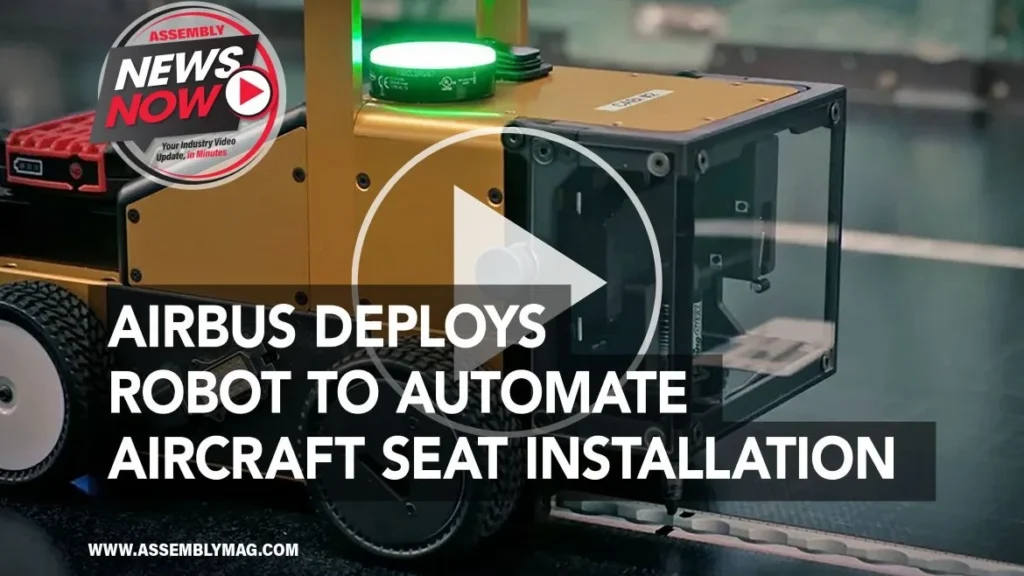
The introduction of Airbus’s new CabinMarker robot marks a significant advancement in aerospace manufacturing, specifically targeting the highly intricate and labor-intensive process of outfitting aircraft cabins. This innovative 4-kilogram robotic system autonomously navigates the unfinished interior of aircraft, precisely marking the designated locations where passenger seats will eventually be bolted. As reported by Chief Editor John Sprovieri in Episode 33 of ASSEMBLY News Now, this groundbreaking technology dramatically reduces a task that traditionally consumed 150 minutes of manual labor to a mere 30 minutes, simultaneously enhancing accuracy and improving ergonomic conditions for human operators. This development underscores a broader industry trend towards leveraging advanced robotics and digital integration to streamline complex production cycles, boost efficiency, and ensure unparalleled precision in high-stakes environments like aerospace.
The Imperative for Automation in Aerospace Manufacturing
The global aerospace industry is currently experiencing unprecedented demand, with major manufacturers like Airbus holding substantial order backlogs that stretch for years, even decades. Meeting this demand necessitates continuous innovation in production methodologies, focusing on accelerating assembly lines without compromising the stringent safety and quality standards inherent to aircraft construction. Traditional aircraft assembly, particularly the intricate process of cabin outfitting, has historically been characterized by manual labor, requiring highly skilled technicians to perform repetitive yet critical tasks. These tasks, while essential, can be time-consuming, prone to human error, and physically demanding, leading to ergonomic challenges for workers over prolonged periods.
The marking of passenger seat bolt locations is a prime example of such a task. Each aircraft cabin contains hundreds, if not thousands, of specific points that must be precisely identified and marked before seats can be installed. This process involves meticulous measurements, template application, and manual marking, all of which contribute to the overall production time and carry the potential for minute inaccuracies that could necessitate costly rework down the line. In an industry where every minute of production time translates into significant financial implications and every fraction of a millimeter in precision is critical for safety and passenger comfort, the need for a more efficient and accurate solution became increasingly evident.

CabinMarker: A Leap in Precision Robotics
The CabinMarker robot represents a sophisticated integration of lightweight robotics, advanced navigation systems, and direct digital manufacturing principles. Weighing only 4 kilograms, its compact design is crucial for operating within the often-confined and complex spaces of an unfinished aircraft fuselage. This lightweight nature also implies a level of inherent safety, potentially allowing for closer collaboration with human workers in a shared workspace, a hallmark of modern collaborative robotics (cobots).
At the heart of the CabinMarker’s precision lies its direct programming from aircraft Computer-Aided Design (CAD) files. This seamless digital integration means that the robot receives exact coordinates and specifications directly from the aircraft’s master digital model. This eliminates the need for manual interpretation of blueprints, physical templates, or human measurement, which are all potential sources of variability and error. By directly translating digital design data into physical action, the robot ensures that each mark is placed with sub-millimeter accuracy, adhering strictly to the engineering specifications.
The autonomous travel capability of the CabinMarker is another critical feature. Equipped with advanced sensors, potentially including LiDAR, cameras, and ultrasonic detectors, the robot can navigate the complex interior of the aircraft cabin without human intervention. This navigation system allows it to map its environment, avoid obstacles, and consistently follow its pre-programmed path to each marking location. Upon reaching a designated point, the robot likely employs a high-precision marking mechanism, such as a laser projector or an automated ink dispenser, to accurately delineate the bolt positions. The result is a consistent, repeatable, and highly accurate marking process across the entire cabin.
The statistical improvement is stark: a task previously requiring 150 minutes of human effort is now completed in just 30 minutes by the CabinMarker. This 80% reduction in time per aircraft translates into substantial time savings across an entire production line, significantly contributing to faster aircraft delivery schedules. Beyond speed, the inherent accuracy of a robot programmed directly from CAD files drastically reduces the potential for rework, which can be incredibly costly and disruptive in aerospace manufacturing.

Ergonomics and Worker Empowerment
One of the often-overlooked benefits of automation is its positive impact on worker well-being. Manual marking tasks within an aircraft cabin can be physically demanding, requiring workers to assume awkward postures, kneel, bend, and reach into tight spaces for extended periods. These repetitive motions and strenuous positions contribute to musculoskeletal strain and fatigue, potentially leading to injuries and reduced productivity over time.
By automating the marking process, the CabinMarker robot liberates human workers from these physically demanding and repetitive tasks. This allows them to be redeployed to more complex, value-added roles that require human judgment, problem-solving, and intricate manual dexterity that robots cannot yet replicate. The improvement in ergonomics means a safer and more comfortable working environment, reducing the risk of work-related injuries and enhancing overall job satisfaction. This shift aligns with the principles of Industry 4.0, where technology is seen not merely as a replacement for human labor but as an enhancer, enabling a more productive and humane industrial ecosystem.
A Chronology of Automation in Aerospace
The aerospace industry has a long history of embracing automation, driven by the need for precision, speed, and safety. Early forms of automation focused on heavy lifting and basic repetitive tasks, evolving significantly over the decades.
- 1970s-1980s: Early industrial robots began to appear in manufacturing, primarily in welding and painting, but their application in aerospace was limited due to the large, complex structures and tight tolerances.
- 1990s-2000s: Increased adoption of automated drilling and riveting systems, particularly for large fuselage sections and wing components. Computer Numerical Control (CNC) machining became standard for manufacturing complex parts with high precision.
- 2010s: The rise of collaborative robots (cobots) and advanced vision systems allowed for more flexible and human-friendly automation. Airbus, Boeing, and other major players began exploring robotics for more intricate assembly tasks, including component placement, inspection, and even flexible tooling. The concept of a "digital twin" – a virtual replica of a physical product or process – gained traction, allowing for simulation and optimization before physical production.
- Mid-2010s onward: Focus shifted towards integrating artificial intelligence (AI) and machine learning (ML) into robotics for adaptive manufacturing, predictive maintenance, and further enhancing precision and autonomy. Lightweight robots, like the CabinMarker, represent the latest iteration of this evolution, addressing tasks previously considered too delicate or complex for robotic intervention within a confined, human-centric workspace. The development of specialized robots for specific tasks, such as automated guided vehicles (AGVs) for material transport and mobile robots for inspection, became more prevalent.
The CabinMarker’s debut fits squarely into this evolving timeline, showcasing how specialized, lightweight, and digitally integrated robotics are becoming indispensable tools for tackling the remaining manual bottlenecks in advanced manufacturing. Its development is likely the culmination of several years of research and development within Airbus’s manufacturing innovation centers, potentially piloted on specific aircraft programs like the A320 family or A350, where high production rates amplify the benefits of efficiency gains.

Broader Implications and Industry Reactions
The introduction of the CabinMarker robot by Airbus is likely to send ripples throughout the aerospace manufacturing sector, prompting competitors and suppliers to evaluate their own automation strategies.
Airbus’s Strategic Vision: For Airbus, this initiative aligns with its broader strategy of enhancing manufacturing efficiency, reducing lead times, and improving profitability. By automating such a critical and time-consuming task, Airbus not only boosts its production capacity but also reinforces its reputation as an innovator in advanced manufacturing. A hypothetical statement from an Airbus manufacturing executive might emphasize the company’s commitment to "leveraging cutting-edge technology to deliver superior aircraft faster, more reliably, and with improved working conditions for our valued employees." This move is also a testament to the company’s investment in Industry 4.0 principles, where smart factories, interconnected systems, and data-driven decision-making are paramount.
Worker and Union Perspectives: While automation often raises concerns about job displacement, the specific application of the CabinMarker highlights a different narrative. By automating a repetitive and ergonomically challenging task, Airbus is not eliminating jobs but rather evolving them. Workers previously assigned to manual marking can be upskilled to roles involving robot supervision, maintenance, programming, or other complex assembly tasks that still require human ingenuity. Union representatives might view such automation positively, provided there are clear programs for retraining and redeployment, focusing on the enhanced safety and reduced physical strain for their members.
Industry Analysts and Competitors: Aerospace industry analysts would likely highlight the CabinMarker as a benchmark for what is achievable with lightweight, precision robotics in complex assembly. They might project similar automation trends across various stages of aircraft production, from fuselage assembly to final outfitting. Competitors, such as Boeing, would undoubtedly be scrutinizing this development, assessing its impact on Airbus’s competitive advantage and potentially accelerating their own research and development into similar robotic solutions. The move could also spur innovation among robotics manufacturers and software developers, encouraging them to create more specialized and adaptable solutions for the aerospace sector.
Economic Impact: The economic benefits extend beyond just Airbus. Faster assembly times mean quicker delivery of aircraft to airlines, which in turn can begin generating revenue sooner. The reduction in rework costs and the improvement in quality contribute to the overall economic health of the aerospace supply chain. Furthermore, the investment in such high-tech solutions stimulates growth in the robotics and automation industries, creating new jobs in design, manufacturing, and maintenance of these advanced systems.
The Future of Aerospace Assembly
The CabinMarker robot is not an isolated innovation but rather a piece of a much larger puzzle in the evolution of aerospace manufacturing. The future likely holds:
- Increased Autonomy and Intelligence: Robots will become even more autonomous, capable of adapting to unforeseen circumstances, learning from their environments, and performing a wider range of complex tasks with minimal human oversight. AI and machine learning will play a crucial role in enabling this.
- Modular and Flexible Production Lines: The ability of robots to quickly reconfigure for different tasks and aircraft models will lead to more flexible and adaptable production lines, capable of responding rapidly to market demands.
- Human-Robot Collaboration (HRC): The line between human and robotic work will continue to blur, with cobots working seamlessly alongside humans, augmenting their capabilities and ensuring safety.
- Digital Twins and Predictive Maintenance: The pervasive use of digital twins will allow for real-time monitoring of production processes, predictive maintenance of robotic systems, and continuous optimization of manufacturing workflows.
- Advanced Material Handling: Robots will increasingly take over the handling of large, awkward, or delicate aircraft components, improving safety and efficiency throughout the supply chain.
- Data-Driven Quality Control: Integrated vision systems and sensor networks will enable real-time, in-line quality inspection, identifying defects immediately and preventing them from propagating further down the assembly line.
In conclusion, Airbus’s CabinMarker robot is a compelling illustration of how targeted, intelligent automation can revolutionize specific, high-value tasks in complex manufacturing environments. By dramatically cutting down assembly time, boosting accuracy, and enhancing worker ergonomics, this 4-kilogram marvel exemplifies the transformative power of robotics in achieving operational excellence. As the aerospace industry continues to push the boundaries of innovation, such advancements will be critical in meeting global demand, maintaining competitive edge, and shaping the future of aircraft production. The successful deployment of the CabinMarker serves as a powerful testament to the ongoing digital transformation within manufacturing, where precision, efficiency, and human well-being converge to create a smarter, more productive industrial landscape.