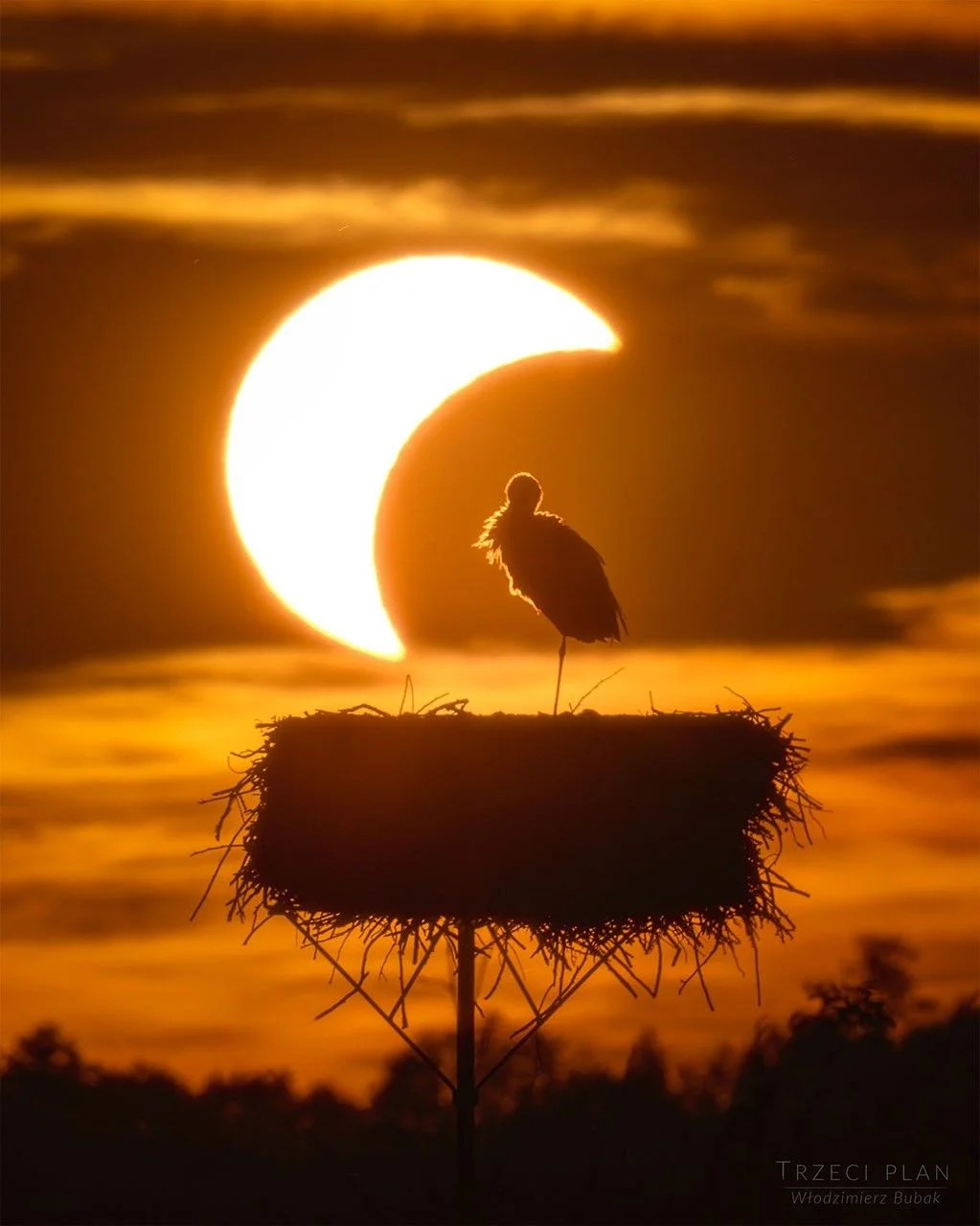
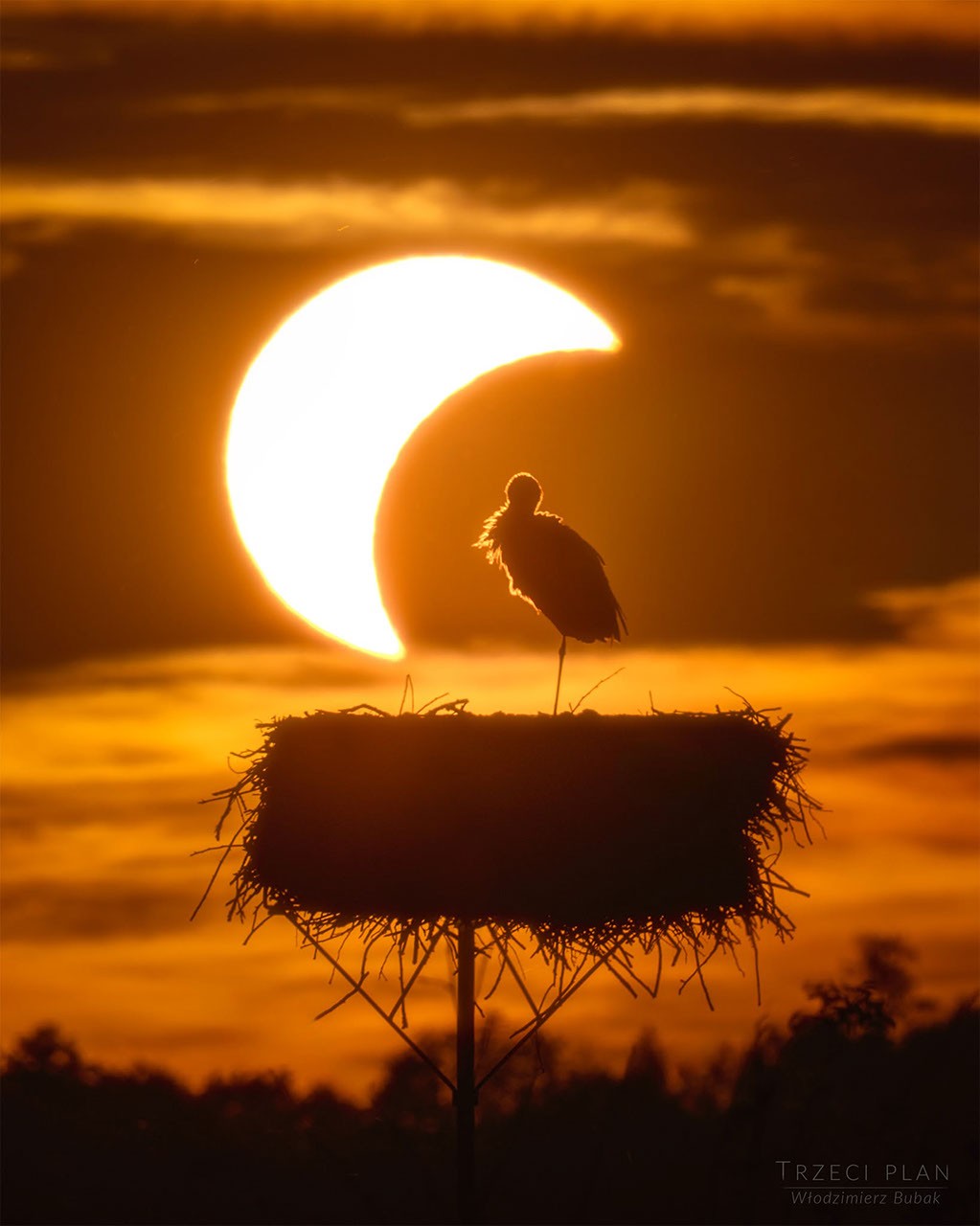
The captivating spectacle of a total solar eclipse, a celestial ballet of cosmic proportions, has provided a unique and poignant backdrop for observing the natural world. Captured in a stunning photograph, a stork stands silhouetted against the dramatic twilight hues of a solar eclipse, its solitary stance on one leg in its nest offering a singular perspective on how wildlife reacts to this profound astronomical event. This image, featured as the Astronomy Picture of the Day (APOD) on September 3, 2026, by NASA, serves as a powerful reminder of the interconnectedness of our planet’s ecosystems and the grander universe we inhabit.
The Celestial Event and its Terrestrial Echoes
The total solar eclipse, a phenomenon where the Moon completely obscures the Sun from Earth’s view, is a rare and awe-inspiring occurrence. During totality, the sky darkens dramatically, and the Sun’s ethereal corona, its outer atmosphere, becomes visible. This abrupt shift in light and ambient conditions can trigger noticeable changes in animal behavior. As documented in the featured photograph taken in Poland by Włodzimierz Bubak, the natural world responds to these celestial phenomena in ways that reveal a deep, instinctual connection to the rhythms of the cosmos.
The image specifically highlights the behavior of a stork, a large wading bird known for its nesting habits. The stork’s poised posture, standing on one leg, is a common resting or vigilance behavior for many bird species. However, its framing against the backdrop of a solar eclipse imbues this natural pose with extraordinary significance. It suggests a moment of stillness and observation, a silent acknowledgment of the unusual atmospheric conditions.
Observing Nature’s Response to Totality
Professional astronomers and naturalists have long been fascinated by how animals react to total solar eclipses. The experience, though brief, can be transformative for those who witness it in quiet, natural settings. As the Moon gradually covers the Sun, the ambient light dims, mimicking the onset of dusk. This change can confuse diurnal creatures, prompting them to revert to behaviors typically associated with nighttime.
Timeline of Behavioral Changes during an Eclipse:
- Partial Phase: As the Moon begins to obscure the Sun, subtle changes may begin. Some animals might show mild curiosity or unease.
- Approaching Totality: The darkening sky becomes more pronounced. Birds may start to seek roosting spots, and their vocalizations may diminish. Insects like crickets might begin their evening chirping.
- Totality: The most dramatic period. The sky becomes dark enough for stars and planets to become visible. Nocturnal animals might emerge. Diurnal birds typically fall silent, and some may even attempt to roost, tucking their heads. Waterfowl might settle on the water, preparing for sleep. Fireflies, if present, may become active.
- End of Totality: As sunlight returns, diurnal animals begin to reawaken. Birds that fell silent might resume their activity, and songbirds may even greet the reappearance of the sun with dawn songs. Nocturnal creatures retreat.
The featured photograph captures a stork during a partial phase of the eclipse, suggesting it is either before the peak of totality or during its receding phase. Even in this partial state, the darkening sky appears to have prompted the stork to adopt its resting posture.
Scientific Insights and Previous Observations
The scientific community has dedicated efforts to document and understand these eclipse-induced animal behaviors. Studies and anecdotal reports from previous eclipses, such as the Great American Eclipse of 2017, have provided valuable data. During that event, observers noted that many diurnal birds became quiet, and some species were observed attempting to roost. Ducks and other waterfowl were seen settling on the water, exhibiting behaviors consistent with preparing for sleep.
The emergence of nocturnal insects like crickets and frogs, whose calls are typically heard at night, has also been a common observation. This suggests that their biological clocks are highly sensitive to light levels, and the sudden, profound darkness of totality can trigger their nightly routines. The appearance of fireflies, bioluminescent insects that are most active during warmer, darker hours, further supports this phenomenon.
Conversely, songbirds, which are primarily active during daylight, tend to fall silent during totality. Their dawn songs, a characteristic vocalization that signals the beginning of a new day, are often heard again as sunlight returns, demonstrating their responsiveness to the changing light cycles.
The Stork’s Story: A Moment of Natural Harmony
The photograph of the stork in its nest offers a unique, almost poetic, illustration of these behavioral shifts. The stork, a symbol of fertility and domesticity in many cultures, is shown in a moment of natural repose, undisturbed by human observation. Its solitary presence in the nest, silhouetted against the celestial spectacle, emphasizes the profound yet subtle ways in which the natural world aligns with astronomical events.
The photographer, Włodzimierz Bubak, captured this image during a partial phase of the total solar eclipse in Poland. The date of the photograph, and therefore the eclipse it depicts, is linked to the APOD posting date of September 3, 2026. While the exact eclipse referenced in the APOD is from August 13, 2026, as indicated by the provided link (ap260813.html), the stork image itself is dated September 3, 2026, suggesting a potential slight temporal discrepancy or a feature from a different, but related, eclipse event. For clarity, the content indicates a "recent total solar eclipse," which aligns with the August 13, 2026, event.
Background Context: The Science of Solar Eclipses
Solar eclipses occur when the Sun, Moon, and Earth align in a straight line. A total solar eclipse happens when the Moon is at its closest point to Earth in its orbit (perigee) and its apparent size in the sky is large enough to completely cover the Sun. The path of totality, the narrow region on Earth where the total eclipse is visible, is known as the "path of totality." Totality can last from a few seconds to over seven minutes, depending on the specific eclipse.
The Sun’s corona, the outermost layer of its atmosphere, is normally hidden by the Sun’s bright disk. During totality, however, the corona becomes visible as a faint, pearly white halo surrounding the Moon. This phenomenon provides scientists with a unique opportunity to study the corona, which plays a crucial role in solar wind and space weather.
Implications and Broader Impact
The observation of animal behavior during solar eclipses offers valuable insights into animal physiology, sensory perception, and their innate connection to environmental cues. It underscores the sensitivity of many species to changes in light, temperature, and atmospheric conditions.
Furthermore, these events highlight the importance of preserving natural habitats. The ability of animals to exhibit their natural behaviors is often dependent on undisturbed environments. Eclipses, by drawing attention to these subtle interactions, can foster a greater appreciation for wildlife and the delicate balance of ecosystems.
The Astronomy Picture of the Day (APOD) initiative, a collaboration between NASA’s Goddard Space Flight Center, NASA Science Activation, and Michigan Technological University, plays a vital role in disseminating astronomical knowledge and breathtaking imagery to a global audience. By featuring images like the one of the stork against the eclipse, APOD not only showcases the beauty of the cosmos but also educates the public about the wonders of our universe and its influence on our planet.
The move of APOD’s main NASA site to science.nasa.gov/apod signifies a strategic effort to consolidate and enhance the accessibility of NASA’s vast educational resources, ensuring that these captivating glimpses into the universe continue to inspire and inform for years to come. The ongoing collaboration between scientific institutions and talented photographers like Włodzimierz Bubak ensures that such extraordinary moments, where celestial grandeur meets terrestrial life, are captured and shared, enriching our understanding of both the universe and the life it sustains.