The landscape of communication protocols within modern motion systems is diverse, tailored to specific operational scales and requirements. While expansive network protocols such as Ethernet, EtherCAT, and CAN facilitate communication between distributed drives, motors, and central controllers across a facility or machine, a different class of protocols governs interactions at a more granular level – specifically, within the confines of a single circuit board or between integrated circuits (ICs) at the controller level. Among these critical intra-board communication standards, the Serial Peripheral Interface, or SPI, stands out as a cornerstone technology for motion microcontrollers. Its robust design and efficiency have cemented its role in enabling precise, real-time control and diagnostics in a vast array of automated systems.
The Foundational Role of Serial Peripheral Interface (SPI)
SPI is a widely adopted input-output standard for synchronous serial data transmission, primarily utilized in embedded systems for short-distance communication between various integrated circuits. Developed by Motorola in the mid-1980s, SPI emerged as a simple yet effective solution for chip-to-chip communication, offering distinct advantages over its predecessors and contemporaries for specific applications. Its enduring relevance in the rapidly evolving world of electronics underscores its fundamental utility and adaptability.
At its most basic physical layer, SPI operates as a four-wire serial interface, supporting full-duplex communication. This means data can be transmitted and received simultaneously, a significant advantage for applications requiring rapid feedback or continuous data streams. The four dedicated lines typically comprise:
- SCLK (Serial Clock): Generated by the master device, this clock signal synchronizes all data transfers between the master and slave devices. Its presence defines SPI as a synchronous protocol, eliminating the need for complex baud rate matching often required in asynchronous communication.
- MOSI (Master Out, Slave In): The data line through which the master device sends data to the slave device.
- MISO (Master In, Slave Out): The data line through which the slave device sends data back to the master device.
- SS/CS (Slave Select/Chip Select): An active-low signal generated by the master to select a specific slave device for communication. Each slave device typically requires its own dedicated SS line from the master.
This four-wire configuration, while requiring more lines than a two-wire interface like I2C, grants SPI its full-duplex capability and often higher data rates. Data rates can vary significantly, ranging from a few megahertz (MHz) in typical applications to upwards of 10 MHz, 20 MHz, or even higher in optimized systems, particularly when communicating with high-speed flash memory or advanced ADCs. The data transmission itself is highly flexible, supporting widths from 2 bits to 24 bits or more, depending on how the interface is programmed and the specific microcontroller and peripheral capabilities. Common data widths include 8, 16, and 32 bits, catering to different register sizes and data packet requirements.
SPI’s Indispensable Role in Motion Control Ecosystems
In the context of motion control, SPI serves as the crucial internal communication backbone, linking the central microcontroller (MCU) to a diverse array of peripheral devices essential for sensing, actuating, and managing movement. This includes various sensor types, control devices, memory cards, and displays, among others. The efficiency and reliability of SPI make it particularly well-suited for the demanding real-time requirements of motion applications.
One of the primary benefits of SPI in motion control circuits is its space-saving attribute. Because it is a serial interface using only four wires (or slightly more if multiple slave devices are present, each requiring a dedicated SS line), it conserves significant printed circuit board (PCB) space compared with parallel bus systems. Parallel buses, while potentially offering higher aggregate throughput over very short distances, demand a large number of traces and microcontroller pins, which can be prohibitive in embedded systems where board space and pin count are at a premium. This miniaturization capability is critical for compact designs in robotics, drones, and portable medical devices.
Connecting Microcontrollers to Critical Motion Peripherals
Typically, a motor driver equipped with SPI connectivity will feature an SPI port that can be directly connected to a microcontroller. This MCU then sends precise control signals, such as Pulse Width Modulation (PWM) signals, step/direction commands, or complex configuration parameters, to the driver. In some highly integrated solutions, the controller logic may even reside on the same silicon chip as the motor driver, where the control signals are generated internally, streamlining the design.
Beyond basic control, SPI is extensively leveraged for diagnostic purposes within motion systems. This allows the microcontroller to retrieve real-time operational data from the motor driver or other peripherals, such as motor current, temperature, fault conditions (e.g., overcurrent, undervoltage, overtemperature), and positional feedback. This diagnostic capability is vital for implementing robust fault detection, predictive maintenance, and closed-loop control algorithms that adapt to changing conditions.
Consider the various peripherals that rely on SPI in a typical motion control application:
- Motor Drivers: SPI is used to configure parameters like current limits, microstepping modes, decay settings, and to send high-level commands. It also retrieves critical diagnostic information.
- Sensors: High-resolution rotary encoders (absolute or incremental), current sensors, temperature sensors, and Hall effect sensors often use SPI to transmit data to the MCU. The synchronous nature of SPI ensures accurate and timely data acquisition for precise feedback control loops.
- Memory: External flash memory or EEPROM chips, often connected via SPI, store critical motion profiles, calibration data, firmware updates, and system logs. The high data rates of SPI are beneficial for fast firmware loading or data logging.
- Analog-to-Digital Converters (ADCs) and Digital-to-Analog Converters (DACs): For systems requiring precise analog signal acquisition or generation (e.g., for motor current sensing or voltage control), SPI often interfaces with external high-resolution ADCs and DACs, enabling fine-grained control and measurement.
- Displays: Small character or graphic LCD/OLED displays frequently use SPI for efficient data transfer, providing user feedback or displaying system status.
A Comparative Glance: SPI Amidst Other Communication Protocols
To fully appreciate SPI’s niche, it’s beneficial to compare it with other common embedded communication protocols:
- SPI vs. I2C (Inter-Integrated Circuit): Both are synchronous, serial, and designed for short-distance chip-to-chip communication. However, I2C uses only two wires (SDA for data, SCL for clock) and features a multi-master, multi-slave architecture with unique device addresses. While I2C is excellent for connecting many devices to a single bus with fewer wires, it is generally slower than SPI, operates in half-duplex mode, and has more overhead due to addressing. SPI, with its dedicated MOSI/MISO lines, offers full-duplex and higher speed, making it preferable for high-throughput applications like communicating with ADCs, DACs, or display controllers.
- SPI vs. UART (Universal Asynchronous Receiver/Transmitter): UART is an asynchronous serial protocol requiring only two wires (TX for transmit, RX for receive). Its asynchronous nature means no clock line is shared; instead, both sender and receiver must agree on a baud rate. UART is simpler to implement for basic point-to-point communication and is often used for console output or simpler sensor interfaces. However, it is generally slower than SPI, lacks the inherent synchronization, and is half-duplex, making it less suitable for high-speed, full-duplex motion control requirements.
- SPI vs. Parallel Buses: As noted, parallel buses transmit multiple bits simultaneously over separate data lines. While offering very high theoretical throughput, they consume significantly more PCB traces and microcontroller pins, leading to larger, more complex designs and higher electromagnetic interference (EMI) at higher speeds. SPI’s serial nature effectively trades some raw instantaneous throughput for reduced complexity, cost, and physical footprint, which is a crucial trade-off in many embedded applications.
- SPI vs. Network Protocols (Ethernet, EtherCAT, CAN): It is critical to understand that SPI operates at a different hierarchical level. While EtherCAT or CAN might be used to control an entire robotic arm or an assembly line, the individual motor drivers, sensors, and microcontrollers within each joint or module of that system will often use SPI for their internal communication. SPI is the intra-device glue, whereas EtherCAT/CAN are inter-device/inter-system communication highways. An EtherCAT slave controller, for instance, might use SPI to communicate with its local microcontroller and memory.
Real-World Implementations and Industry Adoption
The versatility and efficiency of SPI have led to its widespread adoption across numerous industries and applications. Its master/follower configuration, with a single master controller dictating communication to one or more follower (slave) devices, is a common paradigm.
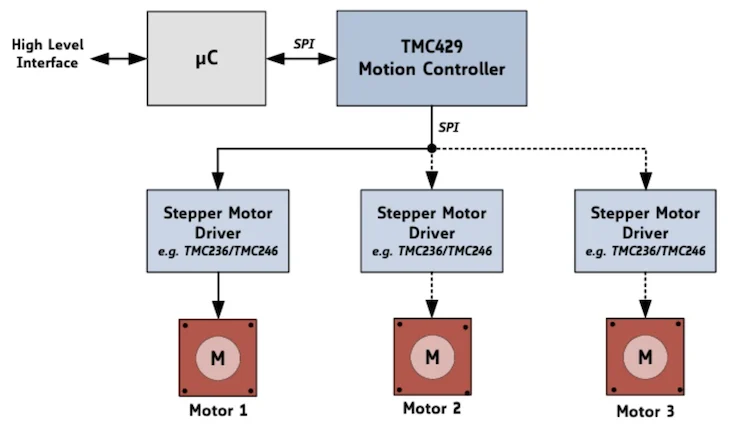
A prominent example can be seen in motion control systems built around specialized chips like the Analog Devices TMC429 motion controller. This chip features an integrated SPI controller and driver interface. In such a setup, the TMC429 acts as a dedicated three-axis motion controller, offloading complex trajectory generation and pulse control tasks from the main system microcontroller. The TMC429 precisely controls stepper motor positions by sending step and direction pulses to dedicated stepper motor drivers. These driver chips then translate these digital signals into the specific coil currents required to actuate the stepper motors. Crucially, the TMC429 often utilizes two separate four-wire SPI interfaces: one for high-level communication with the main system microcontroller (the TMC429 acting as a slave), and another (where the TMC429 acts as a master) to communicate with and configure up to three daisy-chained stepper motor drivers. This architecture exemplifies how SPI facilitates hierarchical control and distributed intelligence within a motion system. Engineers praise this modularity and the ability of SPI to allow specialized ICs to handle computationally intensive tasks, freeing up the main MCU for higher-level system management.
The electrification trend across various sectors has further amplified the demand for integrated motor control solutions incorporating SPI. For instance, in the automotive industry, as vehicles incorporate an increasing number of motors for features like power windows, seats, mirrors, and active suspension, chip manufacturers are developing highly integrated motor controllers. Toshiba, a key player in automotive semiconductors, has introduced gate drivers such as the TB9104FTG, designed for brushed DC motors in automotive applications. This gate driver features integrated SPI, allowing the vehicle’s central electronic control unit (ECU) to configure, control, and retrieve diagnostics from the motor. The TB9104FTG also includes built-in motor current sense amplifier circuitry and a PWM drive circuit, all manageable via the SPI interface. This integration reduces component count, simplifies wiring harnesses, and enhances diagnostic capabilities, which are paramount in safety-critical automotive environments. Industry analysts predict continued growth in such integrated solutions, driven by the need for greater efficiency, reliability, and functional safety in automotive subsystems.
Beyond these specific examples, motion control chips leveraging SPI are being implemented in a wide variety of applications, including:
- Automating Laboratory Equipment: Precise fluid dispensing, sample positioning, and microscope stage control.
- 3D-Printing Systems: Controlling stepper motors for XYZ axis movement and extruder filament feeding.
- Robotics: Manipulating robotic arms, grippers, and mobile robot platforms.
- Industrial Automation: Machine tools, packaging machinery, conveyor systems.
- Medical Devices: Infusion pumps, diagnostic equipment, surgical robots.
- Consumer Electronics: Camera lens focusing mechanisms, drone gimbals.
The Evolution and Future Trajectory of SPI in Motion Control
While SPI has been a staple for decades, its core strengths – simplicity, speed for short distances, and low overhead – ensure its continued relevance. The protocol’s adaptability is also evident in its evolution. For applications requiring even higher throughput, especially for external memory interfaces, variants like Quad-SPI (QSPI) and Octal-SPI (OSPI) have emerged, adding more data lines to increase bandwidth significantly. While these enhanced versions are primarily for memory, they illustrate the underlying protocol’s robustness.
Challenges with SPI do exist. The need for a dedicated slave select line for each slave device can consume a significant number of microcontroller pins if many slaves are present. Additionally, SPI lacks built-in arbitration, meaning the master is always in control, and there’s no inherent mechanism for multiple masters or for slaves to initiate communication without explicit polling. For longer distances or more complex network topologies, other protocols are certainly more appropriate.
However, for the critical task of intra-board communication within a motion microcontroller, SPI remains a highly effective and preferred choice. Its straightforward implementation minimizes software complexity and debugging time, while its full-duplex, synchronous nature guarantees reliable and high-speed data exchange essential for precise motion control loops. As embedded systems continue to miniaturize and demand greater computational density at the edge, the efficiency of SPI in managing data flow between microcontrollers and their specialized peripherals will only grow in importance.
In conclusion, the Serial Peripheral Interface is far more than just another communication protocol; it is a fundamental enabler of modern motion control. Its blend of simplicity, speed, and efficiency makes it an indispensable tool for engineers developing sophisticated motion systems, from consumer electronics and medical devices to advanced industrial robotics and automotive applications. By facilitating seamless, high-speed data exchange between microcontrollers and their peripheral components, SPI ensures the precision, responsiveness, and diagnostic capabilities that are paramount to the success of today’s automated world.