Cambridge, MA – Engineers at the Massachusetts Institute of Technology (MIT) are at the forefront of developing a groundbreaking spacecraft propulsion system that promises to redefine the capabilities of small satellites by seamlessly integrating the raw power of traditional chemical rockets with the meticulous efficiency of electric thrusters. This innovative dual-mode system, leveraging a single, specialized propellant, aims to address long-standing limitations in satellite maneuverability, paving the way for more ambitious and cost-effective missions across the solar system and closer to Earth.
The core innovation lies in a "green monopropellant" that can fuel both rapid, high-thrust chemical maneuvers and slow, precise electric adjustments from a shared fuel reservoir. This eliminates the need for separate propulsion systems, each with its own propellant tank and hardware, thereby significantly reducing the weight, complexity, and overall cost of small satellites. Historically, spacecraft have been forced to choose between the brute force of chemical propulsion, ideal for quick orbital changes or escape velocities, and the fuel-sipping endurance of electric propulsion, perfect for long-duration, gentle acceleration. The MIT breakthrough, detailed in a recent study published in the Journal of Propulsion and Power, offers the "best of both worlds," as Amelia Bruno, a former postdoc in MIT’s Department of Aeronautics and Astronautics (AeroAstro) and lead author of the study, articulated. "This opens the door for small satellites to do even more science, more observations, and more interesting missions, all on a smaller and cheaper platform."
The Genesis of Dual-Mode Propulsion: Addressing Small Satellite Limitations
The burgeoning small satellite industry, particularly the proliferation of CubeSats, has democratized access to space. These compact, standardized satellites, often weighing just a few kilograms, offer unprecedented opportunities for scientific research, Earth observation, telecommunications, and technology demonstration. However, their diminutive size imposes significant constraints, especially concerning propulsion. Traditional propulsion systems, designed for larger spacecraft, are often too bulky, heavy, or power-intensive for CubeSats. This has largely confined many small satellites to their initial deployment orbits, limiting their ability to perform complex maneuvers, extend their mission lifespans, or venture beyond low Earth orbit.
For decades, space exploration has relied heavily on two primary propulsion paradigms. Chemical propulsion, epitomized by liquid-fueled rockets, generates thrust by rapidly expelling hot gases produced from the combustion of propellants. These systems, like those using highly toxic hydrazine, offer high thrust-to-weight ratios, enabling swift changes in velocity (delta-V). They are indispensable for launch, orbital insertion, large trajectory corrections, and de-orbiting. In contrast, electric propulsion systems, such as ion thrusters or Hall effect thrusters, generate thrust by accelerating charged particles (ions) to very high velocities using electric fields. While their thrust levels are typically very low, they boast extremely high specific impulse (a measure of propellant efficiency), allowing them to achieve substantial velocity changes over extended periods with minimal fuel consumption. This makes them ideal for long interplanetary journeys or precise station-keeping maneuvers where time is less critical than fuel efficiency.
The challenge for small satellites has been reconciling these two divergent needs within their stringent mass and volume budgets. A dual-mode system using separate propellants and hardware would be prohibitively complex and heavy. MIT’s approach, therefore, represents a paradigm shift, enabling satellites to dynamically switch between propulsive modes based on mission requirements, all while simplifying the spacecraft architecture.
The Revolutionary Propellant: ASCENT’s Dual Functionality
At the heart of MIT’s innovation is the Advanced SpaceCraft Energetic Non-Toxic (ASCENT) propellant. Originally developed by the U.S. Air Force as a "green" alternative to the highly toxic and carcinogenic hydrazine, ASCENT is an ionic liquid mixture. Hydrazine has been the workhorse propellant for spacecraft attitude control and orbital maneuvering since the 1960s, but its extreme toxicity necessitates elaborate handling procedures, adding to mission costs and risks. The U.S. Air Force’s efforts to find safer, yet equally effective, propellants led to ASCENT, which is significantly less hazardous, making spacecraft integration and ground operations safer and more economical.
The serendipitous discovery that ASCENT, a propellant designed for chemical combustion, is also an ionic liquid mixture proved crucial for the MIT team. Ionic liquids are salts in a liquid state, composed entirely of ions. Their inherent stability, low volatility, and ability to remain liquid in the vacuum of space make them ideal candidates for electric propulsion systems, particularly electrospray thrusters. "ASCENT happens to be an ionic liquid mixture," Bruno explained. "And we said, hey, that’s the stuff we typically use. Theoretically, this should work. Let’s go figure out how." This realization sparked the collaboration between MIT’s electrospray propulsion experts and the Air Force’s green propellant initiatives, setting the stage for the groundbreaking research.
MIT’s Pioneering Research and the Electrospray Thruster
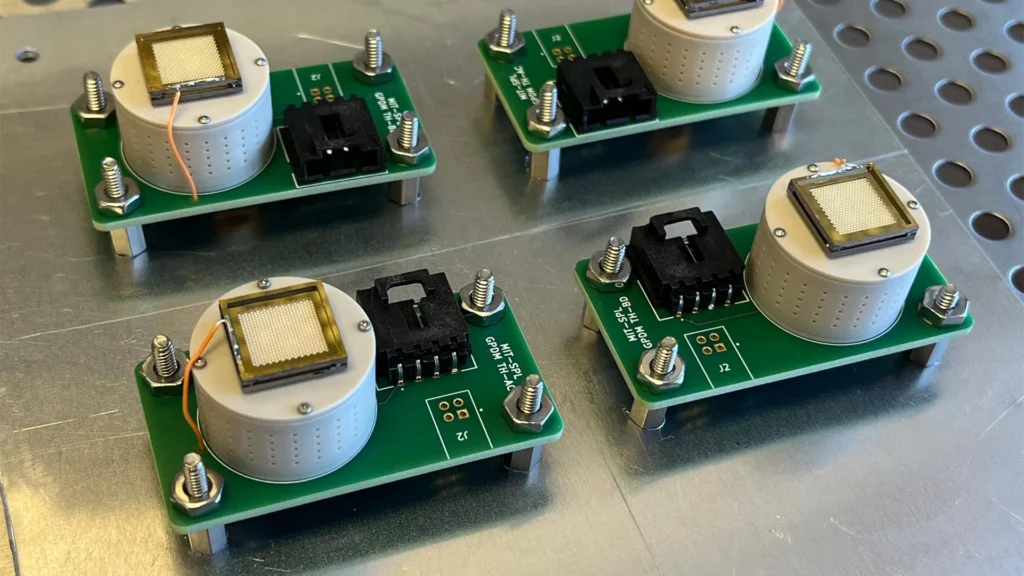
The research was primarily conducted in Professor Paulo Lozano’s laboratory at MIT, a renowned hub for developing and testing electrospray propulsion systems tailored for compact satellites. Lozano, the Miguel Alemán Velasco Professor of Aeronautics and Astronautics at MIT and a co-author of the study, has dedicated over a decade to miniaturizing these "tiny rocket engines," which are often no larger than a dime or even a thumbnail.
Electrospray thrusters operate on a principle distinct from traditional chemical rockets. They utilize strong electric fields to extract and accelerate ions from a liquid propellant, ejecting these charged particles at high velocities to generate thrust. This electrostatic acceleration mechanism is incredibly fuel-efficient, achieving specific impulses far exceeding those of chemical systems. Lozano’s lab has been instrumental in refining the design of these micro-thrusters, experimenting with various geometries, operating conditions, and ionic liquid fuels to optimize their performance for diverse small satellite applications, from lunchbox-sized CubeSats to small carry-on suitcase-sized spacecraft.
The critical step for the MIT team was to rigorously test ASCENT’s viability as a propellant for electrospray thrusters. Amelia Bruno, Matthew Corrado (a former MIT graduate student), and Professor Lozano designed a series of experiments to evaluate the fuel’s performance and efficiency in this unconventional application.
Testing and Validation: Proving ASCENT’s Versatility
The experimental setup involved miniature electrospray thrusters, each attached to a small, cube-shaped reservoir, roughly the size of a LEGO brick, filled with approximately one gram of ASCENT. The propellant, described as having a viscosity similar to baby oil, was then subjected to the thrusters’ electric fields. To simulate the vacuum conditions of space, the thrusters were mounted on a custom magnetic levitation test platform, known as the MagLev, housed within a large vacuum chamber. This specialized platform allowed researchers to precisely measure the minute forces generated by the thrusters.
During the testing phase, the MIT team remotely varied the voltage supplied to the thrusters, observing the resulting electrospray. The generated thrust was sufficient to cause a mock CubeSat, positioned on the MagLev, to spin like a top, demonstrating effective propulsion. Crucially, the researchers operated the thrusters continuously for periods of up to 100 hours, allowing for a comprehensive assessment of the fuel’s long-term stability and performance.
The results were unequivocally positive. ASCENT successfully powered the electrospray thrusters, performing comparably to conventional ionic liquid propellants specifically designed for electric propulsion systems. "Compared to our normal electrospray propellants, ASCENT can provide similar performance in terms of thrust," Bruno affirmed. This validation confirmed the dual-mode potential of ASCENT, moving the concept from theoretical possibility to demonstrated reality. The implications were profound: a single propellant could now serve as the chemical fuel for powerful bursts and the electric fuel for sustained, precise maneuvers, all from a unified tank.
NASA’s Green Propulsion Dual Mode Mission: A Crucial Space Test
The promise of this integrated propulsion system is not confined to laboratory experiments. The technology is poised for a critical real-world test through NASA’s Green Propulsion Dual Mode mission, scheduled for launch in November. This mission will deploy a briefcase-sized CubeSat equipped with one chemical thruster and four electrospray thrusters, all drawing propellant from a single, shared tank of ASCENT. This will mark the inaugural attempt to test such a unified dual-mode propulsion system on a small spacecraft in the unforgiving environment of space.
NASA’s involvement underscores the agency’s commitment to fostering innovative technologies that can enhance mission capabilities while reducing costs and environmental impact. A successful demonstration of the Green Propulsion Dual Mode mission would validate the concept for future deep-space CubeSat missions, potentially transforming how these small platforms are designed and utilized. NASA officials have long emphasized the importance of advanced propulsion for expanding exploration frontiers, and the potential for a single propellant system to enable both rapid transit and precise scientific observations aligns perfectly with these strategic goals. This mission represents a significant step towards unlocking the full potential of CubeSats for more complex and distant destinations.
Broader Implications for Space Exploration and Commercialization
The implications of MIT’s dual-mode propulsion system extend far beyond the upcoming NASA mission, promising to reshape various facets of space exploration and commercial activity.
Deep-Space Exploration: One of the most exciting prospects is the ability to send CubeSats on long-duration deep-space missions. "We could send CubeSats to Mars, or the asteroid belt, where they could make the journey slowly, using electrospray thrusters," Professor Lozano envisioned. Upon arrival, the chemical thrusters could be activated for "quick moves to look at interesting features," offering unprecedented flexibility for close-up observations or rapid trajectory adjustments around celestial bodies. This capability could enable distributed sensor networks around planets or asteroids, or allow for multiple fly-by investigations by a swarm of small, agile probes, something previously unfeasible due to propulsion limitations.
Enhanced Earth Observation and Telecommunications: Closer to Earth, the technology could revolutionize constellations of small satellites used for weather monitoring, climate science, and global telecommunications. Lozano illustrated this with a scenario: "Say there’s a storm coming, and you’d want to deploy your constellation of small satellites to observe over one location. You could choose to send them quickly or slowly depending on the nature of the observation. And the only way to do that is if you have two propulsion systems, which is now possible." This dynamic maneuvering capability would allow satellite operators to respond swiftly to unfolding events, optimize coverage over specific regions, or precisely reconfigure constellations for improved service.
Reduced Costs and Increased Accessibility: By eliminating redundant hardware and propellant tanks, the dual-mode system inherently reduces the mass, volume, and complexity of small satellites. This translates directly into lower manufacturing costs, simplified integration, and potentially reduced launch costs, as lighter payloads are generally cheaper to send to space. The use of a non-toxic propellant like ASCENT further streamlines ground operations, cutting down on the specialized infrastructure and safety protocols required for hazardous fuels, thereby reducing overall mission expenditures.
The Growing Ecosystem of Small Satellites
The global small satellite market is experiencing exponential growth. Valued at over $5 billion in 2023, it is projected to reach nearly $20 billion by 2030, driven by the increasing demand for broadband internet, Earth imaging, remote sensing, and in-orbit services. This boom in small satellite deployment has fueled an urgent need for advanced propulsion solutions that can unlock their full potential. While thousands of CubeSats and other smallsats are launched annually, many are still passive, lacking the propulsion needed for active orbital management, collision avoidance, or mission extension. The MIT dual-mode system offers a compelling answer to this critical industry demand, positioning it as a pivotal technology for the next generation of small satellite missions.
Looking Ahead: The Future of In-Space Mobility
The successful development and upcoming flight test of MIT’s dual-mode propulsion system represent a significant leap forward in spacecraft mobility. It embodies the ongoing quest for efficiency, versatility, and sustainability in space exploration. While the initial focus is on validating the concept in space, future research will likely concentrate on further optimizing the performance of ASCENT in electrospray thrusters, exploring different thruster configurations, and scaling the technology for a broader range of small satellite platforms.
The ability to command both power and precision from a single, compact system will empower scientists and commercial operators to design missions previously confined to the realm of larger, more expensive spacecraft. As humanity continues to push the boundaries of space exploration and exploit the orbital frontier, innovations like MIT’s hybrid propulsion system will be instrumental in making space more accessible, sustainable, and ultimately, more capable for all. This collaborative effort, supported in part by NASA, underscores the transformative power of interdisciplinary research and strategic partnerships in advancing the future of space technology.