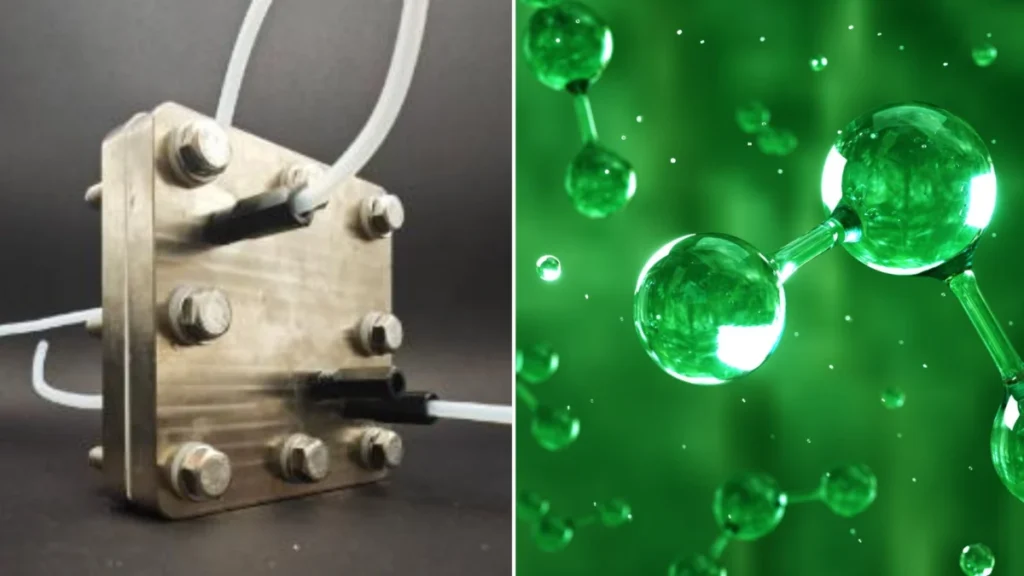
Scientists at Keele University in the UK have achieved a significant breakthrough in green chemistry, developing an innovative electrolyzer that simultaneously converts food waste into two high-value products: green hydrogen and crucial raw materials for sustainable plastics. This dual-purpose technology represents a pivotal advancement in tackling two of the world’s most pressing environmental challenges—food waste and plastic pollution—while dramatically reducing the cost and complexity associated with green hydrogen production. Initial testing has demonstrated that the electrolyzer operates at industrially relevant reaction rates, indicating its strong potential for large-scale application and profound impact on global sustainability efforts.
A Paradigm Shift in Electrolysis: Eliminating Costly Membranes
The core innovation of the Keele University electrolyzer lies in its radical departure from conventional electrolysis methods. Standard electrolyzers operate by passing electricity through water, splitting it into hydrogen and oxygen gases. While hydrogen is captured for energy, the oxygen is typically released into the atmosphere. A critical and costly challenge in this process is the need to keep hydrogen and oxygen separate due to their explosive potential when mixed. Traditional systems rely on expensive internal membranes for this separation. These membranes, often made from specialized polymers or ceramics and sometimes incorporating rare metals like iridium and platinum, are prone to degradation, require substantial amounts of electrical power to facilitate the reaction across them, and contribute significantly to both the capital and operational expenditures of green hydrogen production.
The Keele team, led by Dr. Charlie Creissen and PhD student Lewis Cousins, has entirely circumvented this problem. Their ingenious solution involves introducing "biomass-derived molecules" extracted directly from food waste into the electrolyzer system. This innovative approach fundamentally alters the chemical reaction occurring within the device. Instead of producing oxygen gas at the anode, the system now generates valuable organic molecules that serve as precursors for sustainable plastics. The complete cessation of oxygen generation means there is no dangerous gas mixing, rendering the costly and energy-intensive internal membrane entirely obsolete. The elimination of this membrane barrier not only enhances safety but also drastically reduces the energy requirements for the electrolysis process, allowing the cell to operate at a significantly lower voltage, specifically under 1.5 V at high current densities (500 mA cm⁻²). This efficiency gain is a critical factor in making green hydrogen production more economically viable.
Dual-Benefit Solution: Addressing Pressing Global Challenges
The significance of this development is multifaceted, offering a potent solution to two interconnected global crises: food waste and plastic pollution. Food waste is a colossal environmental issue, contributing approximately 8 to 10 percent of global greenhouse gas emissions. When organic waste decomposes in landfills, it produces methane, a potent greenhouse gas many times more effective at trapping heat than carbon dioxide over a short period. Globally, about one-third of all food produced for human consumption, roughly 1.3 billion tons annually, is lost or wasted. This waste represents not only a squandering of resources but also a significant contributor to climate change and environmental degradation. The Keele electrolyzer offers a transformative pathway for this waste, converting it from an environmental liability into a valuable resource.
Concurrently, the world grapples with an escalating plastic crisis. Global plastic production exceeds 400 million tons annually, with the vast majority derived from fossil fuels. This petrochemical-based production generates hundreds of millions of tons of carbon dioxide emissions and contributes to widespread microplastic pollution, which infiltrates ecosystems from the deepest oceans to the highest mountains, posing serious threats to biodiversity and human health. The ability to produce raw materials for plastics from food waste biomass directly addresses this challenge by providing a fossil-free alternative. By replacing crude oil derivatives with these sustainable building blocks, the Keele technology offers a path toward a circular economy for plastics, reducing reliance on virgin fossil resources and mitigating the environmental footprint of plastic manufacturing.
The Economics of Green Hydrogen: A Cost-Cutting Breakthrough
Green hydrogen, produced using renewable electricity to split water, is heralded as a vital clean energy carrier capable of decarbonizing heavy industries that are difficult to electrify directly, such as steel, cement, and long-haul shipping. It also holds immense potential for storing excess intermittent renewable energy from solar and wind power for months, thereby stabilizing power grids and replacing fossil fuels in global manufacturing and chemical production. However, despite its promise, green hydrogen currently accounts for less than one percent of total global hydrogen production. The primary impediments to its widespread adoption have been high energy demands and the prohibitive cost of conventional electrolyzer membrane materials, which often rely on expensive and rare metals like iridium and platinum.
The Keele team’s innovation directly tackles these economic barriers. By eliminating the membrane entirely, their system significantly reduces both capital expenditure (CapEx) and operational expenditure (OpEx). Conventional alkaline electrolyzers typically require 50-55 kWh to produce one kilogram of hydrogen, while PEM (Proton Exchange Membrane) electrolyzers, known for their higher efficiency and compactness, consume around 45-50 kWh/kg H2 but come with higher capital costs due to expensive membrane and catalyst materials. The ability to operate at a lower cell operating voltage (under 1.5 V) translates directly into lower electricity consumption per unit of hydrogen produced, further reducing operational costs. This cost reduction is crucial for making green hydrogen competitive with "grey" hydrogen, which is produced from fossil fuels via steam methane reforming and currently costs significantly less (around $1-2/kg compared to $3-8/kg for green hydrogen). Dr. Creissen emphasized this point, stating, "These membrane-free configurations can operate with lower costs and added value, enhancing access to green hydrogen and sustainable building blocks for everyday products."
Industrial Viability and Scalability: From Lab to Market
A key indicator of the Keele electrolyzer’s potential is its performance during testing, where it achieved "industrially relevant reaction rates" and operated at "commercial speeds" while drawing significantly less power from the grid. This demonstrates that the technology is not merely a laboratory curiosity but possesses the fundamental characteristics required for real-world deployment. The rapid reaction rates are essential for meeting the high demands of industrial processes, where efficiency and throughput are paramount.
The scalability of such a system is critical for its global impact. While the initial research has proven the concept and its viability, the next phases would typically involve scaling up the technology from laboratory prototypes to pilot plants and then to full commercial installations. This process involves optimizing reactor design, material selection for electrodes, and integrating the food waste pre-treatment and product separation processes efficiently. The inherent simplicity of a membrane-free design, however, suggests a potentially smoother and faster path to scale compared to systems burdened by complex membrane manufacturing and maintenance.
Statements and Expert Commentary: A Glimmer of Hope for a Sustainable Future
The researchers themselves underscore the profound implications of their work. Dr. Creissen, the lead author, remarked, "This research is a significant step towards fossil-free plastic production using renewable electricity." This statement highlights the strategic importance of decoupling plastic production from fossil fuels, a goal that has long eluded the industry. Co-author Lewis Cousins further noted the elegance of their engineering solution: "Our design effectively demonstrates that electrolyzer configuration is key to improving performance. We hope that our development inspires new research in sustainable engineering." This sentiment reflects a broader trend in scientific innovation, where smart design and fundamental re-thinking of chemical processes can unlock monumental efficiency gains and environmental benefits.
From an industry perspective, this development could be met with considerable enthusiasm. Major chemical companies and plastic manufacturers are under increasing pressure from consumers, regulators, and investors to reduce their carbon footprint and transition to sustainable practices. A technology that offers a viable, cost-effective pathway to bio-based plastic precursors, coupled with green hydrogen production, represents a compelling business case. Environmental organizations would likely laud this breakthrough as a "double victory" in the fight against climate change and pollution, seeing it as a tangible step towards a circular economy model where waste is transformed into resources. Policy makers, particularly those focused on decarbonization targets and waste management strategies, might view this as a potential cornerstone for future industrial policy and investment in green technologies.
Broader Implications: Decarbonizing Heavy Industries and Beyond
The implications of Keele’s membrane-free electrolyzer extend far beyond the immediate benefits of green hydrogen and sustainable plastics. Hydrogen’s role as a clean energy carrier is pivotal for decarbonizing sectors that are difficult to electrify directly. Industries like steel and cement production, which rely on high-temperature processes, currently emit vast amounts of CO2. Hydrogen can serve as a clean fuel for these processes or as a reducing agent in steelmaking. Similarly, long-haul shipping and aviation, sectors where heavy lithium-ion batteries are impractical, can transition to hydrogen or hydrogen-derived synthetic fuels. The ability to produce hydrogen more cheaply and efficiently could accelerate the decarbonization of these critical economic pillars.
Furthermore, the technology’s capacity to store excess solar and wind power for months is a game-changer for grid stability and energy security. Intermittent renewable energy sources require robust storage solutions to ensure a continuous power supply. Hydrogen storage offers a high-density, long-duration storage option that can bridge seasonal variations in renewable energy generation, replacing the need for fossil fuel-fired backup power plants.
In the plastic industry, the shift from crude oil derivatives to food waste biomass is revolutionary. It offers a tangible solution to two major environmental challenges simultaneously: reducing landfill waste from agricultural and municipal food waste, and curbing global pollution and carbon emissions linked to petrochemical-based plastic production. This approach aligns perfectly with the principles of the circular economy, where resources are kept in use for as long as possible, extracting the maximum value from them whilst in use, then recovering and regenerating products and materials at the end of each service life.
The Path Forward: Next Steps and Future Research
The publication of these findings in the prestigious journal ACS Electrochemistry marks a significant milestone, bringing the research to the attention of the global scientific and industrial communities. The next critical steps will involve further research and development to optimize the process, explore the range of food waste types that can be effectively utilized, and refine the extraction and conversion of biomass-derived molecules. This could include investigating different types of catalysts to enhance reaction rates and selectivity, as well as developing integrated systems for efficient waste processing and product separation.
Pilot projects, possibly in collaboration with industrial partners, will be essential to validate the technology’s performance at a larger scale, assess its economic viability in diverse settings, and identify any unforeseen challenges in real-world applications. Such projects would also help establish best practices for sourcing and pre-treating food waste, ensuring a consistent and sustainable feedstock supply. The potential for this development to inspire new research in sustainable engineering, as hoped by Cousins, is immense, potentially leading to further innovations in waste-to-resource technologies and green chemical processes.
In conclusion, the Keele University team, through their ingenious modification of the chemical process within an electrolyzer, has potentially cleared a path for significantly cheaper zero-emission fuel and fossil-free everyday products. This "double victory" in green chemistry offers a compelling vision for a more sustainable future, where waste is transformed into valuable resources, and the environmental impact of essential industrial processes is drastically reduced. The innovative membrane-free design not only addresses the critical cost barriers to green hydrogen but also provides a novel pathway for a circular plastic economy, setting a new benchmark for sustainable engineering.