A groundbreaking achievement in defense technology was recently unveiled as a Florida-based aerospace and defense company, L3Harris Technologies, successfully completed the inaugural flight test of its advanced electromagnetic battle management ecosystem. This pivotal demonstration, conducted in July 2026, showcased the seamless integration of L3Harris’s Distributed Spectrum Collaboration and Operations (DiSCO) system with Shield AI’s cutting-edge Hivemind mission-autonomy software, marking a significant stride towards fully autonomous electronic warfare (EW) capabilities.
The Technological Core: DiSCO, Hivemind, and Green Wolf
At the heart of this innovation lies DiSCO, a resilient, vendor-agnostic Electromagnetic Spectrum Operations (EMSO) architecture. Designed to operate across a distributed network, DiSCO’s primary function is to connect multiple disparate electronic warfare systems, enabling real-time threat detection and rapid response across a dynamic battlespace. Its "vendor-agnostic" nature is crucial, emphasizing interoperability and flexibility in integrating various hardware and software components, a growing necessity in modern multi-domain operations. This open architecture approach aims to prevent vendor lock-in and foster a more adaptable, scalable defense ecosystem.
Complementing DiSCO is Shield AI’s Hivemind, an artificial intelligence-powered mission-autonomy software. Hivemind is engineered to empower unmanned systems with the ability to make complex decisions independently, adapting to evolving mission parameters and threats without direct human intervention. Its integration with DiSCO signifies a powerful synergy: DiSCO provides the critical threat intelligence and operational picture from the electromagnetic spectrum, while Hivemind processes this data to command and control autonomous platforms, executing defensive or offensive actions at machine speed.
The flight test itself was conducted using an L3Harris Green Wolf, an unmanned aircraft system (UAS) specifically designed as a multi-mission platform. The Green Wolf is equipped with a launched effects system, capable of deploying various payloads for electronic attack and advanced detection. Its role in this demonstration underscored its versatility, acting as the primary platform for carrying the Deceptor electronic warfare payload and executing the autonomous maneuvers dictated by Hivemind. The Deceptor, described as a compact, software-defined EW payload, highlights the trend towards smaller, more versatile EW tools that can be rapidly deployed and reconfigured.
A Landmark Flight Demonstration
The July 2026 flight test represented a critical milestone following a successful simulated test conducted in February 2026. This real-world validation moved the concept from virtual environments to operational reality, demonstrating the system’s efficacy on a live flight test range. During the test, the unmanned aircraft systems (UAS) autonomously detected, analyzed, and responded to simulated electromagnetic threats. Crucially, these actions were performed without any human intervention, showcasing a level of autonomy previously confined to conceptual stages or highly controlled laboratory settings.
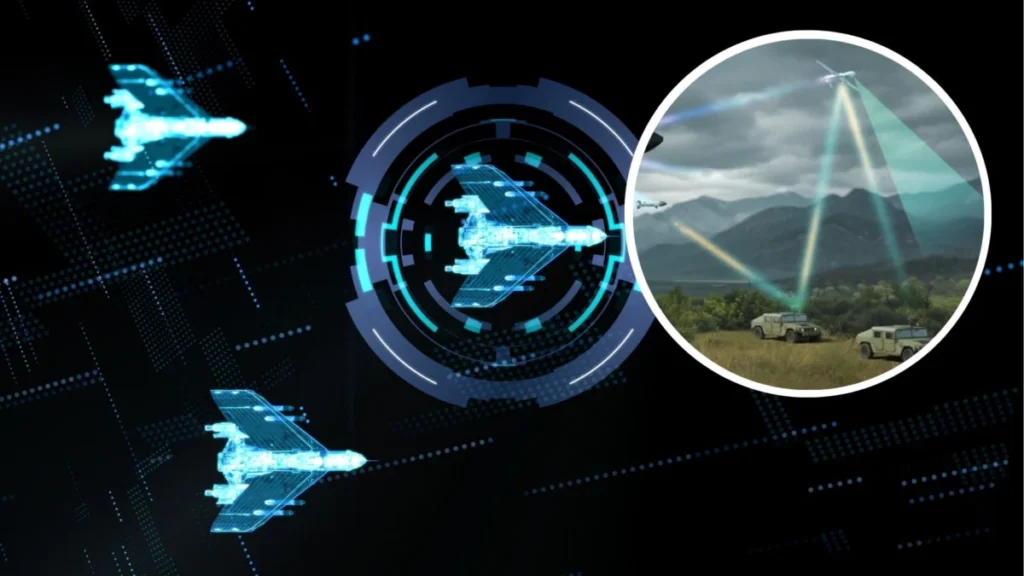
The mission scenario was meticulously designed to validate several key capabilities. Initially, a UAS equipped with the Deceptor payload was tasked with sensing and characterizing unknown electromagnetic threats. This involves identifying the type, location, and intent of hostile emissions within the electromagnetic spectrum. Once this data was gathered, it was seamlessly shared across the distributed network via DiSCO. Hivemind, onboard the Green Wolf, then leveraged this threat data to make immediate, autonomous decisions.
One of the most impressive aspects of the demonstration was Hivemind’s ability to autonomously reroute follow-on unmanned systems. Based on the real-time threat assessment provided by DiSCO, Hivemind directed subsequent UAS through a designated safe operating zone, effectively mitigating risk without requiring human input. This capability is paramount in contested environments where human decision-making cycles might be too slow to react to rapidly emerging threats, or where communication links could be jammed or denied. The system’s capacity to "compress the sensor-to-decision cycle" in real-time translates directly into a significant operational advantage, allowing for responses far faster than human operators could achieve.
Strategic Imperatives: Why Autonomous EW Matters
Electronic warfare has long been a critical, albeit often understated, element of modern military operations. It encompasses a broad range of activities aimed at controlling the electromagnetic spectrum, from jamming enemy communications and radar (electronic attack) to protecting friendly systems (electronic protection) and gathering intelligence (electronic support). In contemporary conflicts, and particularly in the context of great power competition, the ability to dominate the electromagnetic spectrum is increasingly seen as a decisive factor. Adversaries are investing heavily in sophisticated EW capabilities, creating highly contested environments where traditional human-in-the-loop systems may struggle to keep pace.
The integration of artificial intelligence and machine learning into EW systems addresses several pressing challenges. Firstly, it promises to significantly reduce operator workload. The sheer volume and complexity of electromagnetic data in a modern battlespace can overwhelm human analysts. Autonomous systems can process vast amounts of data, identify patterns, and classify threats with greater speed and accuracy, freeing human operators to focus on higher-level strategic decisions.
Secondly, and perhaps most critically, AI-enabled EW accelerates response times. In a domain where milliseconds can determine success or failure, autonomous systems can react instantly to new threats or opportunities. This speed is vital for staying "ahead of rapidly evolving threats," as highlighted by L3Harris. The ability to autonomously adapt routes, deploy countermeasures, or execute electronic attacks in real-time offers a decisive edge, especially when facing sophisticated, adaptive jamming or targeting systems.
Furthermore, the concept of "distributed and networked electronic warfare operations" championed by DiSCO enhances resilience. By spreading EW capabilities across multiple platforms and locations, the system becomes less vulnerable to single points of failure. If one platform is compromised or destroyed, others can continue to operate and share information, maintaining the integrity of the overall EMSO architecture. This resilience is a cornerstone of future military doctrines, particularly those focused on operating in denied or degraded environments.
Voices from the Front Lines of Innovation
Lauren Barnes, President of Spectrum Superiority, Communications & Spectrum Dominance at L3Harris, underscored the rapid progression from concept to operational capability. "This successful demonstration shows how quickly we can transform concepts into operational capability for the joint force," Barnes stated in a press release. She further elaborated on the strategic importance, adding, "By pairing autonomous decision-making with advanced spectrum battle management, we’re giving warfighters the resilience and speed they need to stay ahead of rapidly evolving threats." Her remarks highlight the imperative to deliver advanced capabilities to the warfighter with unprecedented speed, reflecting the urgency of modern defense challenges.
Christian Gutierrez, Senior Vice President of Hivemind at Shield AI, emphasized the synergistic effect of the collaboration. "L3Harris brings some of the most advanced electronic warfare capabilities in the world, and pairing DiSCO with Hivemind onboard Green Wolf produced something neither system could deliver alone," Gutierrez commented. He further elaborated on the core benefit of their joint endeavor: "This flight test proved Hivemind can compress the sensor-to-decision cycle in real time, enabling autonomous systems to sense, share, and act on spectrum threats faster than ever before. We are proud to be expanding that capability alongside L3Harris." Gutierrez’s statement underscores the power of integrating specialized systems, creating a whole that is greater than the sum of its parts.
Officials from both companies have consistently stressed the profound value of open-architecture systems. This philosophy, which allows advanced autonomy software like Hivemind to work seamlessly with sophisticated EW platforms like the Green Wolf and DiSCO, is considered fundamental for future defense innovation. It fosters greater collaboration, reduces development cycles, and ensures that the most cutting-edge technologies can be rapidly integrated and deployed.
The Road Ahead: Expanding Capabilities and Strategic Impact
Looking forward, L3Harris and Shield AI are committed to expanding mission applications and enhancing autonomous capabilities through continued development of their open-architecture approach for electronic warfare at the tactical edge. "Tactical edge" operations refer to combat actions conducted in forward areas, often under extreme pressure and with limited connectivity, where rapid, autonomous decision-making is most critical. Future efforts will likely focus on increasing the complexity of autonomous mission scenarios, integrating more diverse EW payloads, and further refining the AI’s ability to learn and adapt in unpredictable environments.
The collaboration between L3Harris and Shield AI is a microcosm of a broader trend within the defense industry: a growing emphasis on AI-enabled autonomous systems. Militaries worldwide are actively seeking more effective ways to operate in increasingly contested domains – not just the electromagnetic spectrum, but also air, land, sea, space, and cyber. Technologies such as DiSCO and Hivemind are therefore expected to play an increasingly important role in shaping next-generation electronic warfare capabilities and, by extension, future military doctrines.
The implications of this successful demonstration extend beyond immediate tactical advantages. It signals a strategic shift towards greater autonomy in critical combat functions, raising important questions for military planners, ethicists, and policymakers. While the current system operates within defined parameters and likely with human oversight at higher levels, the trajectory towards more advanced machine decision-making requires careful consideration of command and control structures, accountability, and the very nature of warfare.
Moreover, this advancement has significant geopolitical ramifications. Nations that successfully develop and integrate such advanced autonomous EW systems will gain a substantial strategic advantage, potentially reshaping the balance of power in regional and global conflicts. This drives an urgent need for continued investment in research and development, fostering public-private partnerships, and ensuring a robust talent pipeline in AI, robotics, and electromagnetic engineering.
In conclusion, the successful flight test of the DiSCO and Hivemind ecosystem on the Green Wolf platform represents a pivotal moment in the evolution of electronic warfare. By demonstrating autonomous detection, analysis, and response to electromagnetic threats, L3Harris and Shield AI have laid a crucial foundation for a future where AI-enabled systems operate at machine speed and scale, enhancing the resilience and effectiveness of military forces in the face of complex and rapidly evolving challenges. This achievement not only validates years of research and development but also sets a new benchmark for what is possible in autonomous defense capabilities.