Scientists at Lawrence Livermore National Laboratory (LLNL) have published a groundbreaking study in the journal Analytical Chemistry that fundamentally challenges long-held assumptions regarding the formation of nuclear fallout. By utilizing a sophisticated plasma flow reactor to simulate the extreme conditions of a nuclear fireball, the research team investigated the chemical behaviors of uranium, cerium, and cesium during the cooling and condensation phases following a high-energy event. The findings indicate that the "thermal history"—the specific path and duration of cooling—significantly dictates how radioactive elements are incorporated into solid particles, suggesting that current predictive models may be insufficient for accurate forensic and safety assessments.
The study of nuclear fallout is a cornerstone of nuclear forensics and national security. When a nuclear device detonates or a catastrophic reactor failure occurs, the energy release is nearly instantaneous, occurring in less than a millionth of a second. This release generates temperatures reaching millions of degrees, vaporizing everything in the immediate vicinity and creating a rapidly expanding cloud of plasma and ionized gas. As this fireball expands into the atmosphere, it begins to cool, and the vaporized materials—ranging from the weapon’s components to environmental soil and debris—condense into microscopic solid particles. These particles, known as fallout, carry a chemical and isotopic signature of the event. Understanding the nuances of this condensation process is vital for determining the nature of a nuclear event and predicting the long-term environmental impact of radioactive dispersal.
The Science of the Nuclear Fireball and Particle Condensation
To understand the significance of the LLNL research, one must first look at the physics of a nuclear detonation. The initial "flash" of a nuclear explosion creates a vacuum-like environment of extreme heat. Within seconds, the fireball rises like a hot air balloon, drawing in surrounding air, dust, and debris. As the temperature drops from millions of degrees to several thousand, the vaporized elements begin to transition back into solid states.
Traditionally, many fallout models have operated on the assumption of "independent behavior," where different elements condense based solely on their individual boiling and melting points. However, the LLNL team, led by scientist Rakia Dhaoui, hypothesized that the chemical environment within the cooling fireball is far more interactive. The study focused on three specific elements: uranium, which serves as the primary nuclear fuel; cerium, which is frequently used as a chemical surrogate for plutonium due to its similar reactive properties; and cesium, a highly volatile fission product that poses a significant long-term radiological hazard.
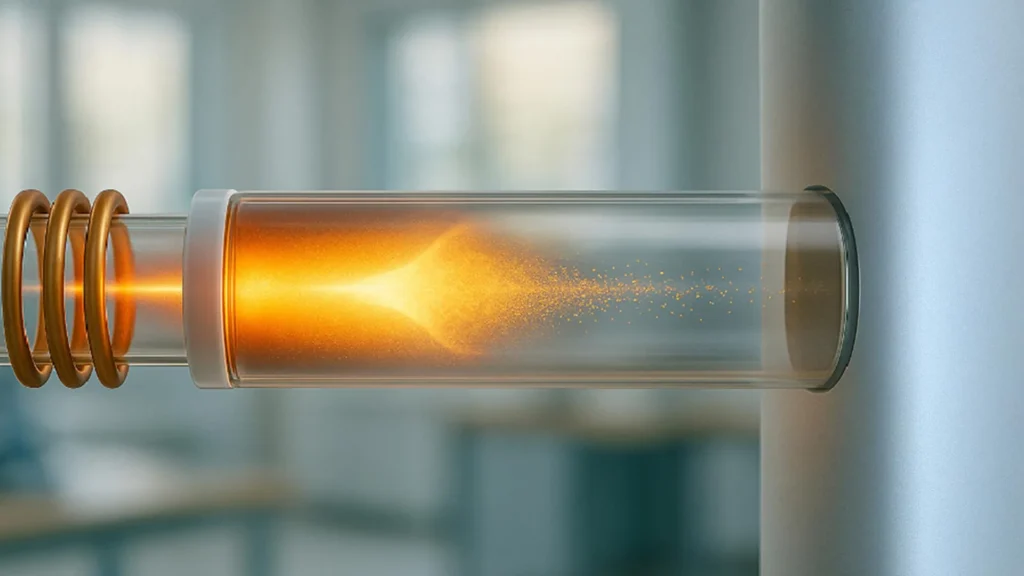
The researchers utilized a plasma flow reactor to recreate these conditions in a controlled laboratory setting. This device allows scientists to inject materials into a high-temperature plasma—effectively a "laboratory sun"—where they are instantly vaporized. The vapor then travels through a cooling tube, where the researchers can manipulate the temperature gradient and the duration the materials spend at specific heat levels.
Experimental Methodology: Recreating Thermal Histories
The LLNL experiment was designed to compare two distinct cooling scenarios, or thermal histories. In the first scenario, the vaporized material was subjected to a steady, gradual decline in temperature as it moved through the reactor. In the second scenario, the material was held at a high temperature for an extended period before being subjected to a rapid cooling phase.
Because the plasma flow reactor operates as a continuous system, the team was able to collect samples at various points along the cooling path. This provided a "stop-motion" view of particle formation, allowing the scientists to observe exactly when and how different elements began to clump together or react with one another.
The results showed that the duration of heat exposure was just as critical as the temperature itself. "Changing how long materials remain at high temperature can alter chemical reactions and how volatile elements like cesium are incorporated into particles," Dhaoui explained. This suggests that the physical structure of fallout is not just a result of what materials were present, but a record of the specific atmospheric and thermal conditions during the seconds and minutes following the detonation.
Key Findings: Uranium, Cerium, and Cesium Interactions
The behavior of the three elements studied provided a clear picture of the complexities involved in fallout formation:
-
Uranium and Cerium: As expected, uranium and cerium—both being relatively "refractory" or less volatile—condensed early in the cooling process. However, the study found that their chemical speciation (the specific chemical form or oxidation state they took) changed depending on the thermal history. When held at high temperatures longer, these elements had more time to react with available oxygen and other materials in the plasma, resulting in different mineralogical structures in the final particles.
-
The Cesium Anomaly: The most striking findings involved cesium. In most traditional models, cesium is expected to condense much later than uranium because it is highly volatile. While this held true, the LLNL team discovered that when the mixture remained at high temperatures for a longer duration, the cesium mixed much more extensively with the uranium and cerium. Rather than forming a separate layer on the outside of the particles, the cesium became integrated into the core matrix of the fallout.
-
Chemical Interdependence: The data indicates that elements do not condense in isolation. The presence of uranium and cerium actually influenced how and when cesium transitioned from a gas to a solid. This "co-condensation" means that the final composition of fallout is a product of complex chemical bonding that occurs while the material is still in a semi-vaporized or molten state.
Implications for Nuclear Forensics and Safety Models
The implications of this research are far-reaching, particularly for the field of nuclear forensics. When an unknown nuclear event occurs, forensic scientists analyze collected fallout to "reverse-engineer" the event. They look at the ratio of isotopes and the chemical structure of the particles to determine the type of fuel used, the efficiency of the reaction, and even the location of the event based on environmental minerals incorporated into the debris.
If existing models overlook the fact that thermal history changes how these elements mix, the interpretations of forensic data could be skewed. By replacing "assumptions with measurements," as Dhaoui noted, LLNL is providing a more accurate toolkit for national security agencies.
Furthermore, these findings are critical for public safety and emergency response. Cesium-137 is one of the most concerning isotopes following a nuclear accident (such as Chernobyl or Fukushima) or a detonation, because it has a 30-year half-life and is easily absorbed by biological systems. If cesium is being incorporated into larger, heavier particles more readily than previously thought due to specific thermal histories, its dispersal pattern in the wind would change. Heavier particles fall closer to the source, while lighter, independent cesium aerosols travel much further. Improving these models allows for more accurate evacuation orders and land-use restrictions following an event.
A Chronology of Fallout Research
To understand the context of the LLNL study, it is helpful to view the evolution of fallout science over the last eight decades:
- 1945 (The Trinity Test): The first nuclear detonation provided the first samples of "Trinitite," a glassy residue formed from melted desert sand. Early analysis focused primarily on radioactivity levels rather than the microscopic chemical structure.
- 1950s-1960s (Atmospheric Testing Era): During the height of the Cold War, the U.S. and USSR conducted hundreds of atmospheric tests. Scientists began to notice that fallout from different heights (ground bursts vs. air bursts) had different physical properties, leading to the first rudimentary models of particle formation.
- 1986 (Chernobyl Disaster): The reactor meltdown provided a different kind of data, showing how fuel particles and volatile fission products like cesium and iodine behave in a non-explosive but high-heat environment.
- 2000s (Advanced Computing): The development of high-performance computing allowed for the creation of the "independent condensation" models that are widely used today. These models rely on thermodynamic data to predict fallout composition.
- Present Day (The LLNL Study): Using the plasma flow reactor, LLNL has moved beyond computer simulations to physical recreation. This represents a shift from theoretical physics to experimental chemistry in the study of nuclear debris.
Official Reactions and Future Directions
While the study was conducted by LLNL, the broader scientific community and national security apparatus have closely monitored the results. Sources within the National Nuclear Security Administration (NNSA) suggest that this data will likely be integrated into the next generation of post-detonation atmospheric dispersal codes.
"This work is a vital step in reducing the uncertainties that have plagued fallout modeling for decades," said a senior researcher in nuclear chemistry, speaking on the condition of anonymity. "The ability to simulate the fireball environment without an actual detonation is a massive technological advantage."
The LLNL team has already outlined the next phases of their research. While the current study focused on a simplified mixture of uranium, cerium, and cesium, real-world nuclear events involve hundreds of different isotopes and complex environmental materials like soil, concrete, and metal from structures. Future experiments will introduce these "complex matrices" into the plasma flow reactor to see how environmental debris alters the chemical interactions discovered in this study.
Conclusion: Refining the Record of Nuclear Events
The research conducted by Rakia Dhaoui and her colleagues at Lawrence Livermore National Laboratory marks a significant advancement in our understanding of the most violent chemical environments known to man. By proving that the thermal history of a nuclear fireball dictates the chemical architecture of fallout, the team has provided a new lens through which to view nuclear debris.
As the world continues to navigate the complexities of nuclear non-proliferation and the potential risks of aging nuclear infrastructure, the ability to accurately interpret the "record" preserved in fallout particles is more than just a scientific achievement—it is a fundamental requirement for global security and safety. The move toward measurement-based models ensures that if the unthinkable happens, or if a reactor accident occurs, the international community will have the most precise data possible to inform its response.