Lotus is poised to reignite the legendary Esprit nameplate with a dual-pronged attack on the supercar market, offering both a potent hybrid V8 and a more accessible V6 variant. This strategic move, revealed by Lotus CEO Feng Qingfeng during the company’s second-quarter earnings call on August 27, underscores a renewed commitment to the brand’s core philosophy of lightweight engineering while navigating the complexities of global emissions regulations. The upcoming supercar, codenamed Type 135, is slated for a 2028 launch, promising to bridge the gap between the brand’s current Emira sports car and the hypercar-level performance of the Evija.
H2. A Dual Powertrain Strategy for the Modern Supercar
The cornerstone of the new Esprit’s appeal will be its innovative hybrid powertrain. The flagship model will feature a V8 engine augmented by electric motors, a combination engineered to deliver over 1000 horsepower. This hybrid setup is not merely about raw power; it is a calculated response to increasingly stringent environmental standards worldwide. "The hybrid drivetrain will allow the company to conform to global emissions regulations – while preserving essential Lotus DNA of lightweight engineering and extreme track-focused driving dynamics," Feng Qingfeng stated to investors. This dual approach allows Lotus to cater to different market segments and price points. The V8 hybrid is envisioned as a halo product, pushing the boundaries of performance and technology, while the V6 hybrid is positioned to offer a more attainable entry into the Esprit lineage, building upon the success and familiarity of the V6 powertrain.
H2. Targeting the Scales: A Weighty Challenge
Achieving the brand’s signature lightweight ethos with a complex electrified drivetrain presents a significant engineering hurdle. Lotus has set an ambitious target weight of 1.5 tonnes for the V8 hybrid version of the Esprit. This figure is remarkably lean for a vehicle of this caliber, especially considering the inclusion of an 800-volt architecture, a V8 engine, and electric motors. "Achieving that target with an 800-volt architecture, a hybrid system, a V8 engine and electric motor in just is not easy," Feng acknowledged.
To meet this challenge, Lotus is leveraging cutting-edge technology, including insights gleaned from its Formula 1 endeavors. A prime example is the development of an ultra-lightweight electric motor. While a typical 150-kilowatt (201bhp) motor can weigh between 75 and 95 kilograms, Lotus has managed to reduce this to a mere 20 kilograms for the new Esprit. This substantial weight saving is crucial in offsetting the inherent mass of the hybrid components.
H3. The V6 Hybrid: Building on Proven Success
While the hybrid V8 has garnered significant attention, the confirmation of a V6 hybrid variant is equally noteworthy. This strategy echoes the powertrain direction for the upcoming replacement of the Emira sports car, which is also expected to adopt a V6 hybrid setup. The inclusion of a V6 hybrid in the Esprit signifies Lotus’s intention to create a lighter, more accessible model within the Esprit family. This variant is likely to appeal to enthusiasts who appreciate the visceral driving experience of a V6 engine, enhanced by the instant torque and efficiency of electrification, at a more attainable price point than the V8 flagship.
H3. Strategic Partnership for Powertrain Development
The development of both the V6 and V8 engines for the new Esprit is being undertaken by Horse, a joint venture between Lotus’s parent company, Geely, and the French automotive manufacturer Renault. This collaboration provides Lotus with access to extensive powertrain expertise and resources, accelerating the development process and ensuring that the engines meet the demanding performance and efficiency targets. The focus on optimizing both volume and weight for the turbocharged V8, as stated by Feng Qingfeng, indicates a meticulous approach to engine design, aiming to set a new benchmark in power-to-weight ratios for V8 engines.
H2. Engineering for Performance: The Eight-Speed Dual-Clutch Gearbox
Complementing the powerful hybrid powertrains will be an all-new eight-speed dual-clutch gearbox. This transmission has been specifically engineered to handle the immense torque generated by the hybrid V8 while simultaneously contributing to the vehicle’s overall lightweight construction. "The car will be engineered with an eight-speed dual-clutch gearbox – designed to handle high torque while keeping weight to a minimum," Feng explained. The selection of a dual-clutch transmission suggests a focus on rapid gear changes and optimal power delivery, essential for a supercar experience, while its lightweight design reinforces Lotus’s core principles.
H2. A New Era for Lotus: Bridging Electrification and Internal Combustion
The new Esprit represents a significant step in Lotus’s evolving product strategy. It signifies a crucial juncture where the company is integrating its burgeoning expertise in electric vehicle technology with a strategic re-engagement with internal combustion engines. This is a marked departure from the previously announced all-electric strategy by 2028. The Eletre X, a plug-in hybrid version of the electric SUV slated for UK release next year, serves as an early indicator of this shift, showcasing Lotus’s capability in hybrid powertrains.
The Type 135 is positioned to occupy a vital space in Lotus’s lineup, effectively bridging the gap between the Emira and the track-focused, all-electric Evija hypercar. "The Type 135 will fill the gap between the Emira and Evija, preserving the emotional connection Emira owners have with the Lotus mechanical handling, while leveraging V8 hybrid technology to approach the technical benchmark set by the Evija," Feng articulated. This positioning aims to retain the tactile, engaging driving experience that Lotus is renowned for, while incorporating the advanced technological capabilities that define the Evija.
H2. Manufacturing at the Historic Hethel Site
In a move that will bolster its ancestral home, the new Esprit supercar will be manufactured alongside the Emira sports car at Lotus’s historic Hethel facility in Norfolk. This decision not only underscores the significance of Hethel as Lotus’s engineering and manufacturing hub but also signifies a renewed investment in traditional sports car production. This aligns with Lotus’s broader strategy to place ICE (Internal Combustion Engine) sports cars back at the forefront of its future product portfolio, following the abandonment of the full-electric-only plan.
H3. Design Cues from the Theory 1 Concept
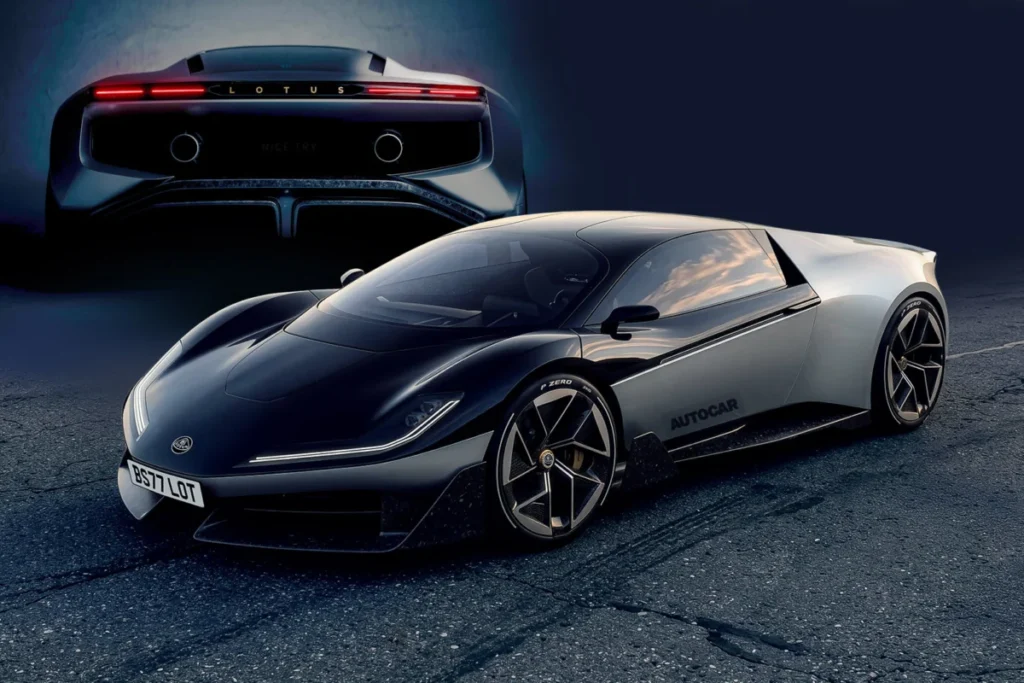
The design of the new Esprit is expected to draw heavily from the striking aesthetics of the 2024 Theory 1 electric supercar concept. A teaser image of the production car’s rear, released by Lotus, reveals a strong visual resemblance to the concept. Notably, the production version will feature the addition of two substantial exhaust pipes, a clear indication of its internal combustion engine integration. This design approach suggests a seamless blend of futuristic styling with the muscularity expected of a V8-powered supercar.
H2. The Context of Lotus’s Strategic Evolution
The announcement of the new Esprit and its hybrid powertrains comes at a pivotal moment for Lotus. The company, under the ownership of Geely, has been undergoing a significant transformation. The initial ambition to transition to an all-electric lineup by 2028 was a bold statement of intent. However, market dynamics, technological advancements, and perhaps a recalibration of enthusiast demand have led to a revised strategy. The return of ICE and hybrid powertrains, particularly in performance-oriented vehicles like the Esprit, reflects a pragmatic approach to catering to a broader range of customers and maintaining its heritage in performance engineering.
The decision to reintroduce the Esprit nameplate is also a significant one. The original Esprit, a name synonymous with exotic Italian design and thrilling performance, enjoyed a production run of over 28 years and became an icon of the automotive world. Reviving this legend with modern hybrid technology and a dual-powertrain strategy is a calculated move to leverage brand recognition and appeal to both nostalgic enthusiasts and a new generation of supercar buyers.
H3. Broader Implications for the Supercar Market
The Lotus Esprit’s hybrid V8 and V6 offerings are set to inject fresh competition into the supercar segment. The emphasis on lightweight engineering, a hallmark of Lotus, combined with the power and efficiency of hybrid technology, positions the Esprit as a compelling alternative to established players. The sub-1.5-tonne target for the V8 hybrid, if achieved, would be a remarkable feat and could set a new benchmark for performance electrified vehicles.
Furthermore, Lotus’s successful integration of advanced electric motor technology, particularly the F1-derived lightweight motor, highlights the increasing cross-pollination of technologies between motorsport and road-going vehicles. This innovation not only contributes to performance but also offers a glimpse into the future of electric and hybrid vehicle design.
The company’s strategic pivot back towards ICE and hybrid sports cars, while still embracing electrification, demonstrates a nuanced understanding of the evolving automotive landscape. It suggests that the future of performance vehicles may not be exclusively electric but rather a sophisticated blend of different powertrain technologies, tailored to specific applications and market demands. Lotus, with its rich heritage in lightweight sports car engineering, appears well-positioned to navigate this complex and exciting future. The upcoming Esprit, with its blend of tradition and innovation, promises to be a significant chapter in this ongoing narrative.