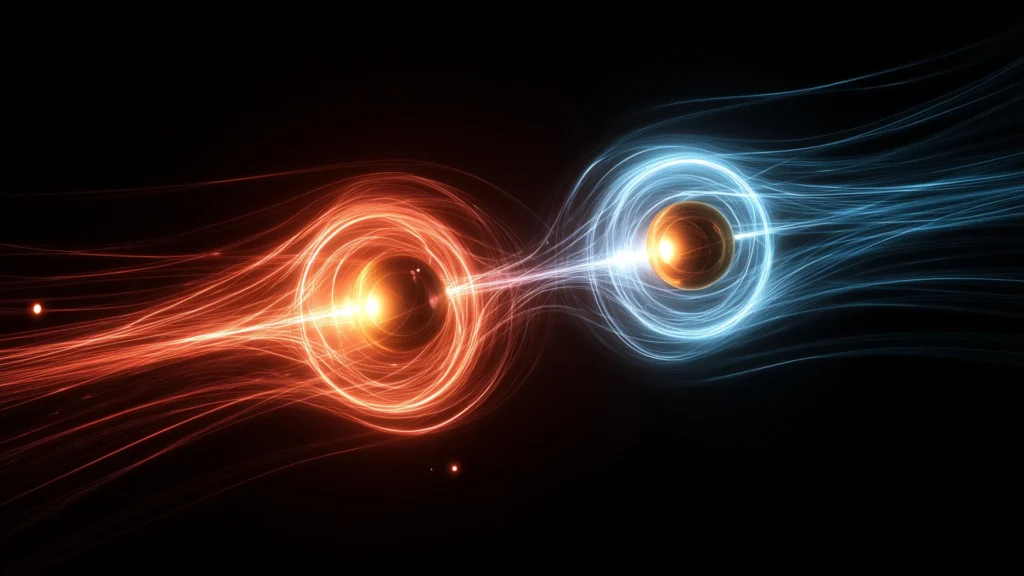
Physicists at Emory University have achieved a significant breakthrough, employing a sophisticated machine learning approach to unveil previously unknown details about how particles interact within intricate systems. Their innovative work, published in the esteemed journal PNAS, primarily focuses on non-reciprocal forces—a class of interactions where the influence one particle exerts on another differs from the influence it receives in return. This collaboration, spanning both experimental and theoretical physics, demonstrates that artificial intelligence can transcend its conventional roles of data analysis and prediction, instead serving as a potent instrument for the discovery of entirely new physical laws.
Unveiling New Physics Through AI
The groundbreaking research represents a paradigm shift in scientific methodology, where AI transitions from a supportive tool to an active agent in fundamental discovery. By integrating a custom-designed neural network with meticulous laboratory data derived from a dusty plasma, the Emory team has shown that AI can illuminate underlying physical principles that have long eluded traditional investigative methods.
"We have definitively demonstrated that AI can be leveraged to uncover novel physics," stated Justin Burton, an Emory professor of experimental physics and a senior co-author of the seminal paper. Burton emphasized the transparency of their approach, noting, "Our AI method is not a black box; we possess a clear understanding of its operational mechanisms and rationale. Furthermore, the framework it establishes is universally applicable, holding immense potential for deployment across a myriad of other many-body systems, thereby charting new avenues for scientific exploration."
This development comes at a time when the scientific community is increasingly exploring the intersection of AI and fundamental research. While AI has revolutionized fields like image recognition and natural language processing, its direct contribution to the formulation of new physical laws has been comparatively rare. This study, therefore, marks a crucial milestone, showcasing AI’s capacity to derive foundational insights rather than merely processing existing ones.
High-Precision Insights into Dusty Plasma Forces
The study provides one of the most exhaustive and precise descriptions to date concerning the complex physics governing dusty plasma. This unique system comprises an ionized gas replete with interacting charged particles, including microscopic grains of dust. Such systems are notoriously challenging to model and measure due to the intricate interplay of forces, particularly the non-reciprocal variety.
Through the deployment of their bespoke AI model, the researchers achieved an unprecedented level of accuracy, describing these non-reciprocal forces with over 99% precision. This level of detail has not only allowed for superior characterization but has also enabled a critical re-evaluation of long-held theoretical assumptions.
Ilya Nemenman, an Emory professor of theoretical physics and the co-senior author, elaborated on this achievement: "We are now able to describe these forces with an accuracy exceeding 99%. What truly excites us is the revelation that some prevalent theoretical assumptions regarding these forces are not entirely accurate. Our ability to perceive the dynamics in such exquisite detail empowers us to rectify these inaccuracies, paving the way for more robust theoretical models."
The implications of this high-precision modeling extend far beyond dusty plasma. The team firmly believes that this innovative methodology can be broadly applied to any system composed of numerous interacting components. This vast category encompasses diverse phenomena, ranging from industrial materials like paints and inks, where particle interactions dictate macroscopic properties, to complex biological systems such as groups of living cells, where collective behavior is paramount.
The Interdisciplinary Engine of Discovery
The success of this endeavor is a testament to the power of interdisciplinary collaboration. Wentao Yu, the study’s first author, initiated his contributions as an Emory PhD student and is currently a postdoctoral fellow at the California Institute of Technology. Co-author Eslam Abdelaleem also played a pivotal role during his tenure as an Emory graduate student and is now a postdoctoral fellow at Georgia Tech. The research received primary financial backing from the National Science Foundation (NSF), complemented by additional funding from the Simons Foundation.
Vyacheslav (Slava) Lukin, program director for the NSF Plasma Physics program, underscored the significance of this collaborative effort: "This project stands as an exemplary model of interdisciplinary collaboration, where the synergistic development of new knowledge in plasma physics and artificial intelligence promises to catalyze further advancements in the study of living systems. The intricate dynamics characteristic of these complex systems are largely governed by collective interactions, which emerging AI techniques may significantly help us to better describe, recognize, understand, and ultimately control." Lukin’s statement highlights the broader vision of applying these tools to unravel mysteries across scientific disciplines, from fundamental physics to the intricacies of biological processes.
The Fourth State of Matter: A Deeper Dive into Plasma
To fully appreciate the context of this research, it is crucial to understand the nature of plasma, often referred to as the fourth state of matter. Unlike solids, liquids, or gases, plasma is an ionized gas where electrons have been stripped from their atoms, resulting in a mixture of free electrons and ions. This state exhibits unique properties, most notably electrical conductivity, and is profoundly abundant, constituting approximately 99.9% of the visible universe. From the relentless solar wind emanating from the Sun to the dramatic flashes of lightning on Earth, plasma is a pervasive and fundamental component of cosmic and terrestrial phenomena.
Dusty plasma, the focus of the Emory study, introduces an additional layer of complexity by incorporating charged dust particles into this ionized gas. These systems are not only found in exotic cosmic environments, such as the majestic rings of Saturn and the Earth’s ionosphere, but also manifest in more terrestrial and sometimes problematic contexts.
Justin Burton provided a vivid example from lunar exploration: "On the Moon, the weak gravitational pull allows charged dust to hover above the surface. This is precisely why astronauts’ suits become thoroughly covered in dust after walking on the lunar regolith." On Earth, dusty plasma can form spontaneously during natural disasters like wildfires, where soot particles become charged and mix with smoke. These charged particles can severely disrupt radio signals, creating significant communication challenges for firefighters battling blazes. Understanding the dynamics of dusty plasma, therefore, has both fundamental scientific merit and practical implications for technology and safety.
Tracking Particle Motion in Three Dimensions
The experimental foundation of this research was meticulously laid in Burton’s laboratory, where dusty plasma and analogous materials are recreated under precisely controlled conditions. Researchers suspend minuscule plastic particles within a plasma-filled vacuum chamber, carefully simulating more complex real-world systems. By finely adjusting gas pressure, they can mimic diverse environmental conditions and meticulously observe how particles respond to various forces.
For this specific project, Burton and Wentao Yu engineered an advanced tomographic imaging method capable of capturing the intricate three-dimensional (3D) motion of particles. This technique involves a laser sheet traversing the chamber, while a high-speed camera simultaneously records a series of images. These individual snapshots are subsequently composited to reconstruct the precise positions of dozens of particles over time, furnishing researchers with an unparalleled, detailed chronicle of their trajectories and interactions. This experimental rigor provided the rich, high-fidelity data essential for training the custom AI model.
Leveraging AI to Understand Collective Motion
Ilya Nemenman, a theoretical biophysicist by training, dedicates his research to understanding how complex systems arise from simpler, underlying interactions. His particular interest lies in collective motion, a phenomenon observed across scales, from the synchronized movement of cells within the human body to the coordinated flight patterns of bird flocks.
"The fundamental questions surrounding how an entire system emerges from the interactions of its minute constituent parts are profoundly important," Nemenman explained. He offered a compelling example from biomedicine: "In the context of cancer, for instance, a crucial objective is to comprehend how cellular interactions might lead to some cells detaching from a primary tumor and migrating to new locations, thereby becoming metastatic."
Compared to the inherent complexities of living systems, dusty plasma offers a more controlled and experimentally tractable environment for testing novel theoretical ideas and computational approaches. This relative simplicity made dusty plasma an ideal testbed for exploring the audacious question of whether AI could genuinely uncover new physical principles, rather than merely reconfirming existing ones.
"Despite the widespread discourse regarding AI’s transformative potential in science, there remain remarkably few instances where something truly fundamental and novel has been discovered directly by an AI system," Nemenman observed, underscoring the unique nature of their achievement.
Designing a Neural Network for Discovery
The construction of the AI model necessitated an exceptionally thoughtful and deliberate design process. Unlike many AI systems that thrive on vast datasets, this project was constrained by the inherent limitations of experimental data when probing uncharted scientific territory.
"When you are investigating something entirely new, the availability of extensive data to train AI is inherently limited," Nemenman clarified. "This constraint meant we had to engineer a neural network specifically capable of being trained with a relatively small amount of data, yet still possessing the capacity to learn something profoundly new."
The team dedicated over a year to meticulously refining the neural network’s architecture, a process marked by rigorous weekly meetings and intensive intellectual exchange. "We recognized the necessity of structuring the network to adhere to established physical rules while simultaneously affording it the latitude to explore and infer unknown physics," Burton detailed, highlighting the delicate balance required between constraint and discovery.
Nemenman recounted the iterative process: "It required more than a year of continuous back-and-forth discussions in these weekly meetings. However, once we converged upon the correct structural design for the network, the final implementation proved to be surprisingly elegant and straightforward."
The ultimate model decomposed particle motion into three principal influences: drag attributable to velocity, environmental forces such as gravity, and the intricate forces acting between individual particles. This structured approach, informed by physics, allowed the AI to focus its learning on the unknown aspects of particle interaction.
Surprising Results and New Insights Challenging Orthodoxy
Upon training with the high-fidelity 3D particle trajectories, the AI model successfully captured the intricate dynamics of particle interactions, including the subtle and often elusive asymmetrical forces between them. The researchers likened this complex behavior to two boats navigating a lake. Each boat generates waves that, in turn, influence the other. Depending on their relative positions and motions, these waves can exert differential pushes or pulls on each boat, demonstrating a non-reciprocal interaction.
"Within the dusty plasma, our AI described a scenario where a leading particle invariably attracts the trailing particle, yet the trailing particle consistently repels the leading one," Nemenman elucidated. "While this specific phenomenon had been hypothesized by some, we now possess a precise, data-driven approximation for it, a level of detail that previously did not exist."
Beyond confirming theoretical predictions with unprecedented accuracy, the results also posed a direct challenge to several long-standing theoretical assumptions in the field. One widely accepted theory posited that a particle’s electric charge increases in direct proportion to its size. The new findings, however, revealed a more nuanced relationship: while larger particles do indeed carry more charge, the relationship is far more complex, dynamically dependent on additional factors such as plasma density and temperature. This correction refines our understanding of charge distribution in such systems.
Another prevailing assumption held that forces between particles decay exponentially with distance, and that this decay rate was independent of particle size. Contrary to this, the AI model unveiled that particle size does significantly affect how rapidly these inter-particle forces diminish, adding a crucial parameter to future theoretical models. The team meticulously confirmed these startling conclusions through a series of additional, corroborating experiments, solidifying the validity of the AI’s discoveries.
A New Tool for Exploring Complex Systems and the Future of Science
The researchers have successfully developed a physics-informed neural network that operates efficiently on a standard desktop computer, making this powerful analytical tool widely accessible. They contend that it offers a flexible and robust framework for studying a diverse array of many-body systems across various scientific domains.
Nemenman’s upcoming role as an instructor at the Konstanz School of Collective Behavior in Germany exemplifies the broader applicability of this research. At this institution, scientists from around the globe convene to study systems ranging from the intricate formations of bird flocks to the emergent behaviors of human crowds. "I will be instructing students from across the world on how to employ AI to infer the physics of collective motion—not within a dusty plasma, but within a living system," he announced, signaling the exciting transferability of their methodology.
Despite these significant technological advances, the researchers emphatically underscore the enduring and indispensable role of human expertise. Scientists remain crucial for the careful design of these sophisticated models, the meticulous interpretation of their outputs, and the critical assessment of their implications.
"It requires profound critical thinking to develop and deploy AI tools in ways that genuinely advance science, technology, and the humanities," Burton emphasized, highlighting the symbiotic relationship between human intellect and artificial intelligence. He concluded on an optimistic note, envisioning a future where AI acts as an enabler for unprecedented discovery. "I often liken it to the Star Trek motto: ‘to boldly go where no one has gone before.’ When utilized judiciously and ethically, AI possesses the unparalleled capacity to unlock doors to entirely new realms of scientific exploration." This research not only pushes the boundaries of our understanding of particle interactions but also redefines the very methods by which scientific discovery is pursued.