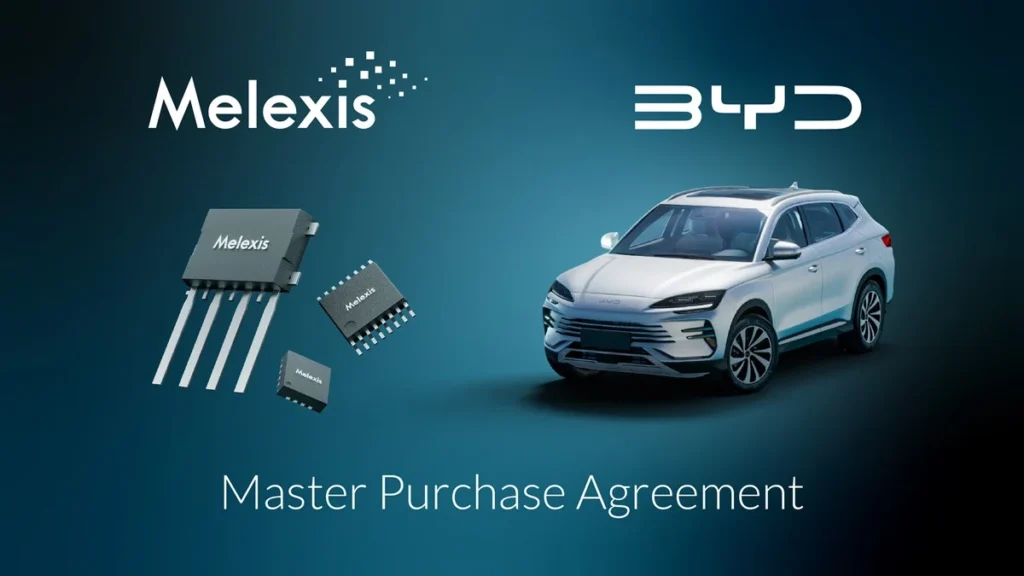
In a significant move poised to reshape the electric vehicle (EV) supply chain, Melexis, a global leader in micro-electronic semiconductor solutions, has formally cemented its relationship with BYD, the world’s leading manufacturer of New Energy Vehicles (NEVs). The signing of a Master Purchase Agreement (MPA) establishes Melexis as a direct supplier within BYD’s extensive global procurement network, marking a pivotal evolution from a multi-year collaborative history between the two industry giants. This strategic partnership grants BYD streamlined, direct access to Melexis’s cutting-edge semiconductor technologies, which are critical for a wide array of electric vehicle applications, promising enhanced efficiency, innovation, and supply chain resilience for both entities.
A Strategic Deepening of Collaboration
The formalization of Melexis as a direct supplier to BYD is not merely a transactional agreement but rather a strategic deepening of an already robust, albeit previously indirect, collaboration. For years, Melexis’s advanced sensor and driver technologies have likely found their way into BYD vehicles through various Tier-1 automotive suppliers. This MPA, however, eliminates intermediaries, fostering a more direct line of communication, procurement, and, crucially, engineering collaboration. This direct conduit is expected to significantly reduce supply chain complexities, improve operational efficiencies, and accelerate the integration of next-generation semiconductor solutions into BYD’s rapidly expanding portfolio of electric and plug-in hybrid vehicles.
The implications of this agreement extend far beyond simplified logistics. It signifies a strategic alignment of technological roadmaps, enabling Melexis to tailor its innovations more precisely to BYD’s evolving vehicle platforms and future requirements. For Melexis, this translates into a stronger foothold in the burgeoning Chinese automotive market and a deeper partnership with one of the most influential players in global electrified mobility. For BYD, it means guaranteed access to high-performance, critical semiconductor components, which are increasingly becoming the neural network of modern vehicles, particularly those powered by electricity.
Melexis’s Portfolio: Powering BYD’s Electric Future
Under the terms of the MPA, BYD will gain direct access to Melexis’s comprehensive portfolio of semiconductor technologies, spanning an extensive range of automotive applications crucial for electric and new energy vehicles. This includes an array of advanced sensors and driver integrated circuits (ICs) designed to optimize performance, enhance safety, and improve energy efficiency across multiple vehicle systems.
Key areas of application include:
- Automotive Powertrain: Melexis’s magnetic sensors are vital for precise motor control, providing feedback on rotor position and speed in electric motors. This precision is fundamental for maximizing efficiency, power delivery, and regenerative braking capabilities in BYD’s electric drive units. Current sensors are also critical for monitoring energy flow and managing power electronics within the inverter systems.
- Thermal Management: The efficient management of heat is paramount in electric vehicles, affecting battery longevity, motor performance, and passenger comfort. Melexis offers temperature sensors and control ICs that enable sophisticated thermal management systems for battery packs, electric motors, power electronics, and cabin climate control (HVAC). These components help maintain optimal operating temperatures, preventing overheating or under-cooling, which can degrade performance and shorten component lifespan.
- Lighting Systems: From adaptive headlights to sophisticated interior ambient lighting, Melexis provides LED driver ICs that enable advanced and energy-efficient lighting solutions. These drivers offer precise current control, dimming capabilities, and diagnostic features, enhancing vehicle aesthetics, safety, and energy conservation.
- Braking and Steering Systems: In modern EVs, electronic braking and power steering systems rely heavily on accurate sensor feedback. Melexis’s position sensors are crucial for electronic power steering (EPS) systems, providing precise steering angle information. Similarly, their sensors contribute to advanced braking systems (e.g., ABS, ESC), ensuring optimal control and safety.
- Battery-Related Applications: The Battery Management System (BMS) is the brain of an EV’s battery pack, and Melexis contributes vital components here. High-precision current sensors are essential for accurate state-of-charge (SoC) and state-of-health (SoH) calculations, critical for range estimation and battery longevity. Voltage and temperature monitoring sensors also play a pivotal role in ensuring battery safety and optimizing charging/discharging cycles.
This direct access facilitates a closer integration of Melexis’s technological roadmap with BYD’s future vehicle platforms, enabling bespoke solutions and accelerating the development cycle for next-generation NEVs. The synergy between Melexis’s deep expertise in micro-electronics and BYD’s rapid innovation in vehicle design and integration is expected to yield significant advancements in vehicle performance, safety, and intelligence.
BYD’s Ascendancy and the Semiconductor Imperative
BYD’s journey from a battery manufacturer in the mid-1990s to a global NEV powerhouse is a testament to its relentless innovation and vertical integration strategy. In 2022, BYD surpassed Tesla as the world’s largest producer of NEVs by volume, selling over 1.86 million vehicles globally, a figure that continues to climb rapidly. Its expansive product portfolio ranges from passenger cars to buses, trucks, and even monorail systems, all underpinned by its core competencies in battery technology, electric powertrains, and semiconductor manufacturing.
The sheer scale of BYD’s production and its ambitious global expansion plans necessitate robust, secure, and technologically advanced supply chains. Semiconductors, often dubbed the "new oil," are at the heart of this imperative. Every modern vehicle, particularly an EV, can contain thousands of semiconductor chips controlling everything from the engine management unit (or electric motor controller) to infotainment systems, safety features, and battery management. The global chip shortage experienced in recent years starkly highlighted the vulnerability of automotive supply chains and underscored the strategic importance of direct relationships with semiconductor manufacturers. For BYD, securing a direct supply of critical components from a trusted partner like Melexis mitigates risks, enhances predictability, and ensures the continuous flow of innovation into its vehicle lines.
Timeline of Collaboration and Evolution
While the precise inception of Melexis and BYD’s collaboration remains proprietary, the announcement of the MPA signifies a culmination of a multi-year engagement. Initially, Melexis likely supplied components to BYD indirectly through various Tier-1 automotive system integrators. As BYD scaled its NEV production and intensified its focus on in-house technological development and vertical integration, the strategic value of a direct relationship with key component suppliers like Melexis became increasingly apparent.

The progression can be logically inferred:
- Early 2010s (Indirect Engagement): Melexis components, known for their reliability and performance in automotive applications, begin to be integrated into BYD vehicles, possibly through modules supplied by Tier-1 partners.
- Mid-2010s (Growing Adoption): As BYD’s EV portfolio expands, the demand for sophisticated sensors and drivers increases, leading to more frequent, albeit still indirect, usage of Melexis technology.
- Late 2010s (Strategic Evaluation): BYD’s rapid growth and the emerging challenges of global supply chain stability likely prompted an evaluation of direct supplier relationships for critical components. Discussions between Melexis and BYD would have intensified, exploring the mutual benefits of a more integrated partnership.
- Early 2020s (Formalization): Following successful evaluations and a proven track record of technological compatibility, the decision to formalize the relationship into a Master Purchase Agreement was made, culminating in the recent public announcement. This timeline underscores a natural evolution driven by market dynamics, technological convergence, and strategic foresight from both companies.
Simplifying the EV Supply Chain: A Broader Industry Trend
The automotive industry, particularly the EV sector, is characterized by an intricate and often opaque supply chain. Traditionally, Original Equipment Manufacturers (OEMs) relied heavily on Tier-1 suppliers to integrate various components and systems. However, the increasing complexity and criticality of semiconductors in modern vehicles, coupled with recent supply chain disruptions, have spurred a paradigm shift. OEMs are increasingly seeking direct engagements with semiconductor manufacturers.
This direct purchasing and supply process offers several advantages:
- Reduced Complexity: Cutting out intermediaries streamlines communication and logistics, making the supply chain more agile and responsive.
- Improved Efficiency: Direct relationships can lead to faster decision-making, quicker integration of new technologies, and more efficient problem-solving.
- Enhanced Visibility and Control: OEMs gain greater insight into the manufacturing process of critical components, improving quality control and risk management.
- Cost Optimization: Direct negotiations can lead to more favorable pricing structures, optimizing overall production costs.
- Future-Proofing: Aligning technology roadmaps directly allows for proactive development of components tailored to future vehicle architectures, ensuring that innovation keeps pace with market demands.
This trend reflects a broader recognition that semiconductors are no longer mere commodities but strategic assets that define a vehicle’s performance, safety, and intelligence.
Official Responses and Inferred Statements
Dieter Verstreken, VP China Strategy at Melexis, articulated the strategic significance of this agreement, stating, "BYD continues to set the global pace for scale and innovation in electrified mobility. Transitioning to a direct supplier relationship is a natural evolution of our multi-year collaboration. It allows our engineering teams to collaborate more closely, ensuring our high-performance semiconductor solutions directly support BYD’s mission to deliver safer, more efficient, and smarter vehicles." Verstreken’s statement underscores the shared vision of innovation and the mutual benefits derived from deeper technical integration.
While a direct statement from BYD was not released in the initial announcement, a spokesperson for the Chinese EV giant would logically emphasize the strategic importance of securing advanced semiconductor technologies for their rapidly expanding production volumes. Such a statement would likely highlight how direct partnerships are crucial in ensuring robust and resilient supply chains, especially in a volatile global economic landscape. Furthermore, BYD would likely stress the value of fostering innovation that directly benefits their next-generation vehicle platforms, ultimately enhancing product quality, driving technological leadership, and elevating the customer experience through safer, more intelligent, and higher-performing vehicles. The ability to co-develop and customize components with Melexis would be positioned as a key differentiator in BYD’s continuous pursuit of automotive excellence.
Broader Impact and Industry Implications
The Melexis-BYD MPA sends a strong signal across the automotive and semiconductor industries. It validates the growing trend of direct OEM-supplier relationships for critical components and highlights the increasing strategic importance of micro-electronics in the electrification of mobility.
- For the Semiconductor Industry: This agreement strengthens Melexis’s competitive position within the automotive sector, particularly in the high-growth EV segment. It could encourage other semiconductor companies to pursue similar direct engagements with major automotive OEMs, potentially reshaping the traditional multi-tiered supply chain structure. The focus on direct engineering collaboration also signifies a move towards more application-specific and customized chip development, moving away from purely off-the-shelf solutions.
- For the Automotive Industry: Other global automotive manufacturers, observing BYD’s success and proactive supply chain management, may accelerate their own efforts to establish direct ties with key semiconductor providers. This could lead to a more diversified and robust global automotive supply chain, less susceptible to single points of failure. The emphasis on advanced sensors and drivers also points to the continued evolution of vehicle intelligence, autonomous capabilities, and enhanced user experience as core competitive battlegrounds.
- Geopolitical Context: In an era marked by increasing geopolitical tensions and concerns over supply chain sovereignty, particularly in critical technologies like semiconductors, direct agreements between companies across different regions (Belgium-based Melexis and China-based BYD) demonstrate a pragmatic approach to securing essential components and fostering technological exchange. It underscores the global interdependence of the technology sector despite broader nationalistic tendencies.
- Future of EV Technology: This collaboration is likely to accelerate advancements in critical EV domains such as battery efficiency, power electronics optimization, and sophisticated sensor fusion for advanced driver-assistance systems (ADAS) and potentially autonomous driving. The direct feedback loop between BYD’s vehicle design and Melexis’s chip development ensures that semiconductor innovations are highly relevant and optimized for real-world automotive applications.
Melexis Expands Automotive Partnerships: A Strategic Imperative
This agreement with BYD is a cornerstone of Melexis’s broader strategic initiative to solidify its relationships with major automotive manufacturers worldwide and expand its footprint in vehicle electrification applications. The company has long been a trusted supplier of semiconductor technologies for a diverse range of automotive systems, with its sensing and driver products increasingly becoming indispensable across electric powertrains, sophisticated battery management systems, advanced thermal management solutions, and various other critical vehicle functions.
By establishing direct partnerships with industry leaders like BYD, Melexis is not only securing its market position but also actively shaping the future of automotive technology. The company’s commitment to innovation in areas vital for electrification – such as high-precision current sensing, robust magnetic position sensing, and efficient power management – positions it as a crucial enabler of the ongoing global transition to sustainable mobility. As electric vehicles become smarter, more efficient, and more integrated, the role of advanced semiconductors will only grow, making strategic alliances like the one between Melexis and BYD fundamental to the industry’s continued progress.