Microwave Factory (MWF), a prominent developer of advanced software solutions for wireless device testing, has officially announced the integration of the Rohde & Schwarz CMX500 5G one-box signaling tester into its MATEOS Specific Absorption Rate (SAR) measurement software. This pivotal development streamlines and automates the complex process of SAR measurements for both 5G New Radio (NR) and Long-Term Evolution (LTE) devices, marking a significant advancement in ensuring wireless device compliance with human exposure limits. The collaboration leverages the CMX500’s robust signaling capabilities with SPEAG’s cSAR3D vector array system, all orchestrated through a unified MATEOS workflow, promising unparalleled efficiency and accuracy for manufacturers, test houses, and certification laboratories worldwide.
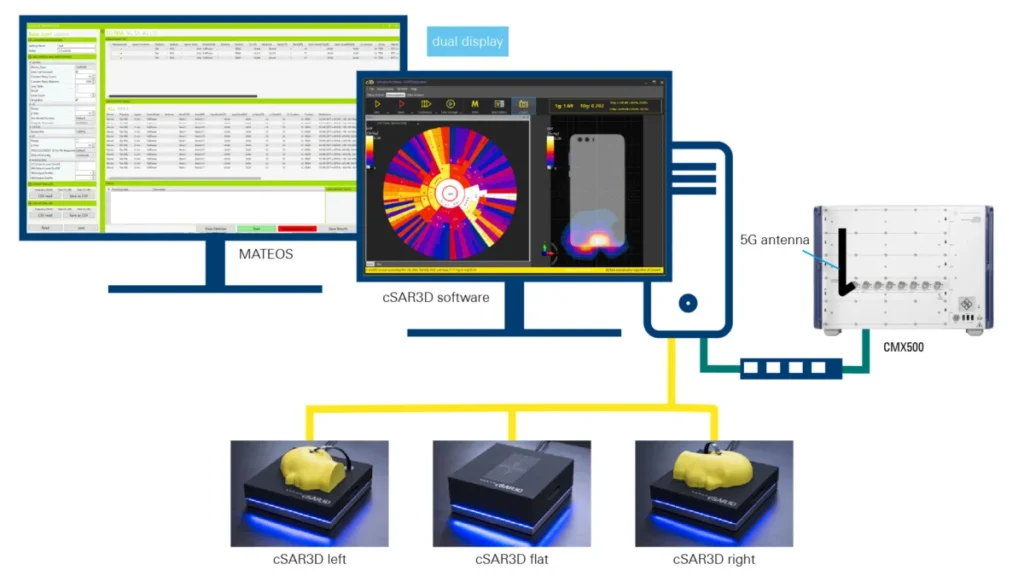
The core of this integration lies in simplifying what has historically been a time-consuming and labor-intensive procedure. Previously, engineers undertaking SAR measurements for advanced wireless devices often contended with disparate systems, requiring manual configuration of calls and separate setup steps on the network emulator. The new MATEOS workflow, by contrast, consolidates control into a single, intuitive interface. This allows for seamless command over the Rohde & Schwarz CMX500, which provides the necessary wireless device signaling, and SPEAG’s cSAR3D vector array system, which meticulously performs the SAR measurements. This holistic approach drastically reduces the potential for human error, accelerates test cycles, and optimizes resource allocation in testing environments.
The Critical Imperative of Specific Absorption Rate (SAR) Testing
Specific Absorption Rate (SAR) testing is a non-negotiable requirement for all wireless communication devices intended for sale and use in most global markets. It quantifies the rate at which radiofrequency (RF) energy is absorbed by the human body when exposed to a transmitting device. Regulatory bodies worldwide, such as the Federal Communications Commission (FCC) in the United States, the International Commission on Non-Ionizing Radiation Protection (ICNIRP) in Europe, and similar authorities in Asia and other regions, establish stringent limits for SAR values to safeguard public health. These limits are typically expressed in watts per kilogram (W/kg) averaged over a specific mass of tissue (e.g., 1g or 10g) and are critical for preventing potential adverse health effects from RF exposure.
The advent of 5G technology, with its intricate architecture and diverse operating modes, has amplified the complexity of SAR measurement significantly. Unlike previous generations, 5G NR introduces several challenging elements:
- Beamforming and Massive MIMO: 5G utilizes advanced antenna technologies like massive Multiple-Input, Multiple-Output (MMIMO) and beamforming, where RF energy is directed precisely towards the user. This dynamic behavior means that the SAR distribution can vary significantly depending on the device’s orientation, proximity to the user, and the network’s signaling strategy.
- New Frequency Bands: 5G operates across a wider spectrum, including sub-6 GHz (FR1) and millimeter-wave (mmWave) bands (FR2). While mmWave signals have lower penetration into human tissue, the localized heating effects and near-field characteristics still necessitate rigorous testing.
- Dynamic Power Control: 5G devices constantly adjust their transmit power based on network conditions and user activity, making it challenging to capture worst-case SAR scenarios reliably.
- Multiple Radios and Antennas: Modern smartphones often integrate multiple wireless technologies (5G, LTE, Wi-Fi, Bluetooth) and numerous antennas, all potentially transmitting simultaneously, requiring complex inter-radio access technology (IRAT) testing.
- Standalone (SA) and Non-Standalone (NSA) Modes: 5G NR operates in both NSA mode, relying on an LTE anchor, and SA mode, which is fully independent. Each mode presents unique signaling and testing challenges for SAR compliance.
For these reasons, the traditional manual methods of SAR testing, which might have been adequate for simpler 2G or 3G devices, are increasingly becoming bottlenecks in the product development and certification lifecycle of 5G and advanced LTE devices. The demand for automated, accurate, and repeatable SAR measurement solutions has thus become paramount.
Automated SAR Testing for 5G NR and LTE: A Leap Forward
The new implementation directly addresses these challenges by offering comprehensive support for 5G NR standalone (SA), 5G NR non-standalone (NSA), and LTE devices. This broad coverage ensures that a wide array of current and future wireless devices can benefit from the streamlined testing process. The companies involved, Rohde & Schwarz and Microwave Factory, explicitly stated that this integration was a direct response to customer requests for an automated SAR measurement solution that combines the industry-leading CMX500 with SPEAG’s highly regarded SAR systems. This customer-centric development approach underscores the market’s urgent need for such a solution.
The operational synergy is straightforward yet powerful:

- MATEOS Software: Serves as the central command and control interface, managing the entire SAR measurement workflow. It orchestrates the communication between the signaling tester and the SAR measurement system.
- Rohde & Schwarz CMX500: Acts as the critical communication emulator, establishing and maintaining stable 5G NR or LTE connections with the device under test (DUT). It simulates real-world network conditions, controls the device’s transmit power, and ensures the device operates in the desired modes (e.g., specific bands, channel configurations, data rates) required for SAR testing. Its role is to provide precise, repeatable signaling for accurate worst-case SAR determination.
- SPEAG cSAR3D Vector Array System: This advanced system, known for its speed and accuracy, performs the actual SAR measurements. It uses an array of E-field probes to rapidly capture the RF absorption pattern within a phantom representing human tissue. The cSAR3D’s ability to quickly scan and analyze complex fields is crucial for the dynamic nature of 5G signals.
This integration eliminates the need for engineers to manually configure calls and conduct separate setup steps on the CMX500, significantly reducing setup time from hours to minutes for each test configuration. The automated script generation and execution capability within MATEOS ensure that tests are run consistently, minimizing variability and enhancing the reliability of the results. This is particularly vital for certification, where regulatory bodies demand high levels of repeatability and adherence to specified test procedures.
Broader Impact and Implications for the Wireless Industry
The implications of this automated SAR measurement solution extend far beyond just faster testing. They touch upon several critical aspects of the wireless ecosystem:
- Accelerated Time-to-Market: For device manufacturers, the ability to conduct SAR testing more quickly and efficiently directly translates into shorter product development cycles. This means new smartphones, IoT devices, and other wireless gadgets can reach consumers faster, providing a competitive edge in a rapidly evolving market.
- Reduced Development Costs: Automation minimizes the need for extensive manual intervention, freeing up highly skilled engineers to focus on more complex tasks. It also reduces the operational costs associated with prolonged test periods and potential re-testing due to manual errors.
- Enhanced Compliance and Quality Assurance: The consistent and repeatable nature of automated testing ensures higher confidence in SAR compliance. This reduces the risk of non-compliance issues during certification, which can lead to costly product recalls or delays. It also contributes to higher overall product quality and user safety.
- Increased Throughput for Test Houses: Independent test laboratories and certification bodies, which often face backlogs due to the sheer volume of new device submissions, will benefit immensely from increased testing throughput. This allows them to process more devices in less time, improving their service offerings and operational efficiency.
- Enabling Future Innovation: By simplifying a critical compliance hurdle, this integration empowers designers and engineers to explore more complex antenna designs, new frequency bands, and innovative device form factors without being unduly constrained by SAR testing challenges. This fosters further innovation in wireless technology.
- Standardization and Best Practices: Such integrations often drive the adoption of standardized test methodologies across the industry, promoting a more uniform and reliable approach to SAR compliance globally.
The Collaborative Expertise Behind the Innovation
This development is a testament to the ongoing collaboration between industry leaders. Rohde & Schwarz, a global technology group with a rich history spanning over 90 years, is renowned for its cutting-edge test and measurement solutions, broadcast and media technology, cybersecurity, radiomonitoring, and radiolocation. Their CMX500 5G one-box signaling tester is a cornerstone in 5G device development and production, offering unparalleled flexibility and performance for testing all 5G NR and LTE modes. Its ability to simulate real-world network conditions makes it indispensable for comprehensive device characterization.
SPEAG (Schmid & Partner Engineering AG) is a world leader in the development, production, and distribution of advanced measurement solutions for electromagnetic near-field testing. Their cSAR3D system is widely recognized for its high-speed and accurate SAR measurement capabilities, critical for meeting stringent regulatory requirements. SPEAG’s expertise in electromagnetic simulation and measurement is fundamental to understanding and mitigating RF exposure risks.
Microwave Factory (MWF), though perhaps less widely known than its partners, plays a crucial role as a specialized software developer. Its MATEOS SAR measurement software acts as the intelligent bridge, integrating diverse hardware components into a cohesive, automated workflow. MWF’s focus on user experience and workflow optimization ensures that complex technical processes are managed with efficiency and precision. This integration builds upon previous collaborations between Rohde & Schwarz and SPEAG in the SAR testing domain, indicating a shared vision for advancing wireless device testing capabilities. The CMX500’s role within automated wireless device test environments has been steadily expanding, and this latest integration further solidifies its position as a central component in the automated test ecosystem.
Looking Ahead: The Future of Wireless Device Compliance
As wireless technologies continue to evolve with 6G research already underway and the Internet of Things (IoT) expanding exponentially, the need for robust, efficient, and automated compliance testing will only intensify. The integration of the Rohde & Schwarz CMX500 with Microwave Factory’s MATEOS software and SPEAG’s cSAR3D system represents a significant step towards a future where device certification is faster, more cost-effective, and ultimately safer for consumers. It underscores the industry’s commitment to not only pushing the boundaries of connectivity but also ensuring that these advancements are introduced responsibly and in full compliance with global health and safety standards. This kind of synergistic development between key players will continue to shape the landscape of wireless device testing, driving innovation and reliability in the ever-connected world.