Imagine a world where the gentle warmth of visible sunlight could be harnessed to generate the powerful ultraviolet (UV) radiation essential for numerous advanced technologies. This seemingly impossible feat, akin to mixing two cups of warm water and producing boiling water, has now taken a significant leap towards reality thanks to groundbreaking research from Kyushu University. A team of scientists has developed a novel solid-state molecular material capable of efficiently converting visible sunlight into higher-energy UV light under ambient outdoor conditions, marking a pivotal advancement in the field of photon upconversion.
The study, published on June 23rd in the prestigious journal Nature Communications, details the creation of a material that achieves an impressive photo upconversion efficiency of 1.9%. This development holds immense promise for a wide array of applications, from industrial processes to environmental solutions, all powered by the ubiquitous energy of the sun.
The Growing Importance of Ultraviolet Light
While often associated with the negative effects of sunburn, ultraviolet light is far from a mere nuisance. It plays a crucial, albeit often unseen, role in a multitude of modern technological applications. Its germicidal properties make it indispensable for air purification systems, effectively neutralizing bacteria and viruses. In the rapidly evolving field of 3D printing, UV light is critical for curing resins, enabling the rapid hardening and precise formation of intricate designs. The dental industry relies on UV light to harden fillings, ensuring durable and long-lasting dental restorations. Even in personal care, UV lamps are a staple for setting gel nail polishes.
Despite its widespread utility, ultraviolet radiation constitutes a mere 6% of the total solar spectrum that reaches the Earth’s surface. Furthermore, not all of this limited UV portion is practical for direct technological utilization. This scarcity underscores the critical need for efficient methods to generate UV light from more abundant solar components, a challenge that the Kyushu University team has now effectively addressed.
The Science of Photo Upconversion: Adding Light’s Energy
At the heart of this innovation lies a fascinating quantum mechanical process known as photo upconversion. Associate Professor Yoichi Sasaki from Kyushu University’s Faculty of Engineering, the study’s corresponding author, explains this phenomenon: "What we do here is ‘add together’ the energy from two visible light photons to make one ultraviolet photon. It’s a fascinating process called photo upconversion."
This process hinges on a mechanism called triplet-triplet annihilation (TTA). In essence, a donor molecule first absorbs visible light, transitioning into a higher-energy state known as a triplet state. This absorbed energy is then efficiently transferred to a nearby acceptor molecule, also placed in a triplet state. The critical step occurs when two such energized triplet states encounter each other. They can then combine their energies, releasing this combined energy as a single photon of much higher energy – in this case, a UV photon.
Overcoming the Solid-State Challenge
For years, scientists have understood that TTA operates effectively in liquid solutions. The inherent mobility of molecules in liquids allows for frequent and facile interactions, facilitating the triplet-triplet encounters necessary for upconversion. However, liquid-based systems often present significant practical limitations. Many require the use of toxic solvents, posing environmental and health concerns. Moreover, liquids are susceptible to evaporation over time, diminishing their long-term stability and operational viability. Consequently, the scientific community has long sought a robust and practical solid-state alternative.
The primary hurdle in achieving efficient solid-state TTA lies in the close proximity of molecules in solid materials. "In solids, molecules are packed tightly, and the π electron clouds – regions of high electron density hovering above and below each molecular plane – can overlap," explains Professor Sasaki. "When that happens, triplets easily fizzle out before they ever meet. Molecules must be close enough for energy to transfer but separated enough to prevent quenching of excitons." This delicate balance between close proximity for energy transfer and sufficient separation to prevent energy loss is what has made solid-state upconversion so challenging.
A Novel Molecular Design for Enhanced Efficiency
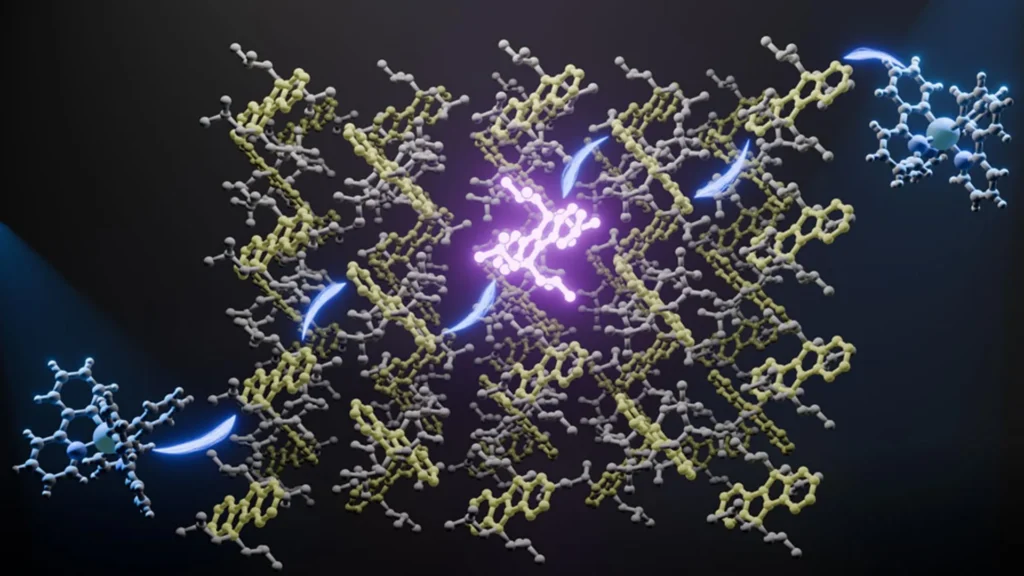
The breakthrough achieved by the Kyushu University team came with their innovative approach to designing a solid-state molecular material. Their solution centers on an organic semiconductor known as dihydroindenoindenedene (DHI). The researchers ingeniously modified the DHI molecule by attaching alkyl chains to its sp³ hybridized carbon atoms. These carbon atoms, characterized by their four bonds directed towards the vertices of a tetrahedron, are crucial for establishing precise three-dimensional arrangements.
This strategic modification resulted in a material where the spacing between neighboring DHI molecules was meticulously controlled. The design ensured that the molecules remained sufficiently close to allow for efficient energy transfer between them, a prerequisite for TTA. Simultaneously, this controlled spacing prevented the overly strong electronic interactions that typically lead to the premature dissipation of energy, a phenomenon known as quenching. This delicate architectural engineering of the molecular arrangement was the key to overcoming the long-standing limitations of solid-state TTA.
The resulting material exhibited several highly desirable properties. It demonstrated strong luminescence, indicating efficient light emission. Its excited states were long-lived, providing ample time for interactions to occur. Crucially, the energy transfer process within the material was highly effective, leading to a solid-state fluorescence quantum yield exceeding 60%.
When this engineered DHI material was paired with a suitable donor molecule, the complete system achieved the remarkable upconversion efficiency of 1.9%. Professor Sasaki elaborated on the significance of this figure: "This means roughly two UV photons are produced for every hundred visible-light photons absorbed. It may sound low, but it runs on natural sunlight alone. Most solid-state materials cannot realize this even at much higher light intensity." This statement highlights the exceptional performance of the material under realistic solar conditions, where light intensity naturally fluctuates.
The 14-Year Journey to a Groundbreaking Discovery
The path to this significant achievement was not a short one, representing over 14 years of dedicated research and persistent scientific inquiry. The foundational work began in 2012 when Professor Emeritus Nobuo Kimizuka, then affiliated with Kyushu University’s Research Center for Negative Emissions Technologies, initiated explorations into photon upconversion via triplet energy migration in self-assembled molecular systems. His overarching vision was to establish a new paradigm in molecular systems chemistry where self-assembly could be harnessed to perform complex and useful functions.
Over the subsequent years, Professor Kimizuka’s group made consistent progress, initially achieving promising results with solution-based and gel-based systems. However, realizing efficient upconversion in a solid-state format remained an elusive goal. The inherent challenges of controlling molecular interactions in solids continued to impede significant advancements.
The critical breakthrough finally arrived in May 2024, a significant milestone that occurred less than a year before Professor Kimizuka’s impending retirement. This timing added a poignant layer to the discovery, marking the culmination of decades of dedicated effort.
The months that followed became a period of intense focus and collaborative effort to finalize the research and prepare it for publication. Graduate students Naoyuki Harada, Hayato Shoyama, and Nutnicha Boonmong worked tirelessly alongside Professor Sasaki and then-Assistant Professor Kiichi Mizukami of Kyushu University’s Faculty of Engineering. Together, they consolidated years of accumulated knowledge and experimental data into a cohesive and compelling scientific publication.
In a touching gesture that underscored the deep mentorship and collaborative spirit within the research group, Professor Sasaki shared, "We handed the draft to Professor Kimizuka just 11 days before he left the lab, which for us felt like a heartfelt retirement gift."
Professor Kimizuka himself reflected on the profound significance of the discovery: "This discovery is the culmination of over 14 years of our research and marks a major milestone in photon-upconversion and molecular self-assembly research." His words encapsulate the long-term vision and the enduring dedication that characterized this scientific endeavor.
Future Implications and Potential Applications
The potential applications stemming from this breakthrough are extensive and impactful. The Kyushu University team has already taken steps to protect their innovation by filing a patent application for the newly developed material.
Beyond its impressive performance metrics, the material offers significant practical advantages. Its synthesis is described as relatively straightforward, and it is derived from inexpensive starting materials, suggesting scalability and economic feasibility for future commercialization.
The researchers envision a range of transformative uses for this solar-powered UV light generation technology. It could revolutionize photocatalysis, enabling more efficient and environmentally friendly chemical reactions powered solely by sunlight. Indoor air purification systems could become more effective and energy-efficient, continuously sanitizing enclosed spaces. Furthermore, the technology could pave the way for low-intensity 3D printing applications that are less reliant on external power sources, making additive manufacturing more accessible and sustainable.
A Paradigm Shift in Solar Energy Utilization
The achievement by the Kyushu University team represents more than just a scientific advancement; it signifies a potential paradigm shift in how we harness solar energy. By enabling the efficient conversion of abundant visible light into the more specialized and technologically valuable UV spectrum, this research opens up new avenues for sustainable energy utilization. It addresses a fundamental limitation in solar energy’s direct application for certain high-value processes.
The development of a robust, solid-state material that performs this conversion under normal outdoor conditions is a critical step towards realizing practical, widespread applications. The low efficiency of natural UV light for many technological purposes has historically necessitated the use of dedicated, energy-intensive UV light sources. This new material offers a compelling alternative, promising to reduce reliance on conventional electricity grids and contribute to a more sustainable energy future.
The meticulous design of the DHI-based material, balancing molecular proximity for energy transfer with sufficient separation to prevent energy loss, serves as a testament to the power of molecular engineering. This precise control at the nanoscale has unlocked a previously unattainable level of performance in solid-state photo upconversion.
As research continues, further optimization of the material’s composition and structure could potentially lead to even higher upconversion efficiencies. Exploring different donor and acceptor molecules, as well as refining the self-assembly processes, are likely avenues for future investigation. The long-term durability and stability of the material under various environmental conditions will also be crucial areas of study as the technology moves from the laboratory towards real-world deployment.
The successful translation of this fundamental scientific discovery into practical technological solutions will undoubtedly require continued collaboration between academic institutions and industry partners. However, the foundation laid by Professor Sasaki, Professor Kimizuka, and their dedicated team at Kyushu University provides a strong and promising starting point for a future where solar energy plays an even more versatile and critical role in powering our world. The journey from warm water to boiling, at the quantum level, is now one step closer to becoming a tangible reality.