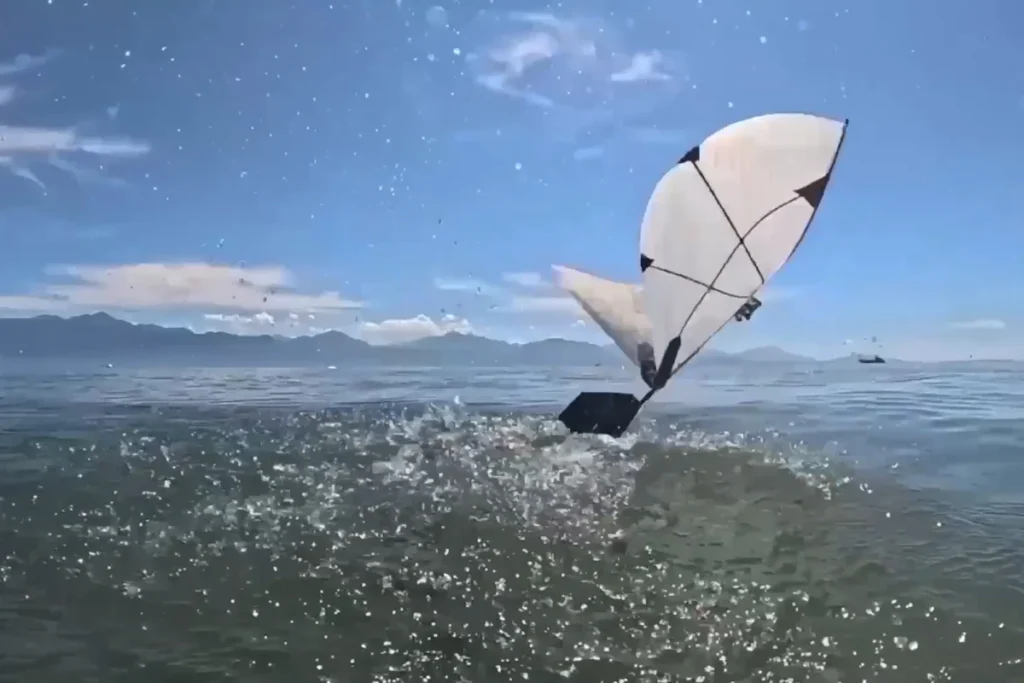
A pioneering breakthrough in biomimetic robotics has emerged from a collaborative effort between engineers at the Massachusetts Institute of Technology (MIT) and EPFL in Lausanne, Switzerland, with additional contributions from Northwest Indian College. The research team has successfully designed and tested a novel robot capable of seamlessly transitioning between underwater swimming and aerial flight, mirroring the extraordinary capabilities of certain avian species. This innovative "flapping-wing aerial-aquatic vehicle," or FAAV, represents a significant leap forward in autonomous multi-modal locomotion, holding immense promise for transforming oceanographic research and environmental monitoring.
Inspiration from Nature: The Bionic Blueprint
The natural world is replete with examples of organisms exhibiting remarkable adaptations, and for this project, the engineers drew profound inspiration from diving birds. Species such as loons, gulls, puffins, and petrels are among the approximately 100 known avian species that possess the unique ability to operate effectively in both air and water. These "aquatic aviators" are masters of two vastly different environments, plunging beneath the surface to hunt for prey with agile swimming motions before leaping back into the air to continue their journeys or escape predators. Their ability to adapt their wing mechanics to propel through mediums with vastly different densities—air being roughly 1,000 times less dense than water—has long fascinated scientists and engineers alike. Observing their efficient transition from a fluid medium to a gaseous one, and vice-versa, provided the foundational biomechanical principles for the FAAV’s design.
The FAAV: A Detailed Look at the "Flapping-Wing Aerial-Aquatic Vehicle"
The FAAV itself is a marvel of miniaturized engineering, weighing in at less than 300 grams (approximately half a pound). Its design philosophy revolves around simplicity and adaptability, featuring a central body or fuselage that houses the core electronics and power source, two flexible, flapping wings, and a steerable tail. A key design consideration was the modularity of its components, allowing for the wings and tail to be interchanged with different sizes. This modularity facilitated extensive experimentation to determine optimal configurations for various operational phases. The wings, crucial for both propulsion and lift, are crafted from thin membranes coated with hydrophobic nanoparticles. This specialized coating serves a vital function: to efficiently wick away water, minimizing drag and energy loss during the critical transition from water to air. The internal mechanics include a waterproof electric motor that drives a crankshaft, translating rotational energy into the precise up-and-down flapping motion required for both swimming and flying. The motorized tail provides essential pitch control, enabling the robot to dive, ascend, and maintain stable flight paths in both mediums.
Overcoming Environmental Extremes: The Physics of Air and Water
The inherent challenge in designing a vehicle capable of operating in both air and water lies in the vastly different physical properties of these two mediums. Water, being significantly denser and more viscous than air, demands substantially different propulsive forces and aerodynamic (or rather, hydrodynamic) efficiencies. A design optimized for flight in air typically struggles in water, and vice-versa. Traditional aerial drones are ill-suited for underwater exploration, while submersible vehicles are tethered to the aquatic environment. The FAAV, however, aims to bridge this gap. The researchers understood that a single, rigid wing design could not possibly be efficient in both environments. Instead, they focused on mimicking the adaptive flapping mechanics of diving birds. These birds adjust their flapping frequency and wing stroke amplitude depending on the medium, using broader, slower strokes for water propulsion and faster, more rapid strokes for flight. This bio-inspired approach guided the development of the FAAV’s flexible wings, which needed to be rigid enough to generate lift in air yet pliable enough to minimize resistance and generate thrust in water.
Rigorous Testing and Optimal Parameters
The development of the FAAV was not merely a theoretical exercise but involved extensive practical testing. The research team conducted a series of meticulous experiments, initially in a controlled water tank environment, followed by more realistic conditions in Lake Geneva in Switzerland. These tests were designed to identify the precise combinations of wing size, flapping frequency, and tail angle that would enable the robot to perform its core function: smoothly transitioning from swimming underwater, breaking through the surface, and continuing its journey through the air.
Three sets of wings were fabricated and tested: small (60 centimeters wide), medium (80 centimeters), and large (100 centimeters). The robot was submerged approximately half a meter below the surface, and various flight parameters were programmed and observed. The data gathered from hundreds of test flights revealed critical insights. The medium-sized wings proved to be the most versatile, striking an optimal balance between the requirements for effective propulsion in water and sufficient lift in air. The flexibility of the wings was identified as a key factor; they needed to be supple enough to reduce flapping amplitude in water, thus minimizing drag, yet firm enough to maintain structural integrity and generate aerodynamic lift during flight.
The experimental results, which were published today in the prestigious journal Science, not only validated the FAAV’s design but also offered profound insights into the biomechanics of diving birds themselves. The robot achieved swimming speeds of nearly 1 meter per second when flapping at approximately 5 Hertz (five flaps per second) and could fly through the air at around 6 meters per second with a similar flapping frequency. These figures closely mirror the observed speeds and flapping rates of actual diving birds, confirming the efficacy of the biomimetic design.
A Leap of Innovation: The Takeoff Mechanism
One of the most remarkable aspects of the FAAV’s performance is its ability to execute a water-to-air transition without relying on the paddling motions commonly employed by many diving birds. When birds like puffins, ducks, or cormorants take off from water, they typically paddle vigorously with their feet, in conjunction with wing flapping and tail adjustments, to generate the necessary initial momentum and break surface tension. The FAAV, however, demonstrated that this paddling maneuver is not strictly necessary for a robotic system.
The key to its successful launch from water into air was found to be a precise pitch angle of 70 degrees during the ascent. This relatively steep angle is crucial as it prevents the robot’s wingtips from re-entering the water’s surface as it flaps upwards, which would create prohibitive drag and disrupt the takeoff. Any steeper angle, and the robot risks tipping backward into the water, losing its momentum. This discovery simplifies the mechanical complexity of such a robot, potentially leading to more robust and energy-efficient designs in the future. As Raphael Zufferey, assistant professor of mechanical engineering at MIT and lead author of the study, notes, "If you look at birds, most birds need to paddle at the surface to take off. And the question was, do we need the same for robots? And it turns out we don’t." This finding represents a significant simplification in the design requirements for aerial-aquatic robots, opening new avenues for development.
Broader Implications: Revolutionizing Oceanography and Beyond
The implications of the FAAV’s success extend far beyond academic curiosity. The ability to seamlessly operate in both air and water addresses a critical gap in current oceanographic research and environmental monitoring capabilities. Traditional methods for collecting marine data often rely on large, expensive research vessels or specialized underwater vehicles. These methods are typically costly, time-consuming, and limited in their reach, particularly in hazardous or remote aquatic regions.
The FAAV offers a compelling alternative. Researchers envision these winged robots being deployed in oceanography to fly to specific aquatic regions that would otherwise be too dangerous or inaccessible for traditional ocean vessels. Imagine a robot launched from a boat or shore, flying rapidly towards an iceberg, a port facility, or even a pod of whales. Upon arrival, it could dive into the water to take precise measurements, collect water or sediment samples, or observe marine life, then swiftly fly back to deliver the collected data. This capability could dramatically reduce the cost and logistical complexity of data collection, enabling more frequent and widespread monitoring of ocean health, climate change indicators, and biodiversity.
Beyond oceanography, the technology could find applications in various other fields. Coastal communities could utilize FAAVs for localized environmental monitoring, detecting pollution, or assessing infrastructure integrity. In disaster response, these robots could quickly survey flooded areas, assess damage, and search for survivors in conditions where human access is perilous. Furthermore, in security and defense, such aerial-aquatic drones could be used for reconnaissance, surveillance, and inspection in complex maritime environments. The potential for deploying swarms of these autonomous, multi-modal robots could create an unprecedented network for real-time, comprehensive environmental sensing across vast marine landscapes.
The Minds Behind the Machine: The Research Team and Their Vision
The development of the FAAV is a testament to interdisciplinary collaboration and a shared vision for bio-inspired engineering. Raphael Zufferey, who leads the AURA Lab at MIT, is at the forefront of this innovative research. His lab specializes in engineering aerial and aquatic vehicles inspired by biomechanics observed in nature, with a particular focus on creating small, unobtrusive robots designed to explore and monitor the health of oceans and waterways. Zufferey emphasizes the transformative potential of their work: "Our dream vision is for oceanographers, marine biologists, and members of coastal communities to launch this robot from a boat, or from shore, and it would fly close to the area of interest… It would dive into the water to take a measurement or collect a sample, and fly back to deliver the data at a fraction of the cost of traditional methods. Then it could go back out to dive for more."
The study is a collaborative effort, underscoring the global nature of scientific inquiry. In addition to researchers from MIT and EPFL, co-authors from Northwest Indian College in Bellingham, Washington, contributed to the project, bringing diverse perspectives and expertise to the complex challenges of aerial-aquatic robotics. This collaborative model, drawing on specialized knowledge from various institutions, has been instrumental in pushing the boundaries of what is technologically possible.
Future Trajectories: Enhancements and Next Steps
While the FAAV has demonstrated groundbreaking capabilities, the research team is not resting on its laurels. Future work will focus on enhancing the robot’s design and expanding its operational envelope. One immediate goal is to improve the design of the wings to enable not only flapping up and down but also turning motions, which would significantly enhance maneuverability and control in both air and water. This would allow the robot to navigate more complex environments and execute more intricate sampling patterns.
Another critical area of future research involves testing the robot’s performance under more challenging and realistic environmental conditions. The initial tests in a controlled tank and the relatively calm waters of Lake Geneva provided essential baseline data. However, real-world ocean environments are characterized by turbulent conditions, including choppy waters, strong currents, and unpredictable winds. Ensuring the FAAV can reliably transition and operate effectively in such dynamic and often harsh conditions will be crucial for its practical deployment.
Ultimately, the long-term vision is to deploy these vehicles to help answer some of the most pressing questions in ocean science. The ability to collect data both frequently and across numerous locations is a major challenge in oceanography today. "You could send this out not just every week, but every hour. It could fly out at high speeds, dive in, fly back, deliver its data, and go back out, multiple times," Zufferey elaborates. This paradigm shift in data collection frequency and coverage could unlock unprecedented insights into marine ecosystems, oceanographic processes, and the impacts of global climate change. The development of the FAAV marks a pivotal moment, ushering in a new era of autonomous, bio-inspired exploration that promises to redefine our understanding and stewardship of the planet’s vast and vital oceans. This transformative work was supported, in part, by a Marie Skłodowska-Curie Actions fellowship grant, highlighting the international recognition of its potential impact.






