MIT engineers are at the forefront of a groundbreaking development in spacecraft propulsion, unveiling a novel system that seamlessly integrates the formidable power of traditional chemical rockets with the unparalleled efficiency and precision of electric thrusters. This innovative approach promises to redefine the operational paradigms for small satellites, offering unprecedented flexibility and capability in the vast expanse of space. By leveraging a single, specialized propellant for both rapid, high-thrust maneuvers and slow, meticulously controlled adjustments, this technology eliminates the need for redundant fuel systems, thereby reducing weight, complexity, and ultimately, mission costs.
The core of this advancement lies in a "green monopropellant" that has proven effective across both chemical and electric propulsion platforms. Historically, these two distinct propulsion technologies have demanded separate propellants and dedicated hardware, contributing significantly to a spacecraft’s mass and intricate design. The advent of a unified propellant solution marks a pivotal moment, poised to unlock new frontiers for compact spacecraft.
"If you can have chemical and electrical propulsion in one small package, it’s the best of both worlds," states Amelia Bruno, a former postdoc in MIT’s Department of Aeronautics and Astronautics (AeroAstro) and the lead author of the seminal study published in the Journal of Propulsion and Power. "This opens the door for small satellites to do even more science, more observations, and more interesting missions, all on a smaller and cheaper platform."
The research specifically demonstrates that the Advanced SpaceCraft Energetic Non-Toxic (ASCENT) propellant, initially conceived by the U.S. Air Force for chemical propulsion, can also successfully power miniature electric thrusters, known as electrospray thrusters. This dual-mode capability is set to revolutionize how small satellites are designed and deployed, enabling them to perform a broader array of tasks with unprecedented agility.
The Duality of Space Propulsion: Chemical vs. Electric
To fully appreciate the significance of this MIT innovation, it is essential to understand the fundamental differences and complementary strengths of chemical and electric propulsion systems. For decades, spacecraft designers have faced a fundamental trade-off: high thrust for rapid maneuvers versus high efficiency for sustained, precise movements.
Chemical Thrusters: These systems operate by igniting a propellant, creating hot gases that are expelled at high velocity through a nozzle, generating significant thrust. They are the workhorses for critical, time-sensitive operations such such as launch vehicle primary stages, orbital insertion, large delta-v (change in velocity) maneuvers, rapid orbit changes, and de-orbiting. Their primary advantage is the ability to deliver powerful bursts of thrust, enabling quick acceleration or deceleration. However, they typically consume a large amount of propellant in a short time, leading to lower fuel efficiency (measured by specific impulse, Isp, often in the range of 200-450 seconds). The traditional propellant of choice for many chemical thrusters, hydrazine, is highly toxic, posing significant handling and safety challenges during ground operations and fueling.
Electric Thrusters: In contrast, electric propulsion systems generate thrust by accelerating charged particles (ions) from a propellant using electric fields. These systems, including ion thrusters, Hall thrusters, and electrospray thrusters, are characterized by extremely high fuel efficiency (Isp often exceeding 1,000 to 3,000 seconds, and even up to 10,000 seconds for advanced designs). This efficiency allows them to perform long-duration missions with minimal propellant mass. Their drawback is their typically very low thrust output, often measured in millinewtons or micronewtons. This makes them unsuitable for rapid maneuvers but ideal for gradual, precise adjustments, station-keeping, or pushing a spacecraft slowly but steadily across vast interplanetary distances over months or years. Electrospray thrusters, in particular, are notable for their miniature size and ability to precisely control very small amounts of thrust, making them perfect for compact satellites.
The challenge for mission planners has always been how to incorporate both capabilities without overburdening the spacecraft with two separate, heavy, and complex propulsion subsystems, each requiring its own tank, plumbing, and control mechanisms. This has been especially pertinent for the burgeoning small satellite sector, where every gram of mass and cubic centimeter of volume is at a premium.
The Rise of Small Satellites and Propulsion Demands
The past two decades have witnessed a paradigm shift in space exploration, largely driven by the proliferation of small satellites, particularly CubeSats. Originating from a university project in 1999, the CubeSat standard (a 10x10x10 cm cube, 1U, weighing up to 1.33 kg) has democratized access to space. These compact, often COTS (Commercial Off-The-Shelf) component-based platforms have dramatically reduced the cost and complexity of launching payloads into orbit, fostering innovation in scientific research, Earth observation, telecommunications, and technology demonstration.
However, the very advantages of small satellites – their compact size and low cost – have also presented significant limitations. Propulsion systems, traditionally bulky and power-hungry, have been a major bottleneck. Many early CubeSats lacked propulsion entirely, relying on their initial launch trajectory and passive drag for orbital decay. Those with propulsion often made compromises, opting for simple, low-thrust systems for basic station-keeping or de-orbiting, or using miniaturized chemical systems with limited fuel capacity for occasional maneuvers. The ability to perform complex orbital changes, rendezvous operations, or deep-space journeys has largely remained the domain of larger, more expensive spacecraft.
This is precisely where the MIT innovation promises a transformative impact. By identifying a single propellant capable of powering both high-thrust chemical maneuvers and high-efficiency electric thrust, researchers are effectively equipping small satellites with a "dual-mode" capability that was once considered impractical or impossible for their size class.
ASCENT: The "Green" Game Changer
At the heart of this dual-mode system is the Advanced SpaceCraft Energetic Non-Toxic (ASCENT) propellant. Developed by the U.S. Air Force Research Laboratory (AFRL) as a safer, high-performance alternative to hydrazine, ASCENT represents a significant step forward in propulsion safety and efficiency. Hydrazine, while effective, is a known carcinogen and neurotoxin, requiring stringent handling procedures, specialized protective gear, and dedicated fueling facilities, all of which add to the cost and complexity of spacecraft integration.
ASCENT, on the other hand, is an ionic liquid mixture. Ionic liquids are salts in a liquid state, typically at room temperature, composed entirely of ions. They possess unique properties, including extremely low vapor pressure, high thermal stability, and non-flammability, making them inherently safer to handle and store than traditional propellants. This "green" aspect is not merely an environmental consideration; it translates directly into reduced operational costs, simplified ground support equipment, and enhanced safety for personnel.
As Amelia Bruno explains, "ASCENT happens to be an ionic liquid mixture. And we said, hey, that’s the stuff we typically use. Theoretically, this should work. Let’s go figure out how." This intuitive leap by the MIT team, recognizing the chemical compatibility of ASCENT with their established electrospray technology, proved to be the catalyst for the dual-mode breakthrough.
Unveiling the Mechanism: Electrospray Thrusters and Ionic Liquids
Paulo Lozano, the Miguel Alemán Velasco Professor of Aeronautics and Astronautics at MIT and a co-author of the study, leads a laboratory dedicated to developing, manufacturing, and testing electrospray propulsion systems. His team’s expertise in handling ionic liquid propellants for electric thrusters was crucial to this discovery.
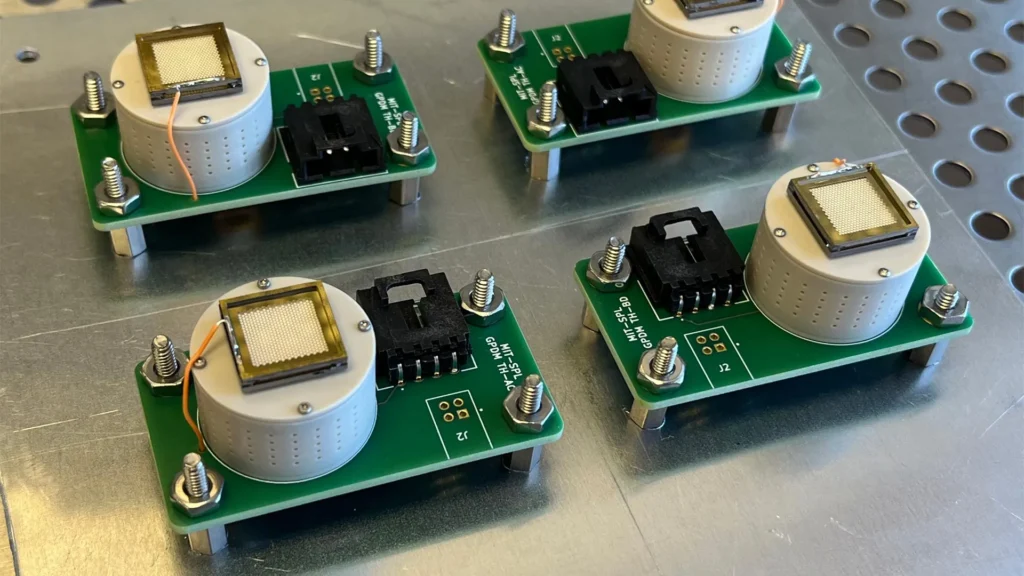
Electrospray thrusters, often no larger than a dime or even a thumbnail, are marvels of miniaturization. They function by applying an electric field to a reservoir of ionic liquid propellant. This electric field charges the ions within the liquid and then extracts and accelerates them through tiny openings (emitters) at the thruster’s surface. The expulsion of these charged particles into space generates thrust. Because they accelerate individual ions rather than bulk fluid, they achieve extremely high exhaust velocities, translating to exceptional fuel efficiency.
The unique properties of ionic liquids make them ideal for electrospray propulsion. Unlike conventional liquids, which evaporate readily in the vacuum of space, ionic liquids have negligible vapor pressure, allowing them to remain stable and liquid even in the harsh space environment. Furthermore, their inherent composition as a "sea of ions" directly facilitates the electrostatic extraction and acceleration process fundamental to electrospray operation. Lozano’s group has spent over a decade refining designs and testing various ionic liquid fuels, building a robust foundation for this new application of ASCENT.
Rigorous Testing and Promising Results
To validate ASCENT’s performance in electrospray thrusters, Bruno, Lozano, and former MIT graduate student Matthew Corrado undertook a series of meticulous experiments. Their setup involved electrospray thrusters attached to small, cube-shaped reservoirs, each holding one gram of ASCENT. The propellant, with a viscosity akin to baby oil, was contained within these reservoirs, roughly the size of a LEGO brick.
The thrusters were strategically mounted on opposite sides of a representative CubeSat model. This model was then placed on a custom-designed magnetic levitation test platform, dubbed the MagLev, housed within a large vacuum chamber. This specialized facility at MIT is capable of accurately recreating the near-vacuum conditions and microgravity environment of space, allowing for precise measurement of minute forces.
During the extensive testing phase, researchers remotely varied the voltage supplied to the electrospray thrusters. The resulting electrospray plumes generated sufficient force to induce a rotational motion in the CubeSat, causing it to spin like a floating top. By carefully measuring the generated thrust and operating the thrusters continuously for periods extending up to 100 hours, the team was able to comprehensively assess ASCENT’s performance metrics and efficiency.
The experimental results were conclusive: ASCENT successfully powered the electrospray thrusters, performing on par with conventional ionic liquid propellants specifically designed for electric propulsion systems. "Compared to our normal electrospray propellants, ASCENT can provide similar performance in terms of thrust," Bruno confirms. "Now that we know our thrusters work with ASCENT, we can start thinking of all the ways we can make them even better." This validation marks a critical step, confirming the technical feasibility of the dual-mode concept.
The NASA Green Propulsion Dual Mode Mission: A Space Validation
The theoretical and experimental success of using ASCENT for both chemical and electric propulsion is now poised for its ultimate test in the unforgiving environment of space. MIT researchers are actively collaborating with NASA on the "Green Propulsion Dual Mode" mission, a groundbreaking endeavor scheduled for launch in November.
This mission will deploy a briefcase-sized CubeSat equipped with one chemical thruster and four electrospray thrusters. Crucially, all five thrusters will draw their propellant from a single, shared tank of ASCENT. This will be the first time such a unified propellant system is tested on a small spacecraft in orbit, representing a significant milestone in propulsion technology. The mission aims to demonstrate the seamless transition and simultaneous operation of both propulsion modes using the same fuel source, validating the concept under real-world conditions.
"This will be the first time that a satellite will have a shared propellant tank," emphasizes Paulo Lozano, underscoring the pioneering nature of the NASA mission. A successful demonstration could pave the way for a new generation of highly versatile and capable small satellites.
Broader Implications and Transformative Potential
The implications of this dual-mode propulsion system extend far beyond enhancing the capabilities of individual small satellites; it promises to reshape the landscape of space exploration, scientific research, and commercial space operations.
Deep Space Exploration for Small Satellites: Currently, CubeSats are largely confined to Low Earth Orbit (LEO) or, less frequently, Geostationary Earth Orbit (GEO). The dual-mode system could enable these compact, cost-effective platforms to venture into deep space. As Lozano envisions, "We could send CubeSats to Mars, or the asteroid belt, where they could make the journey slowly, using electrospray thrusters." Upon arrival, the chemical thrusters could then be activated for rapid maneuvers, allowing the CubeSat to "quickly move to look at interesting features." This flexibility could unlock entirely new mission profiles for small satellites, transforming them from LEO workhorses into interplanetary explorers and scouts. This would significantly reduce the cost and complexity of deep-space missions, opening opportunities for smaller research institutions and commercial entities to participate.
Enhanced Earth Observation and Constellation Management: Closer to Earth, the technology offers profound benefits for missions such as weather and climate monitoring. Lozano illustrates, "Say there’s a storm coming, and you’d want to deploy your constellation of small satellites to observe over one location. You could choose to send them quickly or slowly depending on the nature of the observation. And the only way to do that is if you have two propulsion systems, which is now possible." This means constellations of small satellites could dynamically reconfigure their orbits, respond to rapidly evolving phenomena, or maintain precise formations with unprecedented agility. This responsiveness is critical for applications ranging from disaster monitoring to persistent surveillance and high-bandwidth global internet provision.
Cost Reduction and Accessibility: By eliminating the need for separate fuel tanks and propulsion lines, the system inherently reduces the mass, volume, and complexity of spacecraft. This translates directly into lower manufacturing costs, simplified integration, and reduced launch expenses, as every kilogram saved in mass is significant. The use of a "green" propellant also streamlines ground operations, further reducing costs and improving safety for personnel involved in satellite fueling and integration. This increased accessibility could foster even greater innovation in the burgeoning commercial space sector.
Future Prospects: The success of the NASA Green Propulsion Dual Mode mission will be a crucial validator. Beyond this initial demonstration, researchers will likely focus on scaling the technology for different satellite sizes, optimizing thruster designs for even greater performance, and investigating long-duration reliability in space. The potential for in-space refueling of a single, versatile propellant could also emerge as a future area of interest, further extending mission lifetimes and capabilities.
In conclusion, MIT’s development of a unified chemical and electric propulsion system, leveraging the advanced "green" ASCENT propellant, marks a monumental leap in spacecraft technology. By offering the "best of both worlds" in a compact, efficient, and safe package, this innovation is poised to empower a new generation of small satellites, enabling them to undertake more ambitious scientific endeavors, explore farther into the cosmos, and provide more dynamic services closer to home. The upcoming NASA mission represents a critical step towards realizing this transformative vision, promising a future where smaller, more agile spacecraft play an even larger role in our understanding and utilization of space. This research, supported in part by NASA, underscores the collaborative spirit driving innovation at the forefront of aerospace engineering.






