In the intricate landscape of modern motion systems, effective and efficient communication protocols are paramount. While high-level network protocols such as Ethernet, EtherCAT, and CAN facilitate connections between drives, motors, and controllers across wider industrial networks, a different class of communication becomes critical at the more granular circuit board level. Here, within the confines of a controller or microcontroller’s printed circuit board (PCB), the Serial Peripheral Interface (SPI) stands out as a foundational technology, enabling robust and high-speed data exchange between integrated circuits. Its ubiquitous presence underscores its vital role in the functionality and miniaturization of countless electronic devices, particularly those involving precise motion control.
Understanding the Fundamentals of Serial Peripheral Interface (SPI)
The Serial Peripheral Interface (SPI) is a synchronous serial data transmission standard, widely adopted for its straightforward design and high-speed capabilities. Primarily employed in embedded systems, SPI facilitates short-distance communication between various integrated circuits (ICs) on a PCB. It operates on a full-duplex principle, meaning data can be sent and received simultaneously, a significant advantage for real-time applications requiring immediate feedback and command execution.
At its most basic physical layer, SPI utilizes a four-wire serial interface, differentiating it from other common embedded protocols like I2C (which uses two wires) or UART (which typically uses two wires but is asynchronous). These four wires are:
- SCK (Serial Clock): Generated by the master device, this clock signal synchronizes the data transmission and reception between the master and slave devices. Its presence ensures that both ends of the communication link are operating in lockstep, preventing data skew and errors.
- MOSI (Master Out Slave In): This line carries data from the master device to the slave device.
- MISO (Master In Slave Out): This line carries data from the slave device back to the master device.
- SS/CS (Slave Select / Chip Select): This line, often active-low, is asserted by the master to select a specific slave device with which it intends to communicate. In systems with multiple slave devices, each slave typically requires its own dedicated SS line from the master, though daisy-chaining configurations can optimize this.
Data rates for SPI can vary significantly, ranging from a few megahertz (MHz) in simpler applications to upwards of 10 MHz, and even exceeding 50 MHz in high-performance implementations found in modern microcontrollers and specialized peripherals. The flexibility of SPI extends to its data transmission width, which can be programmed from two to 24 bits or more, depending on the specific hardware and software configuration, allowing for efficient handling of different data packet sizes.
Historical Context and Evolution of Embedded Communication Protocols
The development of serial communication protocols like SPI emerged from a need to simplify inter-chip communication, particularly as integrated circuits became more complex and system designs increasingly compact. In the early days of microprocessors and microcontrollers, parallel bus systems were common. While offering high data throughput, parallel buses required a large number of physical traces on the PCB (one for each bit of data, plus control lines), consuming significant board space and increasing susceptibility to electromagnetic interference (EMI) dueabilities at higher clock speeds. The routing complexity and pin count associated with parallel interfaces also drove up manufacturing costs and design time.
Motorola first introduced the Serial Peripheral Interface in the mid-1980s, specifically with their MC68HC11 microcontroller. Its introduction marked a pivotal moment, offering a robust, efficient, and simpler alternative for connecting microcontrollers to various peripheral devices. The synchronous nature of SPI, coupled with its dedicated clock line, eliminated the need for complex timing recovery mechanisms required by asynchronous protocols, thus simplifying hardware and software implementation.
Over the decades, as embedded systems evolved, SPI’s core design principles have remained largely consistent, testament to its effectiveness. Its adoption became widespread across various industries, cementing its position alongside other key embedded protocols like I2C (Inter-Integrated Circuit, developed by Philips, now NXP) and UART (Universal Asynchronous Receiver/Transmitter). While I2C excels in multi-master, multi-slave scenarios with fewer pins and a built-in addressing scheme, and UART is favored for simple point-to-point communication with external devices (like PCs via USB-to-serial converters), SPI carved out its niche by offering superior speed and full-duplex operation for direct, high-performance inter-chip communication.
Advantages and Strategic Trade-offs of SPI
SPI’s enduring popularity stems from several key advantages:
- High Speed: Unlike I2C, which has an open-drain architecture and often limits clock speeds, SPI can operate at much higher frequencies, enabling rapid data exchange crucial for real-time control applications.
- Full-Duplex Communication: The dedicated MISO and MOSI lines allow data to be transmitted and received simultaneously, significantly improving throughput and responsiveness.
- Simple Hardware Interface: The protocol is relatively simple to implement in hardware, requiring minimal logic.
- No Addressing Overhead: Unlike I2C, SPI does not require a complex addressing scheme for slave devices. Instead, each slave is selected directly by its dedicated SS line, simplifying communication for the master.
- Flexibility: SPI is highly flexible in terms of data width (bits per transfer) and clock polarity/phase (CPOL/CPHA modes), allowing it to interface with a wide variety of devices.
- Reduced PC Board Space: By using only four wires for communication, SPI dramatically saves board space compared to parallel bus systems, making it ideal for compact embedded systems where physical footprint is a premium. This translates directly to smaller product sizes and lower material costs.
However, SPI is not without its trade-offs. One notable consideration is the increased pin count required on the master microcontroller when interfacing with multiple slave devices. Each additional slave typically requires its own dedicated Slave Select (SS) line, which can quickly consume valuable GPIO pins on the microcontroller. While solutions like daisy-chaining or using external demultiplexers can mitigate this, it remains a design consideration. Additionally, SPI lacks inherent arbitration or acknowledgment mechanisms; the master assumes the slave is ready and capable of receiving or sending data. Error detection often relies on higher-level software protocols rather than being built into the physical layer.
SPI in Motion Control Systems: Enabling Precision and Efficiency
The application of SPI is particularly impactful in the realm of motion control systems, where precision, speed, and real-time responsiveness are critical. Motion microcontrollers often need to communicate rapidly with various peripheral devices to control motors, read sensor feedback, and manage system diagnostics.
Typically, a motor driver integrated with SPI connectivity will feature a dedicated SPI port. This port allows it to connect directly to a central microcontroller, which then sends crucial control signals. These signals often include Pulse Width Modulation (PWM) signals, which regulate the power delivered to motors to control their speed and torque, as well as step and direction signals for stepper motors. In highly integrated designs, the controller and motor driver functionality might even reside on the same chip, with SPI facilitating internal communication pathways for generating and executing control signals. Beyond basic control, SPI is also invaluable for diagnostic purposes, allowing the microcontroller to query the motor driver for status information, error codes, temperature readings, and current consumption, enabling predictive maintenance and fault detection.
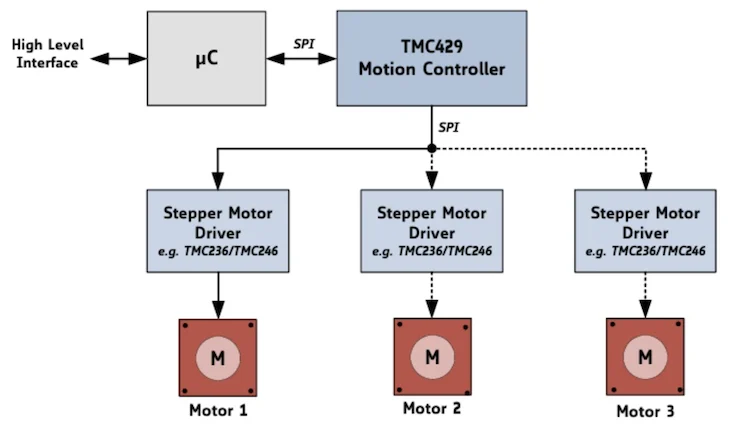
A compelling example of SPI’s utility in motion control is illustrated by systems built around specialized chips like the Analog Devices TMC429 motion controller. This chip is engineered to serve as a high-performance, three-axis motion controller. The TMC429 precisely controls the position of stepper motors by generating and sending step and direction pulses to external stepper motor drivers. These driver chips, in turn, convert these digital signals into the specific coil currents required to actuate the stepper motors. The TMC429 leverages two separate four-wire SPI interfaces: one for communication with a higher-level host microcontroller (which might issue high-level commands), and another for interfacing with up to three daisy-chained stepper motor drivers. This architecture demonstrates SPI’s flexibility in managing both upstream control and downstream execution.
Diverse Applications: Beyond the Factory Floor
While motion control is a significant area, SPI’s utility extends across a vast spectrum of embedded applications:
- Industrial Automation: From robotics and CNC machines to automated assembly lines, SPI connects motor drivers, encoders, sensors, and actuators to central control units, ensuring synchronized and precise movements.
- Automotive Systems: The increasing electrification of vehicles has led to a proliferation of motors controlling everything from power windows and seats to advanced driver-assistance systems (ADAS) and powertrain components. SPI is fundamental in these applications, connecting microcontrollers to gate drivers, sensor arrays (e.g., accelerometers, gyroscopes), and memory modules. For instance, Toshiba’s TB9104FTG gate driver, designed for brushed DC motors in automotive applications, integrates SPI with on-board motor control circuits, current sense amplifiers, and PWM drive circuits, showcasing a highly integrated solution.
- Consumer Electronics: SPI is a workhorse in devices like digital cameras (interfacing with image sensors and memory cards), LCD and OLED displays (for fast pixel data transfer), smart home devices, and portable gadgets, where compact design and efficient power consumption are critical. Many SD cards, for example, can operate in an SPI mode.
- Medical Devices: High-precision medical equipment, including diagnostic tools, infusion pumps, and surgical robots, relies on SPI for accurate sensor data acquisition, motor control, and user interface communication, where reliability and speed are paramount.
- Aerospace and Defense: In demanding environments, embedded systems in avionics, drones, and communication equipment utilize SPI for robust and reliable inter-chip communication, often connecting microcontrollers to specialized sensors, FPGAs, and secure memory.
- Internet of Things (IoT): The proliferation of IoT devices, often battery-powered and constrained by size, greatly benefits from SPI’s efficiency and low power consumption for connecting to sensors, wireless modules, and small displays.
Industry Perspectives and Broader Implications
Industry experts consistently highlight SPI’s straightforward implementation and high-speed, full-duplex capabilities as critical enablers for modern embedded systems, particularly those requiring real-time control and high data throughput. Semiconductor manufacturers, in their continuous drive for miniaturization and integration, frequently emphasize the protocol’s efficiency in reducing component count and board complexity. This directly translates to lower manufacturing costs and smaller form factors for end products, a significant competitive advantage.
Developers, from hobbyists to professional engineers, commend SPI for its flexibility and ease of integration with a wide array of peripheral devices. The clear master-slave hierarchy and lack of complex addressing schemes make it relatively easy to get systems up and running, accelerating development cycles. The availability of robust software libraries and hardware support in most modern microcontrollers further lowers the barrier to entry and promotes its continued widespread adoption.
The broader impact of SPI’s prevalence is profound. It has played a crucial role in driving the miniaturization of electronic devices, making sophisticated functionalities accessible in increasingly compact packages. By providing a reliable and efficient means for chips to communicate, SPI has facilitated the growth of complex embedded systems, enabling advancements in areas like robotic automation, advanced driver-assistance systems, and the pervasive network of IoT devices. Its capacity for high-speed data exchange underpins the responsiveness and precision expected from modern motion control applications, from industrial robots executing intricate tasks to the smooth operation of consumer electronics.
As technology continues to advance, the demand for faster, more compact, and more power-efficient embedded systems will only grow. While new communication standards may emerge, SPI’s fundamental strengths – speed, simplicity, and efficiency – ensure its continued relevance. Future developments may see further enhancements in speed, improved integration with higher-level communication protocols, and potentially more sophisticated error handling mechanisms, cementing its position as a cornerstone technology in the ever-evolving landscape of embedded electronics.






