The global construction industry, a cornerstone of modern civilization, faces a significant environmental challenge: the production of concrete, the world’s most ubiquitous building material, is a major contributor to carbon emissions. In an effort to mitigate this impact, 3D printing of concrete has emerged as a promising innovation. This additive manufacturing technique, akin to a colossal robotic icing dispenser, lays down concrete layer by meticulous layer, precisely where it is needed. This process bypasses the labor-intensive and material-wasteful traditional method of pouring concrete into molds, offering the potential for more efficient and sustainable construction.
However, a significant hurdle has hindered the full realization of 3D-printed concrete’s potential. The most structurally efficient designs, often conceived through sophisticated computer-aided topology optimization, present intricate, organic forms that are beyond the current capabilities of large-scale concrete printers. These mathematically optimized designs, while excellent at minimizing material usage and maximizing strength, fail to account for the physical limitations inherent in the printing process. Thick nozzles, restricted turning radii, and the necessity for continuous printing motions create a disconnect between theoretical perfection and practical manufacturability.
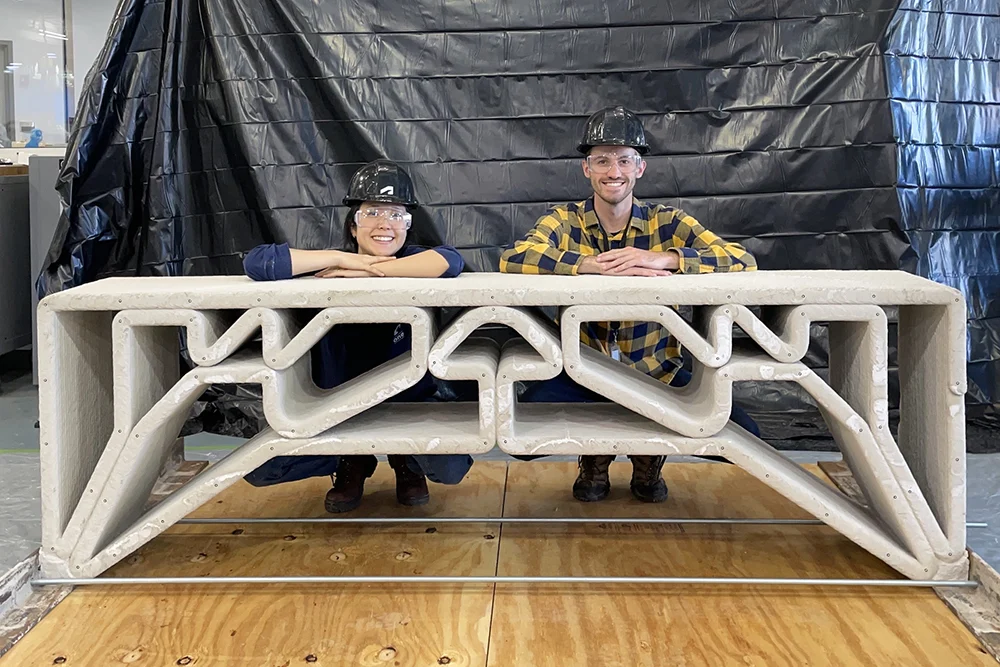
Now, a team of researchers at the Massachusetts Institute of Technology (MIT) has engineered a groundbreaking solution to bridge this critical gap. Their innovative framework, detailed in a recent publication in the journal Additive Manufacturing, integrates the real-world fabrication constraints of 3D printers directly into the design optimization process. This means that the resulting designs are not only mathematically ideal but also inherently printable by existing machinery, significantly reducing or eliminating the need for manual redesign. To demonstrate the efficacy of their approach, the MIT team designed, printed, and rigorously load-tested a 2.3-meter concrete bridge. Their findings revealed a surprising yet crucial insight: it is the limitations of current printing hardware, rather than the inherent properties of the concrete itself, that dictate the maximum possible lightness and efficiency of a 3D-printed structure.
"We were finding a lot of cracks you can fall through when it comes to translating these super-optimal designs into manufacturable designs," explains Hajin Kim-Tackowiak, a postdoctoral associate in MIT’s Department of Civil and Environmental Engineering (CEE) and co-first author of the study. "Those cracks were like chasms." This sentiment underscores the practical challenges faced when attempting to translate abstract mathematical perfection into tangible, buildable forms.
Designing for Manufacturability: Integrating Real-World Constraints
The genesis of this new framework involved a collaborative effort between the MIT researchers and Autodesk, a leader in design and engineering software. As part of the Autodesk Research Residency Program, the team gained direct access to the large-scale printing machines at Autodesk’s Technology Center in Boston. This hands-on experience provided invaluable insights into the practical limitations of the technology.
"They pointed at some of our sharp angles, and they went, ‘I don’t feel safe printing something like that,’" Kim-Tackowiak recalls from these crucial discussions. These direct interactions with machine operators highlighted three primary constraints that needed to be addressed: the minimum thickness of each printed concrete bead, the maximum sharpness of the printer’s nozzle turns, and the fundamental requirement for a single, continuous printing motion to avoid structural discontinuities.
The MIT team meticulously translated each of these physical limitations into precise mathematical rules that were incorporated into their optimization framework. This departure from traditional design methodologies, which often optimize shape first and then attempt to adapt it for manufacturing, represents a significant paradigm shift.
"Existing 3D-printed structures are typically produced with older methods that optimize the shape first, and then require ‘a massive amount of post-processing,’ taking days to run," Kim-Tackowiak elaborated. In stark contrast, the researchers’ new framework was capable of generating fully printable designs in approximately two minutes on a standard laptop. The adaptability of their system was further demonstrated when a minor adjustment to the bridge’s size was required on the day of printing; the team was able to re-run the optimization and obtain an updated, printable design in a mere five to ten minutes.
"Reaching that speed at all is recent," notes Zane Schemmer, a PhD student in CEE and another co-first author. The computational power required for this rapid optimization relies on mixed-integer optimization, a mathematical technique that was, until recently, considered computationally prohibitive for such complex design problems. "You go back five, 10 years ago, the solver we used, even three years ago, could not solve these problems," Schemmer stated. "This field has been avoided, because everyone thinks that’s not an avenue we can go down. But with new algorithms and resources, it’s becoming a way we can start to frame problems." This advancement in computational power and algorithmic efficiency is a critical enabler of this new design paradigm.
A Bridge to Understanding: Revealing the True Limitations
To rigorously validate their new framework, the MIT researchers returned to Autodesk’s facility to fabricate a 2.3-meter-long concrete bridge. The printing process itself was remarkably swift, taking approximately 30 minutes to complete using off-the-shelf mortar.
The subsequent load testing of the roughly 900-pound bridge yielded compelling results. The structure successfully supported over 2,000 pounds distributed across it, exhibiting virtually no measurable deflection. These experimental findings closely aligned with the team’s computational simulations, providing strong evidence for the accuracy and effectiveness of their design framework.
However, the load tests also unveiled the study’s most significant and unexpected finding. "What we found was our result was super over-engineered," Kim-Tackowiak stated, referring to the initial design. "From zero to 200,000 pounds, your design is entirely driven by these ‘can I build it or not’ constraints. And then, after 200,000 pounds, you can start to think about the physics." This indicates that the practical limitations imposed by the current 3D printing hardware – such as nozzle width and turning capabilities – were the primary determinants of the structure’s efficiency, rather than the fundamental load-bearing capacity of the concrete material itself. In essence, the current printing technology is preventing the realization of designs that are truly optimized for strength and material usage.
A Roadmap for Future Innovations: Quantifying Hardware’s Impact
The sophisticated nature of the MIT researchers’ framework, employing mixed-integer optimization, allows for the identification of the mathematically optimal design under given constraints. This capability extends beyond simply creating a printable design; it enables researchers to precisely quantify the material cost associated with each hardware limitation.
"With mixed-integer optimization, we can find the global optimum, the best solution there is, as opposed to just a good solution," explained Josephine Carstensen, the Gilbert W. Winslow (1937) Career Development Professor in Civil Engineering and senior author of the study. "Because we know we’re finding the best solution out there, we can also quantify: If we had a machine that could do other things, what would that mean for how much material we’re using?"
This detailed analysis revealed that the width of the printed concrete bead was the most significant factor influencing material consumption. The bridge, printed with a 4-centimeter bead, could potentially reduce material usage by as much as 76 percent if printed with a 1-centimeter bead, all while remaining "well within safety margins," according to Carstensen. This finding was particularly surprising to Carstensen, who had anticipated that the constraint on continuous printing paths would have a more profound impact. "I thought the continuous path would be the problem, the one that had the highest effect," she remarked. "But it wasn’t. It was the bead width."
The implications of this quantitative analysis are far-reaching. It provides a clear roadmap for manufacturers of 3D concrete printing hardware, highlighting specific areas where modest technological advancements could unlock substantial gains in structural efficiency and significantly reduce the environmental footprint of concrete construction. For instance, developing printers capable of laying down finer beads of concrete would allow for more intricate geometries and a more efficient distribution of material.
A key element enabling the efficiency of the printed bridge was its design to be entirely in compression. "With concrete, it’s really good when you push on it, really bad when you pull on it," Schemmer pointed out. "We’re able to guarantee that every piece of concrete that you see is in compression, there’s no part that’s being pulled on." This design strategy leverages concrete’s inherent strengths while avoiding its weaknesses.
The economic and environmental savings extend beyond reduced material usage. The complete elimination of formwork, a significant cost and time factor in traditional concrete construction, becomes particularly advantageous for unique or one-off structures. Carstensen envisions immediate applications in disaster relief scenarios, stating, "You can quickly put up new infrastructure without needing to make formwork." The ability to rapidly deploy essential structures in the aftermath of natural disasters could be a game-changer.
The bridge’s compression-only nature also underscored a crucial aspect of its performance. While it demonstrated exceptional strength under compression, its behavior when subjected to tension was drastically different. After withstanding over 2,000 pounds without yielding, the bridge fractured when a worker lifted one corner a few inches to sweep underneath. This failure was not indicative of a design flaw in terms of its intended load-bearing capacity but rather a stark illustration of concrete’s inherent brittleness under tension. "It’s optimal in one way, but it’s definitely not optimal in every way," Kim-Tackowiak acknowledged.
The Path Forward: Towards Reinforced and Resilient Structures
This revelation has directly informed the researchers’ next steps: incorporating reinforcement into 3D-printed concrete structures. "We know a pure concrete structure is not necessarily going to be the most optimal thing, so we’re moving it more into the world we live in today, which is reinforced concrete," Kim-Tackowiak stated. The challenge, however, lies in integrating reinforcement, such as rebar, into the printing process. "though working out how to feed rebar into a printed concrete structure, is proving its own challenge." This ongoing research aims to combine the advantages of additive manufacturing with the established resilience of reinforced concrete, paving the way for even more robust and versatile applications.
The research was made possible through funding from the National Science Foundation and support from the MIT Center for Advanced Production Technologies. In addition to Kim-Tackowiak, Schemmer, and Carstensen, the study’s co-authors include Pittipat Wongsittikan, a PhD student in the MIT Building Technology Architecture program, and Jackson Jewett, a former MIT postdoc. Their collective efforts represent a significant leap forward in the quest for sustainable and efficient construction technologies.