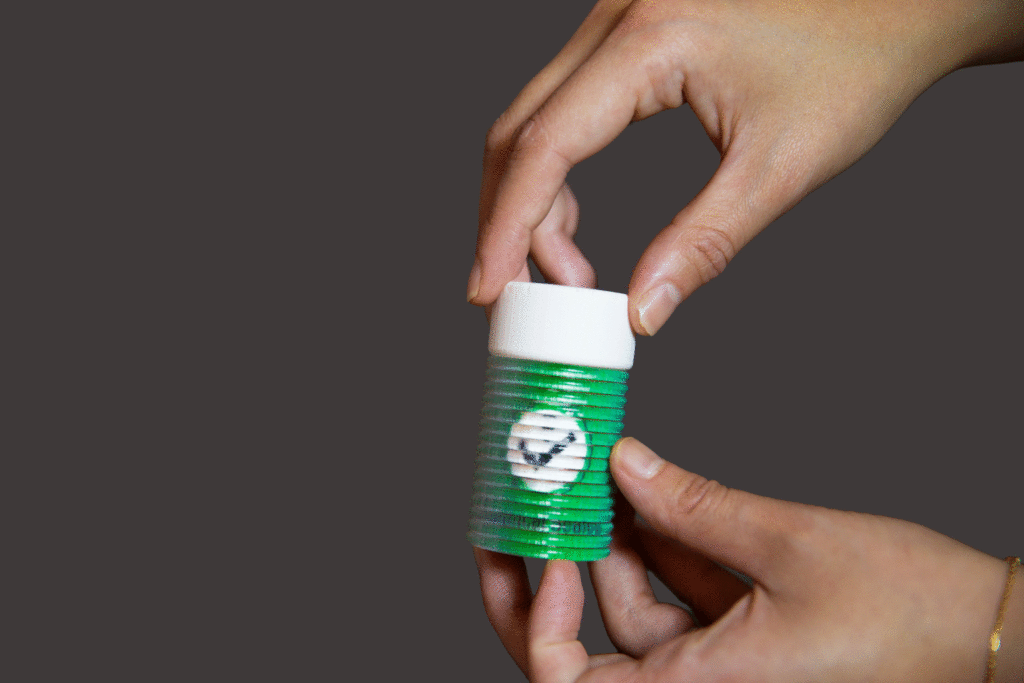
A groundbreaking new system developed by researchers at the Massachusetts Institute of Technology (MIT) promises to revolutionize the way interactive objects are designed and fabricated. Dubbed ShiftLens, this innovative platform enables the creation of objects with dynamic, mechanically switchable surface appearances, eliminating the need for fragile electronic circuits and complex sensors. This advancement opens doors to a wide array of applications, from resilient warning signs capable of withstanding harsh environmental conditions to intelligent packaging that can signal shipping integrity, and even intuitive artistic and architectural installations. The research, which details the end-to-end system for rapid prototyping, is set to be presented at the prestigious ACM Symposium on User Interface Software and Technology.
The core innovation behind ShiftLens lies in its ability to imbue objects with interactive qualities through purely mechanical means. Traditional interactive products heavily rely on electronic displays, such as screens, which are inherently vulnerable to damage from physical stress, moisture, or chemical exposure. While some existing methods attempt to alter an object’s appearance without electronics, they often utilize static optical effects, like stickers or curved lenses that offer limited interactivity, providing pre-defined visual states based on viewing angle rather than user manipulation. ShiftLens sidesteps these limitations by employing a clever combination of optical layers that respond to physical movement, allowing for a far more dynamic and user-controlled interactive experience.
The Mechanics of Mechanical Interactivity: How ShiftLens Works
At its heart, ShiftLens operates by integrating two primary optical components onto an object’s surface: a top layer of specialized lenticular lenses and an underlying patterned backplane. Lenticular lenses are micro-optical elements that refract light in a direction-dependent manner. Each lens in the array is precisely designed to magnify specific sections of the patterned backplane beneath it. The backplane, in turn, is imprinted with strips of different images, each corresponding to a distinct visual state the object can display.
The magic of ShiftLens is activated when the user manipulates the relative position of these two layers. By shifting the lens layer, different portions of the backplane are brought into the focal view of the lenses. As the lenses magnify these underlying image strips, the perceived appearance of the object’s surface changes. This simple yet elegant mechanical interaction allows an object to present multiple visual states in response to user input, creating a form of "mechanical storytelling" without any electronic components.
Yunyi Zhu, a graduate student in MIT’s Department of Electrical Engineering and Computer Science (EECS) and the lead author of the paper, explained the significance of this approach. "With our system, an object can tell you whether you are using it properly, without the need for sensors or any complicated electronics," Zhu stated. "The interactive display is mechanical, so you can create a self-contained, multistate, interactive device that a user can control very intuitively." This intuitive control is a key feature, as it bypasses the often-steep learning curves associated with complex electronic interfaces.
Streamlining Design and Fabrication: The ShiftLens Design Tool
Recognizing that the mechanical and optical complexities could be a barrier to adoption, the MIT research team developed a user-friendly design tool that automates the creation of ShiftLens structures. This software tool takes user inputs, such as desired visual states (represented by images) and the geometric properties of the object, and automatically generates a 3D printable model of the ShiftLens configuration. This greatly simplifies the process of designing and fabricating these interactive objects, making advanced interactive capabilities accessible to a broader range of creators, including designers, artists, and engineers involved in rapid prototyping.
"The biggest challenge in this project was to make sure all moving parts align," Zhu elaborated. "We need to make sure that the optical effect, mechanical linkages, and computational graphics align with one another." The design tool is instrumental in addressing this challenge by meticulously calculating the precise alignment required between the lenticular lenses and the patterned backplane to achieve the intended visual transitions.
Another significant hurdle the team addressed was the communication of the system’s capabilities and limitations to users who may not have a background in optics or mechanical engineering. "Another challenge is to communicate to users who are not familiar with optics or mechanical structures and let them specify and achieve what they have in mind," Zhu noted. The ShiftLens design tool is therefore engineered to provide clear feedback and guidance, ensuring users understand how to best leverage its capabilities and what constraints to consider.
Applications and Implications: Beyond Fragile Electronics
The potential applications for ShiftLens are vast and impactful. The ability to create objects that can dynamically change their appearance without relying on delicate electronics makes them ideal for environments where durability is paramount. For instance, adaptable warning signs could be designed to withstand heavy rain, extreme temperatures, or accidental impacts, while still providing clear, context-sensitive visual cues. Imagine highway signs that can shift from "Road Closed" to "Detour Ahead" based on weather conditions or traffic flow, all through simple mechanical actuation.
In the realm of packaging, ShiftLens could offer a novel way to ensure product integrity during transit. Dynamic packaging could incorporate visual indicators that change if a seal is compromised or if a sensitive component has been subjected to undue stress. This would provide immediate, visible confirmation of handling and potentially reduce product damage and customer complaints related to shipping.
The research team demonstrated the versatility of ShiftLens through several compelling prototypes. One example was a chemical bottle designed to provide a clear safety indication. When the cap is securely tightened, the bottle’s surface displays a green checkmark. However, if the cap is loose, it transforms to show a red exclamation mark, offering a direct and unambiguous visual cue about the container’s integrity.
Another practical application showcased was a tic-tac-toe game. In this prototype, each square on the game board could independently display a red ‘X’, a blue ‘O’, or remain blank. The state of each square could be controlled by a simple knob or dial, demonstrating how ShiftLens can be integrated with basic mechanical input mechanisms to create engaging and interactive experiences. This highlights the system’s suitability for educational tools, toys, and interactive exhibits.
A Timeline of Innovation: From Concept to Presentation
The development of ShiftLens represents a significant step forward in the field of tangible interfaces and interactive design. While the exact timeline of the research project was not detailed in the provided text, the progression from identifying a problem (fragility of electronic interactive objects) to conceiving a novel solution (mechanical interactivity) and then developing a practical implementation (ShiftLens system and design tool) is a testament to the iterative nature of scientific inquiry. The culmination of this work at the ACM Symposium on User Interface Software and Technology, a leading venue for presenting cutting-edge human-computer interaction research, signifies its importance and potential impact within the academic and industry communities.
Expert Perspectives and Future Directions
The collaborative nature of the research, involving students and faculty from multiple departments at MIT, as well as researchers from other institutions like the Technical University of Munich and Northeastern University, underscores the interdisciplinary approach required to tackle complex design challenges. Stefanie Mueller, an associate professor in EECS and Mechanical Engineering at MIT and a member of the Computer Science and Artificial Intelligence Laboratory (CSAIL), served as a key advisor, bringing expertise from both software and hardware domains.
Looking ahead, the MIT team has ambitious plans for further development. "The researchers want to explore additional applications in future work," the article states. This suggests an ongoing effort to identify and validate new use cases across various industries. Furthermore, they intend to refine the design process by developing an algorithm that can generate ShiftLens structures with even fewer user inputs, further democratizing the technology. Enhancements to the design tool are also planned to support a wider range of actuation mechanisms, increasing the flexibility and expressiveness of ShiftLens-enabled objects.
One particularly intriguing future application mentioned is in industrial settings. Zhu envisioned its use for designing piping systems that could visually indicate damage. "The leaking sink in my apartment would be a lot easier to fix if it could tell me where the leak was coming from," she remarked, illustrating a practical, everyday problem that ShiftLens could help solve. This points to the potential for ShiftLens to improve maintenance, diagnostics, and safety in infrastructure and industrial environments.
Broader Impact and Economic Implications
The implications of ShiftLens extend beyond mere convenience and entertainment. By offering a robust and cost-effective alternative to electronic displays for interactive functionalities, it has the potential to democratize the creation of smart objects. This could foster innovation in sectors that have historically been hampered by the cost and fragility of electronic components. Small businesses, independent designers, and educational institutions could leverage ShiftLens to create unique, interactive products without requiring extensive expertise in electronics engineering.
From an economic standpoint, the ability to rapidly prototype and manufacture durable interactive objects could lead to the development of new product categories and enhance the competitiveness of existing ones. The potential for reduced product failure rates due to improved packaging integrity or clearer usage indicators could also translate into significant cost savings for manufacturers and consumers alike. The research team’s acknowledgement that the techniques could be "scaled up for commercial and industrial applications" signals a clear pathway towards market adoption.
In conclusion, the development of ShiftLens by MIT researchers represents a significant leap forward in the quest for more accessible, durable, and intuitive interactive technologies. By harnessing the power of mechanical interaction and clever optical design, this platform promises to unlock new possibilities for how objects communicate with us and respond to our actions, ushering in an era of truly robust and mechanically intelligent design.