Researchers at the Massachusetts Institute of Technology (MIT) have achieved a significant breakthrough in maritime technology, developing wedge-shaped vortex generators that can be affixed to ship hulls to reduce drag by up to 7.5 percent. This innovation promises substantial reductions in fuel consumption and, consequently, greenhouse gas emissions, marking a pivotal step towards the decarbonization of the global shipping industry. The findings were detailed in a paper titled "Net Drag Reduction in High Block Coefficient Ships and Vehicles Using Vortex Generators," which was formally presented at the Society of Naval Architects and Marine Engineers (SNAME) 2025 Maritime Convention held in Norfolk, Virginia.
The development comes at a critical juncture for international maritime regulations. The International Maritime Organization (IMO) has set ambitious targets to reduce the carbon intensity of international shipping by at least 40 percent by 2030, using 2008 levels as a benchmark. Achieving these goals necessitates a multifaceted approach, encompassing advancements in ship design, propulsion systems, fuel alternatives, and operational efficiencies. The MIT research offers a tangible and potentially cost-effective solution that directly addresses the energy efficiency aspect of this complex challenge.
The Science Behind the Breakthrough
The core of the MIT team’s innovation lies in understanding and manipulating fluid dynamics around a ship’s hull. Drag, the force that opposes a vessel’s motion through water, is a primary driver of fuel consumption. A significant portion of this drag arises from the separation of water flow from the hull, leading to turbulent wake formation. This separation is particularly pronounced in ships with high block coefficients, a measure of hull fullness that indicates a more voluminous and less streamlined shape, common in cargo vessels like bulk carriers and tankers.
The newly developed wedge-shaped vortex generators, described as relatively small structures, are strategically placed at specific points along the hull. Their function is to introduce controlled vortices into the airflow. These vortices energize the boundary layer of water flowing along the hull, effectively delaying the point at which the flow separates from the surface. By keeping the water attached to the hull for longer, the separation is pushed further aft, resulting in a smaller, less turbulent wake. This smoother flow not only reduces drag but also improves the efficiency of downstream components such as propellers and rudders, which can then operate in a more uniform flow field.
Professor Michael Triantafyllou, a leading figure in the research and Director of MIT Sea Grant, emphasized the novelty of the findings: "We document for the first time experimentally a reduction in fuel required by ships using vortex generators, relatively small structures in the shape of a wedge attached at a specific point of the ship’s hull." This experimental validation marks a significant step beyond theoretical concepts and computational modeling.
Development and Validation Process
The research team, comprising José del Águila Ferrandis, Jack Kimmeth, and Michael Triantafyllou from MIT Sea Grant and the Department of Mechanical Engineering, alongside Alfonso Parra Rubio and Neil Gershenfeld from the Center for Bits and Atoms, employed a rigorous, multi-stage development process. This process integrated advanced computational fluid dynamics (CFD) analysis with experimental validation, guided by artificial intelligence (AI) optimization methods.
The initial phase involved extensive CFD simulations to establish parametric trends and identify promising shapes and configurations for the vortex generators. This computational power allowed researchers to explore a wide design space efficiently, predicting the performance of various vortex generator designs under different operating conditions.
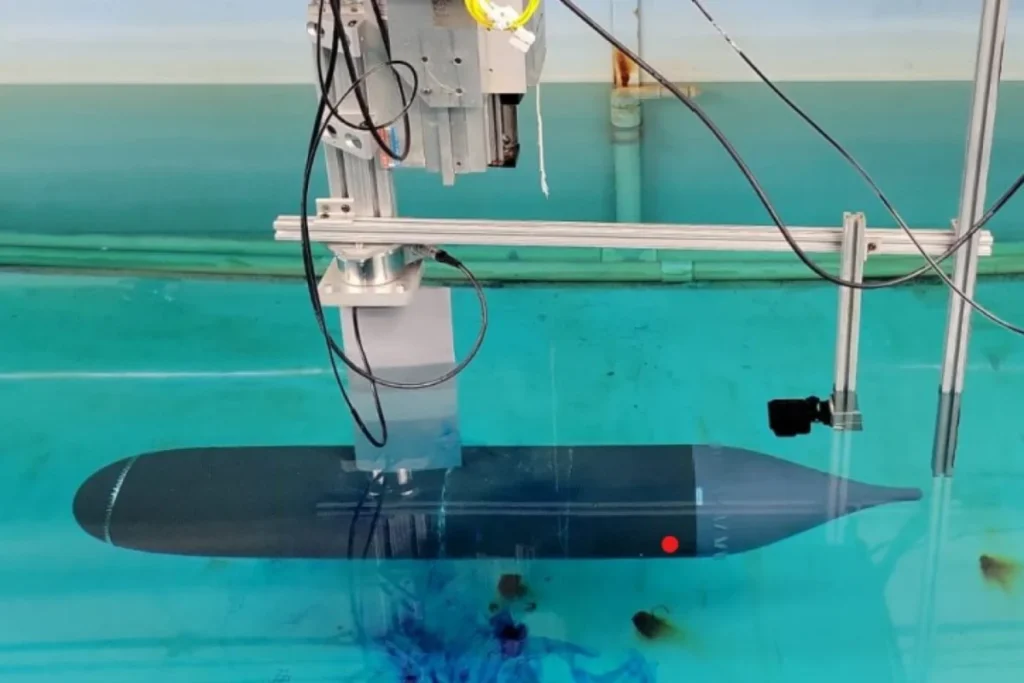
Following the computational modeling, the team moved to experimental testing. This involved rapid prototyping of scale models representing different hull configurations. Specifically, they tested models of an axisymmetric hull, both bare and equipped with delta wing vortex generators and the newly developed wedge vortex generators. These physical tests, conducted in controlled environments, served to validate the CFD predictions and confirm the superior performance of the wedge-shaped design. The experimental results unequivocally pointed to the wedge as the optimal shape for achieving substantial drag reduction.
The effectiveness of the wedge vortex generators in delaying turbulent flow separation was visually confirmed through flow visualization techniques. This provided direct evidence of how the generated vortices interact with the water flow, leading to smoother passage along the hull.
A Legacy of Innovation: Vortex Generators in Aerodynamics
The concept of vortex generators is not entirely new; they have a well-established history in the aerospace industry. For decades, vortex generators have been integral to aircraft wing design. Their primary role in aviation is to maintain lift and prevent or delay aerodynamic stall, particularly at high angles of attack or low speeds. By re-energizing the airflow over the wing’s upper surface, they help keep the air attached, thereby preserving lift.
The MIT study represents a pioneering application of this principle to maritime hydrodynamics. While the underlying physics of fluid flow are distinct between air and water, the fundamental concept of manipulating boundary layers to control flow separation is transferable. This cross-disciplinary insight has enabled a novel solution for a long-standing challenge in naval architecture.
Strategic Integration and Economic Impact
A key advantage of the wedge vortex generators is their modular adaptability. Their design allows for relatively straightforward integration into a wide array of existing and new hull forms, including those of bulk carriers, tankers, and other large commercial vessels. This ease of retrofitting is crucial for impacting the current global fleet, which is estimated to comprise hundreds of thousands of ships.
Furthermore, these devices have the potential to work synergistically with, or even enhance the performance of, existing fuel-saving technologies. For instance, they can complement pre-swirl stators, which are fixed fins mounted in front of propellers designed to impart a swirl to the incoming water flow, thereby improving propeller efficiency. By reducing overall drag, vortex generators can amplify the benefits of such systems, leading to a compounded improvement in the ship’s energy efficiency.
The economic implications of this technology are substantial. The researchers provided a compelling example: installing wedge vortex generators on a 300-meter Newcastlemax bulk carrier operating at 14.5 knots on a cross-Pacific route. Their estimates indicate that this modification could lead to significant reductions in emissions and generate approximately $750,000 in fuel savings per year for a single vessel. Given the scale of global shipping, widespread adoption could translate into billions of dollars in annual savings and a dramatic decrease in the industry’s environmental footprint.
A Collaborative Endeavor
The research was made possible through significant collaborative efforts and funding. The initial development and experimental work were supported by the CBA Consortium, a partnership that included Oldendorff Carriers, a prominent global operator of approximately 700 bulk carriers. This industry collaboration provided invaluable real-world context and facilitated the practical application of the research.
An extension of this research is currently being supported by the MIT Maritime Consortium. This consortium, established in 2025, is led by MIT professors Themis Sapsis and Fotini Christia and aims to address critical gaps in the modernization of the commercial fleet. It fosters interdisciplinary research and cultivates collaboration among academia, industry stakeholders, and regulatory agencies, underscoring the integrated approach needed to drive innovation in the maritime sector.
Broader Implications for the Maritime Industry and Beyond
The successful demonstration of wedge vortex generators by MIT researchers presents a pragmatic and cost-effective pathway for the shipping industry to meet its environmental obligations and enhance operational efficiency. The potential for retrofitting existing vessels means that the benefits can be realized relatively quickly, without requiring the complete replacement of aging fleets.
This innovation aligns with a broader global push towards sustainable transportation. As the world grapples with the urgent need to mitigate climate change, technologies that offer significant emissions reductions in hard-to-decarbonize sectors like shipping are of paramount importance. The MIT study not only provides a technical solution but also serves as a testament to the power of scientific research and interdisciplinary collaboration in addressing complex global challenges.
The presentation at the SNAME 2025 Maritime Convention signifies the technology’s readiness for industry consideration and adoption. Naval architects, ship owners, and operators attending the convention would have been keenly observing these developments, recognizing their potential to reshape the economic and environmental landscape of maritime transport. The ongoing research through the MIT Maritime Consortium suggests a commitment to further refining and scaling this promising technology, potentially paving the way for a cleaner and more efficient future for global shipping. The coming years will likely see increased interest and investment in such innovative drag-reduction techniques as the industry strives to achieve its ambitious sustainability targets.