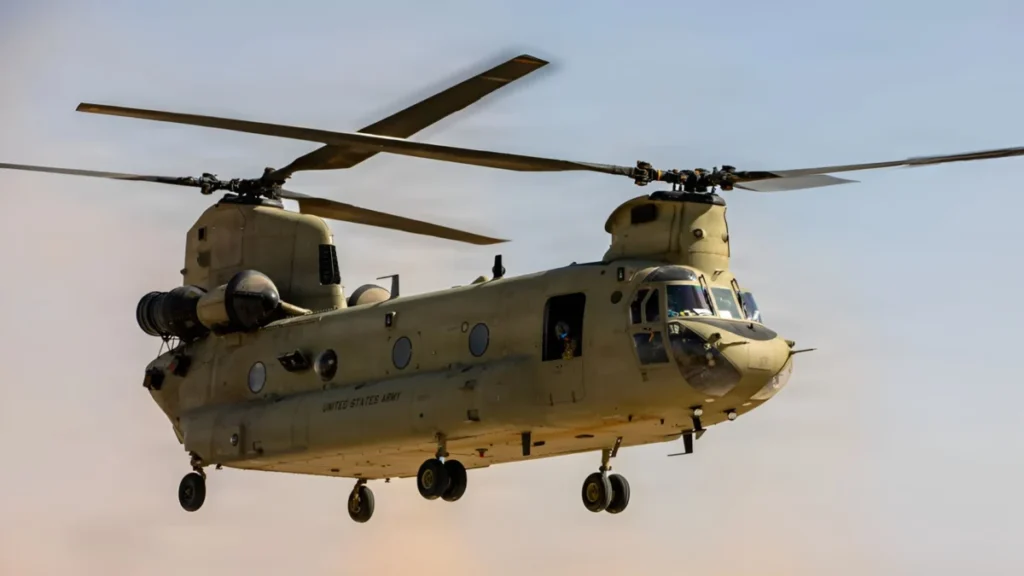
The U.S. Army has embarked on a significant initiative to ensure the continued operational relevance of its venerable CH-47 Chinook heavy-lift helicopter fleet, awarding Collins Aerospace a contract valued at up to $472 million. This substantial investment is earmarked for comprehensive engineering support, with a primary focus on modernizing the aircraft’s avionics systems and sustaining existing, aging components. The core objective extends beyond mere component replacement, aiming instead to cultivate a more adaptable and future-proof avionics infrastructure that will enable seamless integration of new capabilities without necessitating extensive redesigns of the helicopter’s fundamental systems.
The Enduring Legacy of the CH-47 Chinook: A Pillar of Army Aviation
The CH-47 Chinook stands as an undeniable icon of military aviation, a testament to enduring design and unparalleled utility. First flown in 1961 and entering service with the U.S. Army in 1962, this tandem-rotor, heavy-lift helicopter has continuously served for over six decades, distinguishing itself across every major conflict and humanitarian operation since the Vietnam War. Its distinctive silhouette and powerful capabilities have made it indispensable for a wide array of missions, including troop transport, artillery emplacement, battlefield resupply, medical evacuation, and special operations support. With an impressive maximum takeoff weight often exceeding 50,000 pounds (approximately 22,680 kg) and the ability to carry upwards of 33 combat-ready troops or significant external payloads, the Chinook’s heavy-lift capacity remains unmatched in the Army’s rotary-wing inventory. Globally, over 800 Chinooks are operated by more than 20 countries, underscoring its international importance. The U.S. Army alone operates several hundred variants, including the CH-47D, CH-47F, and MH-47G for special operations, with plans for the CH-47F Block II upgrade program already underway to further extend its service life well into the 2060s. This longevity, while a testament to its robust design, also presents the inherent challenge of integrating modern technology with systems conceived decades ago, a challenge precisely addressed by the new Collins Aerospace contract.
The Modernization Imperative: Addressing Obsolescence and Enhancing Capabilities
At the heart of any modern military aircraft lies its avionics suite – the intricate network of electronic systems governing communication, navigation, flight control, mission management, and sensor integration. As technology progresses at an exponential rate, components designed years or even decades ago inevitably face obsolescence. This manifests as increasing difficulty in procuring spare parts, escalating maintenance costs due to specialized repairs, and compatibility issues with newer, more advanced systems. The current effort aims to proactively tackle these obsolescence issues across the entire U.S. Army Chinook fleet.
Collins Aerospace engineers will not only focus on sustaining current avionics but also on laying the groundwork for more efficient integration of future capabilities. This approach is critical because operational requirements are in constant flux, driven by evolving threats, changes in battlefield doctrine, and advancements in digital warfare. For instance, modern military operations demand highly secure, high-bandwidth communication systems, precise GPS-denied navigation capabilities, enhanced digital cockpit displays for improved pilot situational awareness, and the ability to seamlessly integrate with a broader network of ground and air assets. Without a flexible avionics backbone, each new technological insertion becomes a costly and time-consuming "rip and replace" operation, forcing significant downtime for critical assets. By creating a more adaptable electronic foundation, the Army seeks to streamline future upgrades, transforming them from major integration exercises into more manageable, less disruptive processes.
Jenny Miller, vice president and general manager of Vision and Sensing Systems at Collins Aerospace, highlighted the significance of their ongoing partnership with the Army, stating, "Collins equips the Chinook with advanced avionics that integrate communication, navigation and mission subsystems." She further emphasized that the company’s "long-running work with the Army helps the fleet evolve as its requirements change," underscoring their deep understanding of the platform and the Army’s operational needs. This continuity of support is vital for maintaining the Chinook’s readiness posture across its extended service life.
Pioneering an Open and Adaptable Architecture
A cornerstone of this modernization effort is the adoption of an open and reusable avionics architecture. This design philosophy represents a paradigm shift from traditional proprietary systems, offering several transformative advantages for military aviation. An open architecture is characterized by standardized interfaces, modular components, and often, non-proprietary software protocols. This allows for greater flexibility in selecting hardware and software components from various vendors, fostering competition, reducing reliance on single suppliers, and significantly easing the process of introducing new technologies.
In contrast to closed systems, where modifications often require specific vendor expertise and proprietary tools, an open architecture empowers military engineers with greater autonomy. It means that new sensors, communication modules, or mission computers can be "plugged and played" with minimal disruption, much like upgrading components in a personal computer. This modularity not only simplifies upgrades but also reduces the engineering effort involved in future technology insertions, thereby limiting integration costs and shortening the time required to bring new capabilities into operational service.
The implications of this open architecture strategy extend beyond the CH-47. The U.S. Army has a broader strategic goal of achieving greater commonality across its entire aviation fleet. Programs like Future Vertical Lift (FVL), which aims to develop the next generation of Army helicopters, are designed with open systems architectures from the outset. By implementing similar principles in legacy platforms like the Chinook, the Army can establish proven avionics approaches that can be applied across multiple aircraft types. This commonality streamlines training, maintenance, logistics, and supply chains, leading to substantial long-term efficiencies and improved interoperability across the fleet.
This strategy directly addresses a persistent and costly problem for military aviation: aircraft often remain operational for decades, long after the technology originally installed within them has become obsolete. Simply maintaining existing components is no longer sufficient; engineers require an architecture capable of absorbing successive waves of new technology without forcing fundamental, extensive changes throughout the entire aircraft structure and wiring. The shift to an open architecture is thus a forward-looking measure designed to "future-proof" the Chinook, ensuring its adaptability to unforeseen technological advancements and evolving operational demands for decades to come.
Strategic Implications for Army Aviation and Global Readiness
The U.S. Army’s investment in the CH-47 Chinook modernization program carries profound strategic implications across several critical domains:
- Operational Readiness and Lethality: By ensuring its avionics are current and adaptable, the Chinook fleet maintains its cutting edge. This directly translates to enhanced situational awareness for pilots, improved navigation accuracy in contested environments, more secure and reliable communications, and the ability to seamlessly integrate with emerging battlefield networks and joint forces. This readiness is paramount for the Army’s ability to project power and respond to crises globally.
- Long-Term Cost Efficiency: While the initial investment of up to $472 million is substantial, the adoption of an open architecture is projected to yield significant long-term cost savings. By simplifying upgrades, reducing integration timelines, and potentially fostering competition among component suppliers, the Army can mitigate the spiraling costs associated with maintaining legacy systems. This proactive approach avoids more expensive, wholesale overhauls down the line.
- Technological Superiority: The modernization ensures that the Chinook remains technologically competitive against peer adversaries. Integrating advanced avionics enables the helicopter to operate effectively in complex, contested airspace, enhancing its survivability and mission effectiveness. It also allows for the adoption of emerging technologies like advanced sensor fusion, improved electronic warfare capabilities, and even future autonomy features without requiring a new airframe.
- Supply Chain Resilience: An open architecture typically encourages a broader ecosystem of suppliers for various modules and components. This diversification can enhance supply chain resilience, reducing vulnerabilities associated with single-source providers and ensuring a more robust and responsive support network for critical parts.
- Interoperability: The Chinook is a workhorse not just for the U.S. Army but for numerous allied nations. Modernizing its avionics with open standards enhances interoperability with coalition forces, streamlining joint operations and ensuring seamless communication and data exchange across diverse military platforms. This is particularly crucial in multinational expeditionary missions where the Chinook often plays a central logistical role.
The contract’s maximum value of $472 million provides the Army with sustained access to Collins Aerospace’s engineering expertise as modernization requirements inevitably evolve over the Chinook’s extensive service life. This flexibility is a key feature, allowing the Army to dynamically address emerging needs, introduce new mission equipment, and update cockpit systems as dictated by technological progress and operational experience.
Looking Ahead: The Future of Heavy-Lift
The ultimate goal of this comprehensive engineering effort is straightforward yet ambitious: to keep the CH-47 Chinook fleet operationally relevant and highly effective for decades to come, without allowing each new avionics upgrade to become a prohibitive, major redesign effort. The strategic adoption of a more reusable and open architecture is the pathway to achieving this, simultaneously improving commonality across the Army’s broader aviation portfolio.
In an era of increasingly complex global security challenges, the role of heavy-lift capabilities remains as critical as ever, whether for rapid troop deployment, sustained logistical support in austere environments, or humanitarian aid and disaster relief operations. By proactively investing in the modernization of its CH-47 Chinook fleet, the U.S. Army is not merely preserving a legacy aircraft; it is strategically positioning a vital asset to meet the demands of future conflicts and humanitarian missions, ensuring that the iconic "flying banana" continues to serve as the backbone of its heavy-lift capabilities for generations to come. This initiative serves as a powerful model for how long-serving military platforms can be innovatively adapted and maintained to remain at the forefront of defense capabilities.