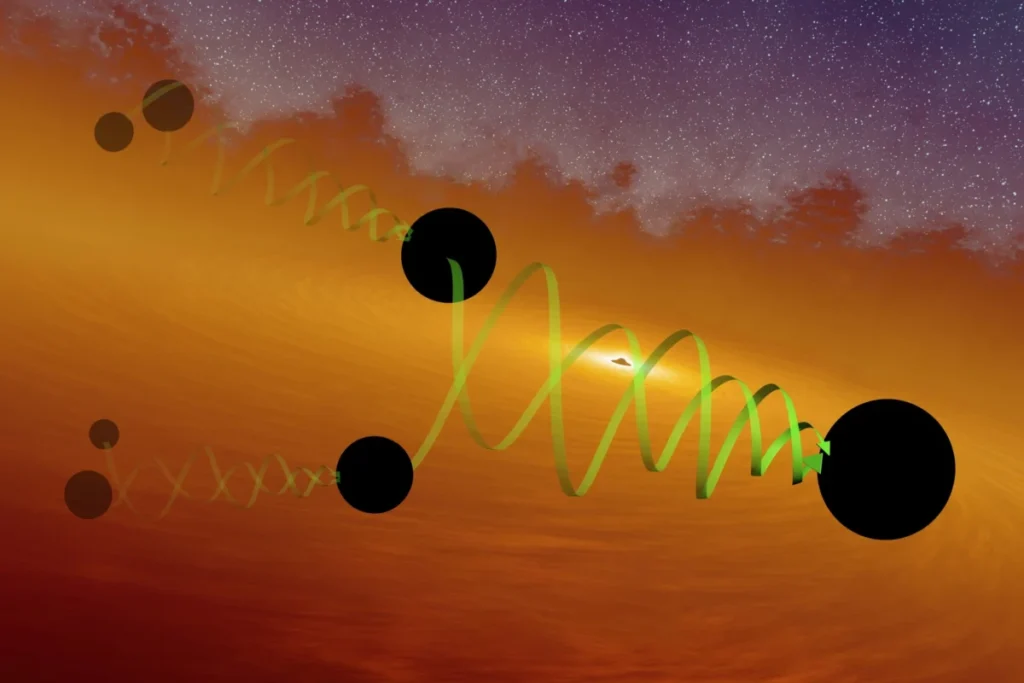
In the traditional narrative of astrophysics, the life cycle of a black hole begins and ends with the death of a star. According to this "textbook" origin story, a massive star exhausts its nuclear fuel, undergoes a violent supernova explosion, and leaves behind a dense core that collapses under its own gravity. However, a groundbreaking study from researchers at the Massachusetts Institute of Technology (MIT) suggests that this is only one part of a much more complex cosmic genealogy. According to new data analysis, a significant portion of the black holes we detect today are not "first-generation" objects born from stars, but rather "second-generation" entities formed from the prior collisions of smaller black holes.
The study, published recently in the journal Physical Review Letters, indicates that approximately 14 percent of merging black holes in the universe may be products of what scientists call "hierarchical merging." This process describes a celestial lineage where black holes repeatedly pair up and collide, creating increasingly massive and rapidly spinning offspring. This discovery provides a vital missing link in our understanding of how the most massive black holes in the universe are constructed and challenges long-held assumptions about the limitations of stellar evolution.
The Shift from Stellar Death to Cosmic Recycling
For decades, the scientific community focused on the collapse of massive stars as the primary mechanism for black hole formation. When a star significantly more massive than our sun reaches the end of its life, it can no longer support itself against the inward pull of gravity. The resulting collapse creates a singularity—a point of infinite density. While this remains a fundamental truth of the universe, the advent of gravitational-wave astronomy has provided a new lens through which to view these phenomena.
Since the first detection of gravitational waves in 2015, the LIGO (Laser Interferometer Gravitational-Wave Observatory) in the United States, Virgo in Italy, and KAGRA in Japan have identified hundreds of black hole mergers. These observatories do not "see" light; instead, they detect minute ripples in the fabric of spacetime caused by the cataclysmic collision of massive objects. By analyzing these ripples, scientists can determine the mass and spin of the black holes involved.
The MIT team, led by graduate student Cailin Plunkett and Associate Professor Salvatore Vitale, sought to determine how many of these detected mergers were "first-timers" versus those that had a previous history of collision. "We’re finding that, for some of these merging black holes, it’s not their first rodeo," Plunkett stated. Her research suggests that the universe is a more active site of "cosmic recycling" than previously estimated.
The Physics of Spin and Orbital Wobble
To distinguish a first-generation black hole from a second-generation one, researchers look at two primary characteristics: mass and spin. In the standard model of stellar collapse, a star loses a significant amount of its angular momentum during a supernova. Consequently, the resulting black hole should possess very little spin.
In contrast, when two black holes merge, the orbital energy of their dance is converted into the rotation of the final, larger black hole. These "second-generation" products are expected to spin at approximately 70 percent of their maximum possible speed. When a second-generation black hole then finds a new partner—likely a first-generation black hole—the resulting pair is often "lopsided," with one partner being significantly more massive and spinning much faster than the other.
This disparity in mass and spin creates a distinct signature in the gravitational waves they emit: an orbital "wobble" known as precession. Just as a spinning top wobbles when its axis is tilted, a pair of merging black holes will precess if their individual spins are not aligned with the plane of their orbit. By developing a model to identify this specific pattern of wobbling, the MIT team was able to scan the vast LIGO-Virgo-KAGRA Gravitational Wave Transient Catalog 4.0 (GWTC-4.0).
Analyzing the GWTC-4.0 Catalog
The researchers focused their analysis on a dataset containing 155 pairs of binary black holes. This represented a shift in methodology; rather than examining each individual signal in isolation, they searched for statistical trends across the entire population of detected mergers.
The data revealed that roughly one in seven mergers involved a black hole that did not fit the profile of a star-born object. Specifically, the analysis highlighted black holes in the mass ranges of 20 and 40 solar masses as likely candidates for second-generation status.
"One of the reasons why the 40-and-above regime is interesting is that stellar evolution theory predicts you shouldn’t be able to form black holes in that mass range at all from just a supernova," Plunkett explained. This refers to the "pair-instability" mass gap. In stars of a certain size, the supernova explosion is so violent that it completely obliterates the star, leaving no core behind to form a black hole. Hierarchical merging provides an elegant solution to this "forbidden" mass range: if two 20-solar-mass black holes merge, they create a 40-solar-mass black hole, bypassing the limitations of stellar death.
Chronology of Discovery and Key Detections
The road to this discovery was paved by two specific gravitational-wave events recorded in 2024, labeled GW241011 and GW241110. These detections were notable because they exhibited the extreme lopsidedness and high spin characteristic of hierarchical mergers.
- Phase 1: Individual Identification. Scientists first noticed individual events that defied standard models. These "outliers" possessed masses that were theoretically impossible for single-star collapses.
- Phase 2: Model Development. Inspired by these outliers, Plunkett and Vitale developed a mathematical framework to quantify the degree of precession (wobble) that should occur in a first-gen/second-gen pairing.
- Phase 3: Population Analysis. The team applied this model to the entire GWTC-4.0 catalog, allowing them to move beyond anecdotal evidence and establish the 14 percent frequency rate.
This chronological progression reflects a maturing field. Gravitational-wave astronomy has moved from the "discovery" phase—where every detection was a headline—to the "demographic" phase, where researchers can study the broader population and evolution of black holes across the cosmos.
The Role of Dense Stellar Environments
The study also sheds light on where these hierarchical mergers are likely taking place. For black holes to merge repeatedly, they must exist in environments where they are "tightly packed."
Standard galactic regions, where stars are spread far apart, are unlikely to foster such frequent collisions. Instead, scientists point toward dense stellar clusters—such as globular clusters or the nuclei of galaxies. In these "cosmic beehives," thousands of stars and black holes whiz around each other in close proximity.
"This process can repeat potentially ad infinitum, by virtue of the fact that you have a ton of stars and black holes in this really dense environment," Plunkett noted. In these environments, gravity acts as a matchmaker, constantly forcing black holes into binary systems where they can eventually spiral inward and collide.
Implications for the Future of Astrophysics
The finding that 14 percent of black holes are "second-generation" has profound implications for our understanding of the universe’s history. It suggests that the "black hole population" is not static but is constantly evolving through a process of mergers and growth.
Furthermore, this research sets the stage for future observatories. Current detectors like LIGO and Virgo are reaching their sensitivity limits, but the next generation of observatories—such as the Einstein Telescope in Europe, Cosmic Explorer in the US, and the space-based LISA (Laser Interferometer Space Antenna)—will be able to detect mergers from much further back in cosmic time.
Professor Salvatore Vitale expressed optimism about the coming decade of research. "In ten years, we’ll go from seeing the first gravitational wave ever to seeing them irrespective of where they happen in the universe," he said during a recent podcast appearance. This expanded view will allow scientists to trace the lineage of black holes back to the early universe, potentially uncovering the origins of the supermassive black holes that reside at the centers of galaxies, including our own Milky Way.
Conclusion
The MIT study marks a significant departure from the simplistic view of black hole formation. By proving that hierarchical merging is a significant pathway for black hole growth, researchers have opened a new chapter in stellar archaeology. We now know that the black holes populating our universe are not just the remnants of dead stars; many are the survivors of ancient, violent collisions, carrying the history of their ancestors in their spin and mass. As gravitational-wave technology continues to advance, the "family tree" of the cosmos will undoubtedly grow even more complex, revealing a universe that is constantly rebuilding itself from the remnants of its past.