Cambridge, MA – In the hallowed halls of the Massachusetts Institute of Technology, a unique educational crucible is shaping the next generation of mechanical engineers. Course 2.72/2.270, officially known as "Elements of Mechanical Design," offers a profound, hands-on immersion for both undergraduate and graduate students into the advanced study of modeling, design, and integration of complex mechanical systems. Beyond the theoretical frameworks, the course instills best practices for the judicious application of fundamental machine elements such as bearings, bolts, belts, flexures, and gears, challenging students to push the boundaries of conventional engineering.
The Genesis of Advanced Mechanical Design at MIT
The philosophy underpinning 2.72/2.270 is a testament to MIT’s enduring commitment to practical innovation. For decades, MIT has been a global leader in engineering education, consistently emphasizing the critical link between theoretical knowledge and real-world application. This particular course, spearheaded by Martin Culpepper, the Ralph E. and Eloise F. Cross Professor in Manufacturing and a distinguished professor of mechanical engineering (MechE) at MIT, stands as a prime example of this pedagogical ethos. Professor Culpepper, affectionately known as "Marty" by his students and colleagues, articulates the course’s overarching objective with clarity: to "make students into stronger engineers." This goal transcends mere technical proficiency, aiming instead for a holistic development that encompasses problem-solving acumen, design intuition, and an unwavering resilience in the face of engineering challenges.
The course itself represents an evolution in mechanical engineering education, moving beyond the isolated study of individual components to their synergistic integration within sophisticated machines. Historically, engineering curricula often prioritized abstract principles, leaving the practical synthesis to on-the-job training. However, the increasing complexity of modern technological systems, from advanced robotics to precision manufacturing equipment, demands engineers who can not only understand theory but also translate it directly into functional, robust designs. Course 2.72/2.270 directly addresses this imperative by requiring students to learn "how to use basically everything from the MechE undergraduate curriculum to build hardcore advanced machines," as Professor Culpepper aptly summarizes.
The pedagogical approach employed by Professor Culpepper is a masterful blend of rigorous instruction and an almost Socratic coaching style. He encourages students to probe the limits of what is conceivable within the laws of physics. Yasin Hamed, a dedicated teaching assistant for the course, encapsulates this guiding principle: "Marty likes to say that ‘as long as something doesn’t break the laws of physics, it’s possible. You just have to figure out how to engineer it.’" This mindset fosters an environment of audacious problem-solving, where perceived impossibilities are reframed as engineering puzzles awaiting ingenious solutions.
Bridging Theory and Tangible Engineering
The semester-long journey through 2.72/2.270 is meticulously structured to reinforce learning through iterative application. It commences with an intensive phase of modeling and analysis exercises. Here, students are required to rigorously apply fundamental principles of physics, advanced mathematics, and core mechanical engineering concepts. This foundational theoretical work is not an end in itself but rather a preparatory stage for the subsequent, hands-on lab experiences and, ultimately, the capstone mechanical system design project.
The detailed study of machine elements is central to this preparatory phase. Students delve into the intricacies of bearings, understanding their load capacities, friction characteristics, and selection criteria for various applications. They analyze the mechanics of bolted joints, considering preload, fatigue, and material compatibility. Belts and gears are studied for power transmission, velocity ratios, efficiency, and dynamic response, crucial for designing precise motion control systems. Flexures, often overlooked in basic curricula, receive significant attention for their role in creating compliant mechanisms and achieving ultra-high precision motion without friction or backlash. This comprehensive theoretical grounding is critical, as even a seemingly minor oversight in the selection or integration of these elements can lead to catastrophic system failure.
The lab experiences serve as a vital bridge, allowing students to transition from abstract calculations to tangible observations. They gain practical proficiency with advanced tools and measurement techniques, validating their theoretical models against real-world performance. This iterative process of predict-measure-analyze-refine is fundamental to developing a deep, intuitive understanding of mechanical systems. Students learn to troubleshoot, identify discrepancies between theoretical predictions and experimental results, and adjust their designs accordingly – an indispensable skill for any practicing engineer.
The Lathe Project: A Test of Precision and Performance
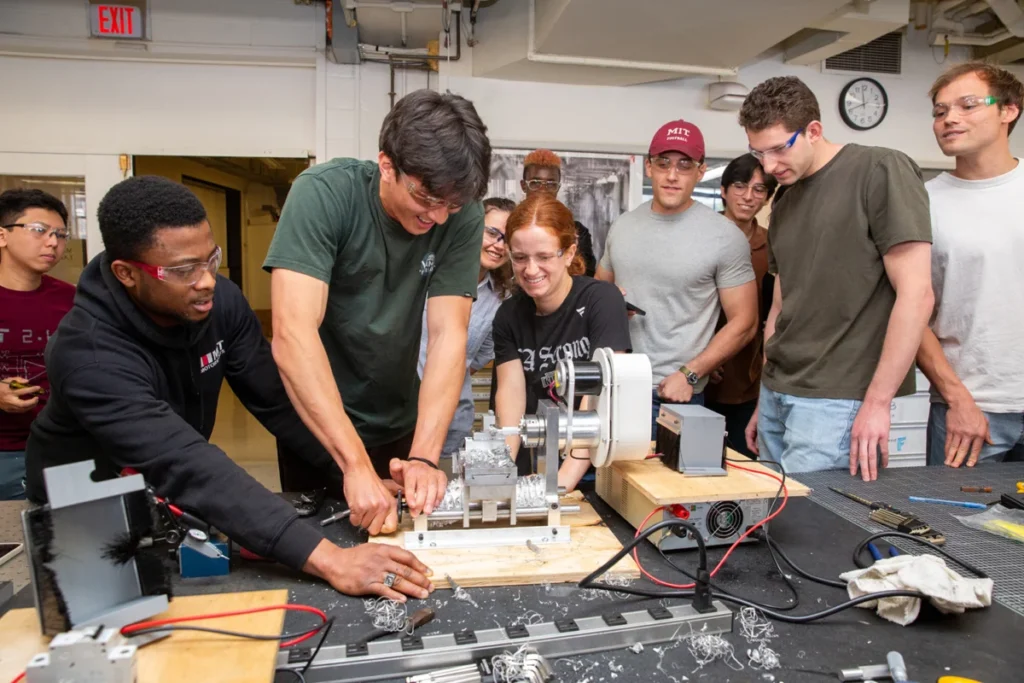
The culmination of the course is an ambitious mechanical system design project: the construction of a fully functional lathe. This is no mere assembly task; students are tasked with designing and building a machine that must meet stringent repeatability, accuracy, and functional requirements. A primary benchmark for success is the lathe’s ability to achieve an astonishing 50 microns of precision in its cutting operations. To put this into perspective, the average human hair is approximately 70 microns in diameter. Achieving such tight tolerances demands meticulous attention to detail in every aspect of the design, from material selection and component alignment to thermal management and vibration isolation. It forces students to confront the real-world challenges of manufacturing variability, machine stiffness, and control system resolution.
Beyond precision, the lathe project also incorporates a competitive element designed to push the boundaries of performance: the material removal rate competition. In this challenge, student teams vie to see who can machine down a specified piece of stock by one inch in the shortest amount of time. This competition is not just about speed; it tests the robustness of the lathe’s design, the power and efficiency of its drive system, the rigidity of its structure, and the effectiveness of its tooling. Amber Velez, a graduate student in MechE, proudly recounts her team’s impressive achievement in this task, completing it in approximately 27 seconds – a remarkable feat that highlights the high-performance capabilities they engineered into their machines. This aspect of the project mirrors real-world industrial demands for both precision and productivity, simulating the pressures faced by engineers in manufacturing and product development.
The Gauntlet: "Marty’s Death Test" and the Cultivation of Resilience
Perhaps the most infamous, yet pedagogically profound, aspect of 2.72/2.270 is what students colloquially refer to as "Marty’s death test." As described by MechE graduate student Sarah Stoops, the test involves a rather dramatic assessment of the student-built lathes. Fellow graduate student Amber Velez elaborates on the practical implications: "at the end of class, Marty takes all our lathes and drops them and hits them with a hammer, and if they explode, you don’t pass the class." This seemingly brutal final examination is far from arbitrary; it is a meticulously crafted exercise in designing for robustness, survivability, and real-world durability.
The "death test" serves multiple critical functions. Firstly, it forces students to consider extreme operating conditions and potential failure modes during their design process. Engineers must not only design for optimal performance but also for resilience against unexpected stresses, impacts, or misuses. This is paramount in industries ranging from automotive to aerospace, where structural integrity under adverse conditions can be a matter of safety and reliability. Secondly, the test imparts invaluable lessons in resilience and perseverance, qualities that are often overlooked in purely academic settings but are indispensable for professional engineers. Hannah Gazdus, another teaching assistant for the course, emphasizes this point: "The students are very resilient. They learn to persevere and take some time to try and figure things out, and through that process… you learn so much."
The process of designing a machine to withstand such a demanding test, and the experience of seeing one’s creation subjected to it, fosters a deep understanding of material properties, structural mechanics, and failure analysis. Students learn that perfection is often an iterative process, and that setbacks are opportunities for deeper learning and refinement. The emotional investment in their projects, coupled with the high stakes of the "death test," engenders a powerful learning experience that transcends traditional classroom lectures and textbook problems. It cultivates a mindset where challenges are embraced as opportunities to innovate and fortify designs.
Cultivating the Modern Engineer: Bridging Abstraction to Application
The overarching success of 2.72/2.270 lies in its ability to bridge a critical gap in engineering education. Yasin Hamed eloquently articulates this: "The core classes are important — things like mechanics, materials, dynamics, controls — but many of them have a degree of abstraction that separates the content within those courses from the mechanical elements that you use in designing an actual machine." He continues, "I feel like this class serves very well to bridge that [and] inspire that confidence as working engineers."
This bridging function is paramount in today’s rapidly evolving technological landscape. Industries such as robotics, aerospace, advanced manufacturing, and biomedical devices demand engineers who possess not only theoretical mastery but also the practical intuition to translate complex concepts into functional hardware. The global market for precision machinery, for instance, is projected to continue its robust growth, underscoring the constant need for highly skilled mechanical engineers capable of designing, building, and optimizing such systems. A course like 2.72/2.270 directly prepares students for these demands by immersing them in the full lifecycle of mechanical design, from conceptualization and analysis to prototyping, testing, and refinement under pressure.
The confidence inspired by successfully navigating such a challenging course is invaluable. Students emerge with a tangible portfolio of skills and a proven ability to tackle complex, multidisciplinary engineering problems. They gain firsthand experience with the iterative nature of design, the importance of meticulous attention to detail, and the resilience required to overcome unforeseen obstacles. These are not merely academic lessons; they are foundational professional competencies that differentiate competent engineers from truly exceptional ones.
Broader Implications for Engineering Education and Industry
The model presented by MIT’s 2.72/2.270 class holds significant implications for the future of engineering education globally. In an era where simulation tools are increasingly powerful, the importance of hands-on, physically demanding projects remains undiminished. While computational modeling is essential, it cannot fully replicate the tactile feedback, unexpected challenges, and the profound learning that occurs when one’s theoretical designs are put to the test in the physical world.
The course demonstrates that high-stakes, comprehensive design projects, coupled with unconventional assessment methods like "Marty’s death test," can be incredibly effective in producing engineers who are not only technically proficient but also resilient, innovative, and deeply confident in their abilities. Such an approach fosters a culture of iterative improvement, critical thinking, and a willingness to push boundaries, all of which are vital for addressing the complex global challenges of the 21st century, from sustainable energy systems to advanced medical technologies.
Ultimately, MIT’s 2.72/2.270 course is more than just an academic offering; it is a rigorous training ground for future innovators. By demanding excellence in both theory and practice, and by cultivating a deep sense of resilience and perseverance, Professor Culpepper and his team are ensuring that MIT continues to produce mechanical engineers who are not only capable of building "hardcore advanced machines" but also possess the strength of character to lead and innovate in an ever-demanding world.