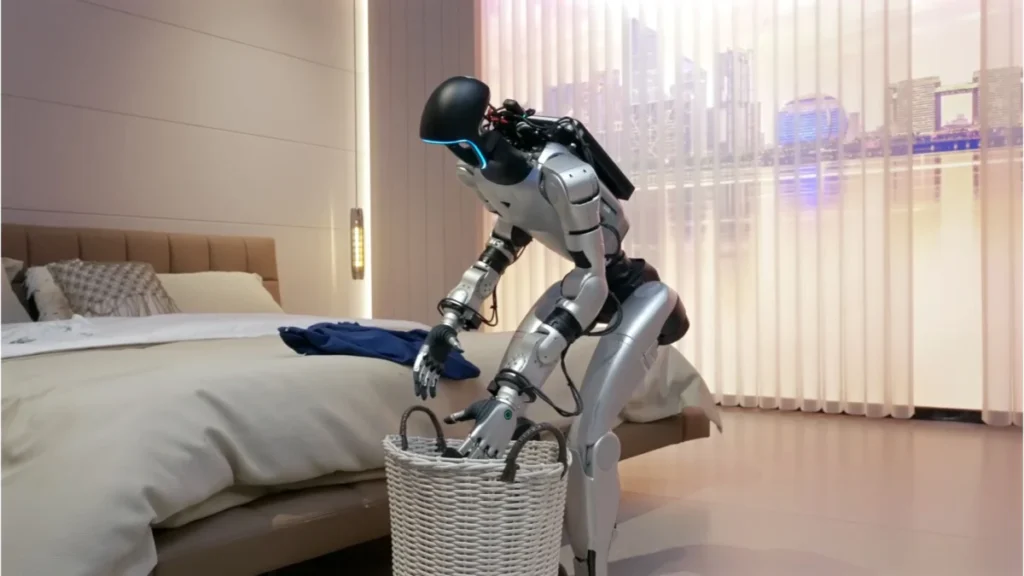
Chinese robotics innovator Unitree has announced the release of UnifoLM-OminiA-0.3, a groundbreaking unified AI model specifically engineered for humanoid robots. This advanced system represents a significant leap forward in embodied artificial intelligence, integrating real-time omni-modal interaction, sophisticated reasoning, natural dialogue capabilities, and comprehensive whole-body mobile manipulation within a single, cohesive framework. The model is strategically designed to empower humanoid robots for critical applications in home-care and wellness sectors, enabling them to autonomously execute a diverse range of tasks, from mundane household chores like tidying rooms and opening drawers to providing crucial assistance to individuals around hospital beds, all while intelligently responding to a complex interplay of voice commands, visual cues, and dynamic environmental inputs.
The introduction of UnifoLM-OminiA-0.3 underscores Unitree’s commitment to making advanced humanoid robotics both capable and accessible. This initiative follows closely on the heels of the company’s recent unveiling of a remarkably low-cost upper-body humanoid robot, priced from 26,900 yuan (approximately $4,290). This aggressive pricing strategy is a clear indicator of Unitree’s ambition to democratize humanoid robotics, moving it beyond specialized industrial applications into more widespread commercial and domestic use. The combination of affordable hardware and sophisticated, unified AI software positions Unitree as a key player in shaping the future trajectory of personal and service robotics.
Revolutionizing Humanoid Control with Unified Intelligence
UnifoLM-OminiA-0.3 stands out as a new paradigm in embodied AI, specifically engineered to enable humanoid robots to seamlessly perform a broad spectrum of household, wellness, and care-related tasks under the command of a single, integrated control system. Traditionally, robots have relied on disparate, task-specific models for various functions – one for speech recognition, another for object detection, yet another for navigation, and so forth. This fragmented approach often results in cumbersome transitions between tasks and limits a robot’s ability to adapt dynamically to unforeseen circumstances.
Unitree’s innovative model addresses this challenge head-on by combining real-time reasoning, natural language dialogue, omni-modal perception, and whole-body mobile manipulation into a singular, cohesive architecture. This allows robots powered by UnifoLM-OminiA-0.3 to interpret spoken instructions, process visual information from their surroundings, effectively navigate complex environments, and physically interact with objects without the need to switch between multiple, siloed AI systems. The core benefit of this unified design lies in its ability to process multiple sources of information concurrently and holistically. When a robot receives a verbal request, it doesn’t just process the audio; it simultaneously analyzes its visual environment, assesses the context, plans the optimal course of action, navigates to the required location, and executes the physical task autonomously. This seamless integration ensures a fluid and responsive interaction experience, moving closer to the intuitive collaboration seen in human-to-human interactions.
Demonstrated Capabilities and Real-World Applications
To illustrate the model’s prowess, Unitree released a compelling demonstration video showcasing UnifoLM-OminiA-0.3 in action across a series of everyday household and care-related scenarios. The footage highlights a humanoid robot executing tasks with remarkable dexterity and contextual understanding. Examples include the robot carefully picking up a cushion and placing it neatly on a sofa, accurately identifying colors of various objects, precisely counting medicine boxes, retrieving a specific medicine package from a cluttered shelf, and efficiently sorting clothes into a laundry basket. Beyond domestic chores, the robot also demonstrated its utility in more sensitive environments, such as loading a plate into a dishwasher and, notably, adjusting a hospital-style bed with care and precision.
One of the most critical aspects highlighted in the demonstration was the robot’s ability to dynamically respond to interruptions during task execution, rather than merely initiating actions based on pre-programmed commands. In a particularly illustrative sequence, while the robot was in the process of adjusting a bed, a user verbally instructed it to stop midway through the operation. The robot immediately processed the interruption, halted its current action, and awaited further instructions. This capability is paramount for real-world deployment, especially in caregiving roles, where human needs and environmental factors can change instantaneously. It underscores Unitree’s profound focus on fostering continuous, adaptable human-robot interaction and enabling dynamic task adaptation, moving beyond rigid, pre-set routines towards more flexible and intelligent autonomy.
The Paradigm Shift Towards Unified Manipulation Models
While many of the individual tasks showcased in Unitree’s demonstration, such as object manipulation or navigation, have been independently achieved by humanoid robots from other companies – including well-known names like Boston Dynamics, Figure AI, and Tesla’s Optimus – the true significance of UnifoLM-OminiA-0.3 lies in its unique ability to coordinate the entire workflow through a singular, integrated AI model. This distinction is crucial. Instead of a patchwork of specialized algorithms, Unitree has engineered a holistic system that unifies language understanding, visual perception, object recognition, complex decision-making, sophisticated navigation, and precise full-body motion control within one comprehensive framework.
This unified architecture is designed not only to execute tasks autonomously but also to maintain stable and reliable performance even when confronted with unexpected changes in the environment or direct human interruptions. This robust adaptability is a cornerstone for deployment in unpredictable, dynamic environments such as homes, hospitals, and care facilities, where objects are frequently repositioned, instructions can evolve, and human interaction often occurs spontaneously while robots are actively working.
This approach aligns with a broader and increasingly prominent trend within the field of embodied AI, where robotics developers are progressively integrating advanced vision-language models (VLMs) directly with robot control systems. This evolution moves away from the laborious process of programming separate, explicit routines for every conceivable object or activity. Instead, these unified systems aim to generalize learning across vastly different environments and tasks, enabling robots to infer and adapt rather than merely execute pre-coded instructions. Such inherent flexibility is not just desirable but essential for the widespread adoption of robots in highly variable human-centric spaces, promising a future where robots can understand and respond to the nuances of human environments with unprecedented efficacy.
Unitree’s Embodied Intelligence Program: A Chronology of Innovation
UnifoLM-OminiA-0.3 is not an isolated breakthrough but the latest evolution within Unitree’s ambitious "UnifoLM embodied intelligence programme." This overarching initiative outlines a clear strategic roadmap for developing increasingly sophisticated and general-purpose AI for robotics.
The journey began in 2025 with the introduction of UnifoLM-WMA-0, an open-source world-model-action framework. This foundational model was designed to equip robots with the ability to understand complex physical interactions and accurately predict environmental changes, allowing them to anticipate outcomes and plan actions more effectively. Building on this, Unitree released UnifoLM-VLA-0 in early 2026, a vision-language-action model specifically tailored for general-purpose humanoid manipulation. Crucially, Unitree made the training code and model weights for UnifoLM-VLA-0 open-source, fostering collaborative development and accelerating innovation within the broader robotics community.
In parallel with these model releases, Unitree has been diligently compiling and publishing an expanding collection of whole-body teleoperation datasets. These datasets, captured from humanoid robots performing a wide array of everyday activities, serve as invaluable training material for developing more capable and versatile robotic systems. Many of the household tasks prominently featured in these datasets, including various cleaning routines and intricate object handling, are precisely those demonstrated by UnifoLM-OminiA-0.3, underscoring Unitree’s systematic and data-driven approach to advancing general-purpose humanoid robots for real-world deployment. This methodical progression highlights a strategic vision to build capabilities incrementally, leveraging both proprietary advancements and open-source contributions to push the boundaries of what humanoid robots can achieve.
Market Context and the Growing Demand for Service Robotics
The development of UnifoLM-OminiA-0.3 arrives at a time of escalating global demand for service robotics, particularly in sectors facing significant labor shortages and demographic shifts. The global humanoid robot market, though nascent, is projected to experience exponential growth. Reports from various market intelligence firms indicate that the global service robotics market, which includes home care, logistics, and healthcare robots, is anticipated to reach valuations exceeding hundreds of billions of dollars within the next decade, growing at a compound annual growth rate (CAGR) of over 20%. Humanoid robots, with their ability to operate in human-centric environments and utilize tools designed for human use, are expected to capture a substantial segment of this growth.
Key drivers for this expansion include the rapidly aging global population, particularly in developed economies like Japan, South Korea, China, and much of Europe, which are facing increasing pressure on their healthcare and elder care systems. Humanoid robots equipped with capabilities like UnifoLM-OminiA-0.3 offer a potential solution to alleviate the burden on human caregivers, providing assistance with daily living activities, monitoring, and companionship. Beyond elder care, the demand for automation in domestic settings, driven by busy lifestyles and the desire for enhanced convenience, also presents a vast market opportunity for robots capable of performing household chores autonomously.
Unitree’s strategic focus on affordability, as demonstrated by its low-cost hardware, is critical for penetrating these markets. High acquisition costs have historically been a barrier to widespread robot adoption outside of specialized industrial applications. By reducing the entry barrier, Unitree aims to accelerate the deployment of humanoid robots in homes, hospitals, and other service environments, making advanced robotic assistance a more viable and accessible option for a broader demographic.
Implications and Future Outlook: Navigating a Robotic Future
The implications of unified AI models like UnifoLM-OminiA-0.3 are profound and multifaceted, touching upon economic, social, and ethical dimensions.
Impact on Healthcare and Home Care: The most immediate and tangible impact is expected in the healthcare and home care sectors. Humanoid robots can perform repetitive, strenuous, or potentially hazardous tasks, freeing human caregivers to focus on more complex, empathetic, and personalized interactions. They could assist individuals with mobility challenges, retrieve medications, monitor vital signs, and even provide therapeutic engagement, thereby enhancing the quality of life for the elderly and those with disabilities, while also addressing critical labor shortages in these fields.
Economic Shifts: The widespread adoption of such robots could lead to significant economic shifts. While concerns about job displacement are valid, especially in sectors like domestic services, there is also potential for job creation in areas such as robot manufacturing, maintenance, programming, and ethical oversight. Furthermore, increased automation could boost productivity, reduce operational costs for care facilities, and unlock new service models.
Ethical and Societal Considerations: As robots become more integrated into daily life, particularly in intimate settings like homes and hospitals, crucial ethical questions arise. Privacy concerns, especially regarding data collection from sensors (visual, audio, environmental), will need robust regulatory frameworks. Ensuring robot safety, reliability, and accountability in complex interactions is paramount. Moreover, the psychological and social implications of human-robot interaction, including potential emotional attachment and the definition of companionship, will require careful consideration and societal dialogue. The potential for misuse of advanced robotic capabilities also necessitates proactive ethical guidelines and safeguards.
Technological Roadmap: Looking ahead, the development trajectory for unified AI models like UnifoLM-OminiA-0.3 will likely involve continued refinement in areas such as fine motor dexterity, understanding of nuanced human emotions, and improved long-term memory and learning capabilities. Integration with other smart home systems and cloud-based AI will further enhance their utility and adaptability. The open-source nature of parts of Unitree’s program suggests a collaborative future, where advancements are accelerated through shared knowledge and community contributions.
Expert analysts generally agree that unified AI models represent the critical next step in achieving truly general-purpose humanoid robots. While significant challenges remain in areas such as robust performance in highly unstructured environments and complex human-robot social dynamics, the progress exemplified by Unitree’s UnifoLM-OminiA-0.3 brings the vision of intelligent, helpful humanoid robots closer to everyday reality. The journey from specialized tools to adaptable companions is ongoing, and Unitree is clearly positioning itself at the forefront of this transformative technological evolution.






