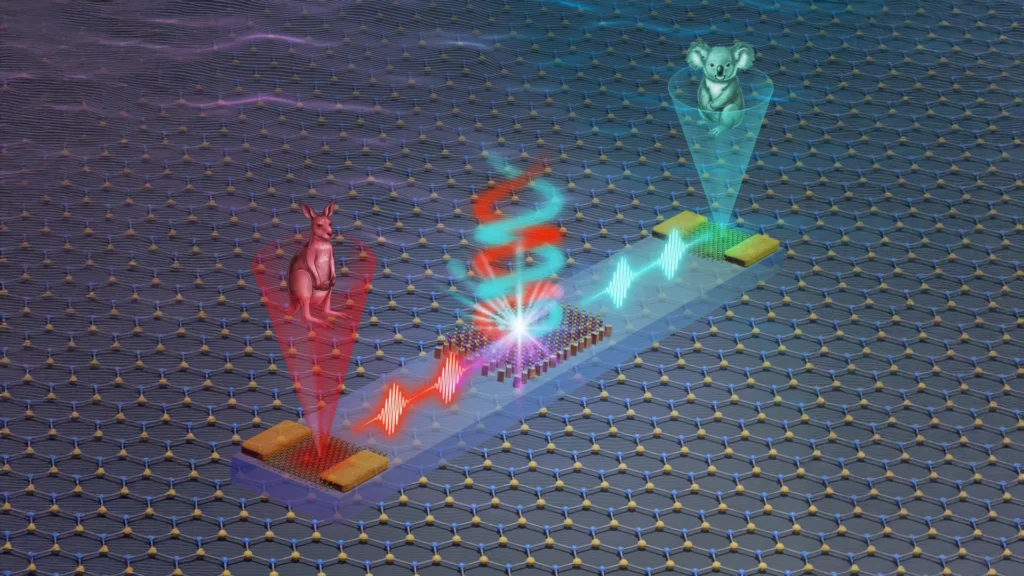
Scientists at Monash University have achieved a significant breakthrough, developing a novel, tiny circuit capable of generating, directing, and reading information carried by light, all contained within a single chip. This monumental advance marks a pivotal moment for valleytronics, an emerging field poised to revolutionize computing speed, drastically reduce energy consumption, and unlock new frontiers in quantum technologies. The integrated device, created by researchers from the Monash School of Physics and Astronomy, skillfully combines advanced nanotechnology with cutting-edge materials, effectively resolving a fundamental challenge that has long impeded the progress of valleytronics research.
Understanding Valleytronics: A New Frontier in Information Processing
To fully appreciate the significance of this Monash University innovation, it is essential to first understand the burgeoning field of valleytronics. Traditional electronics rely on the charge of electrons to process and store information. Spintronics, another advanced field, utilizes the ‘spin’ of electrons. Valleytronics, however, introduces a third quantum degree of freedom: the ‘valley.’ In certain two-dimensional (2D) materials, electrons can exist in distinct energy minima within their momentum-energy landscape, referred to as ‘valleys.’ These valleys possess unique quantum properties, allowing them to encode information in a manner analogous to how spin or charge is used in other computing paradigms.
The concept of valleytronics emerged from theoretical predictions and early experimental observations in materials like graphene and transition metal dichalcogenides (TMDs) over the last two decades. The promise lies in the potential to achieve higher data densities, faster processing speeds, and significantly lower energy consumption compared to conventional electronics. Unlike the random motion of electrons that generates heat in silicon chips, information encoded in valleys could propagate with minimal energy loss. Furthermore, the inherent quantum nature of valleys makes them attractive candidates for building qubits in quantum computers, offering a new pathway for quantum information science. However, a major hurdle has been the inability to efficiently generate, manipulate, and detect these valley-polarized signals within a single, integrated platform – a challenge the Monash team has now surmounted.
The Monash Breakthrough: An Integrated Solution
The device developed by the Monash researchers represents a monumental leap forward, as it is the first fully integrated chip capable of performing all three crucial functions for valleytronic information processing: producing specialized light signals that carry valley information, steering these signals along specific pathways, and converting them into detectable electrical signals. This integration within a single compact system addresses what has been a long-standing fragmented approach in the field, where researchers could typically only achieve one or two of these functions in isolation, often requiring cumbersome external components.
Dr. Chi Li, the lead author of the study whose findings were prominently published in the prestigious journal Nature Photonics, articulated the impact of this achievement. "Until now, we could generate or detect these signals, but not do everything in one integrated device," Dr. Li explained, highlighting the fragmented nature of prior research efforts. "What we’ve built is a complete on-chip system that can create, route and read this information with very high precision." This precision is critical for maintaining the integrity of the delicate quantum information encoded in the valley degree of freedom.
The development positions Monash University at the forefront of this globally competitive research area, building upon its established reputation for excellence in physics, materials science, and nanotechnology. The university has consistently invested in cutting-edge research facilities and fostered an environment conducive to interdisciplinary collaboration, which was crucial for a complex project of this magnitude.
Technical Ingenuity: Materials and Methods
The innovation relies on a sophisticated interplay between ultra-thin materials and specially engineered nanostructures. The core of the device utilizes materials that are only a few atoms thick, typically referred to as two-dimensional (2D) materials. These materials, such as molybdenum disulfide (MoS2) or tungsten diselenide (WSe2), exhibit unique electronic and optical properties at the nanoscale, including strong spin-orbit coupling and direct bandgaps that enable efficient light-matter interaction and valley-selective excitation. Their atomic thinness also means they are highly sensitive to external stimuli and can be easily integrated into nanoscale devices.
These ultra-thin materials are meticulously paired with advanced nanostructures, often referred to as metasurfaces or photonic integrated circuits. Metasurfaces are sub-wavelength structured interfaces designed to precisely control light at extremely small scales, allowing for tailored manipulation of light’s amplitude, phase, and polarization. In this context, these nanostructures are engineered to interact specifically with the light signals carrying valley information, enabling precise routing and conversion.
Dr. Kaijian Xing, co-first author of the study and a Research Fellow at Monash University, elaborated on the practical methodology employed. "We employ a straightforward stacking approach to integrate ultra-thin materials with metasurfaces, overcoming the technical challenges of direct material growth on photonic structures, and enabling further advances in valleytronics," Dr. Xing stated. This ‘stacking approach’ is a critical detail, as direct growth of high-quality 2D materials onto complex photonic structures can be notoriously difficult due to lattice mismatch and process incompatibilities. By developing a method for seamless integration, the Monash team has paved the way for scalable manufacturing and broader adoption of such hybrid systems. This innovative fabrication technique sidesteps many of the material science hurdles that have previously slowed progress in hybrid optoelectronic devices.
Overcoming the "Cold" Barrier: Room-Temperature Operation
One of the most compelling advantages of this new technology is its ability to operate effectively at room temperature. This feature addresses a significant limitation prevalent in many other advanced quantum systems, which frequently necessitate extremely cold, cryogenic environments (often near absolute zero, or -273.15°C) to maintain quantum coherence. The requirement for such specialized, energy-intensive cooling systems makes quantum technologies difficult, expensive, and impractical for widespread real-world applications outside of highly controlled laboratory settings.
The Monash chip’s room-temperature functionality is a game-changer for the practical deployment of valleytronic devices. It drastically reduces operational complexity and cost, opening pathways for integration into conventional electronics infrastructure and a wider range of industrial and consumer applications. This inherent robustness at ambient conditions positions valleytronics as a more viable candidate for next-generation computing and communication technologies compared to some of its quantum counterparts.
Senior author Dr. Haoran Ren, an ARC Future Fellow and leader of the Monash NanoMeta Group, underscored the importance of this aspect. He noted that the work could "pave the way for a new generation of compact photonic devices that are both programmable and highly efficient." The energy savings alone, by eliminating the need for complex cooling, could have a profound impact on the environmental footprint of future data centers and computing infrastructures.
A Multidimensional Approach: Encoding Information
The information in this new system is stored and processed using the "valley degree of freedom," a concept that adds a new dimension to how data can be encoded. Unlike traditional bits that store information as 0s and 1s based on electrical voltage, or even spin-based systems that use electron spin (up or down), valleytronics leverages the distinct quantum states of electrons in specific valleys within the material’s band structure. This unique characteristic could provide entirely new and potentially more robust ways to encode, transmit, and process data.
The ability to manipulate these valley states with light provides a powerful interface. Light, as a carrier of information, offers immense bandwidth and speed. By imprinting valley information onto light signals, the Monash chip essentially creates an optical pathway for valleytronic data. This hybrid approach — combining the unique quantum properties of valleys with the speed and efficiency of photonics — is what gives this technology its transformative potential. The precision required to differentiate and manipulate these subtle quantum states speaks volumes about the team’s mastery of quantum materials and nanophotonics.
Demonstrating Capability: Parallel Processing
To rigorously demonstrate the practical capabilities of their innovative chip, the Monash researchers conducted a crucial experiment: they successfully encoded and processed two separate images simultaneously. This demonstration was not merely a proof of concept; it showcased the device’s inherent ability to manage multiple streams of information concurrently. This parallel processing capability is a critical feature for any future computing technology aiming to surpass the limitations of current architectures, which often struggle with the increasing demands for simultaneous data handling.
In modern computing, the ability to process multiple tasks or data streams in parallel is fundamental to enhancing performance and efficiency. From artificial intelligence and machine learning algorithms to complex scientific simulations and real-time data analytics, the demand for parallel processing is ever-growing. The Monash chip’s success in this area suggests it could significantly boost throughput and reduce latency in future computing systems, making it highly attractive for applications requiring high-speed, multi-channel data processing.
Professor Stefan A. Maier, Head of the School of Physics and Astronomy and Nanophotonics Laboratory at Monash University, emphasized the broader implications of such practical demonstrations. "This is an important step toward fully integrated valleytronic systems," Professor Maier noted. "By combining light and quantum materials on a chip, we can access new ways of encoding and processing information." This highlights the translational impact of the research, bridging the gap between fundamental scientific discovery and tangible technological application.
Broader Implications for Future Technologies
The development of this integrated valleytronics chip carries profound implications across multiple sectors, promising to reshape the landscape of computing, communication, and quantum technologies.
Computing and Data Centers: Dr. Haoran Ren articulated the potential impact on computing systems, stating that the technology could support "faster computing systems, reduce energy consumption, and enable new methods for secure communications and advanced data processing." The "power wall" and "heat wall" are significant challenges facing the semiconductor industry, as traditional silicon-based transistors approach their physical limits. Valleytronic devices, by leveraging light and valley states, could offer a path to circumvent these limitations, leading to processors that are not only faster but also significantly more energy-efficient, reducing the massive energy footprint of global data centers. This could translate into billions of dollars in energy savings annually and a substantial reduction in carbon emissions.
Quantum Computing Potential: While not a quantum computer itself, the Monash chip’s ability to manipulate a quantum degree of freedom (the valley) at room temperature provides a promising avenue for quantum information science. The valley degree of freedom could serve as a robust qubit or a component thereof, potentially offering longer coherence times and easier scalability compared to other qubit modalities that require extreme refrigeration. This could accelerate the development of practical quantum computing, moving it closer to real-world applications in drug discovery, materials science, and complex optimization problems.
Communication and Imaging: The inherent advantages of photonic devices – "massive bandwidths, ultra-fast data transmission speeds, and lower energy consumption" – make this technology a strong candidate for next-generation optical communication systems. As the world transitions to 5G and prepares for 6G, the demand for higher bandwidth and faster data transfer is insatiable. Valleytronic photonics could enable more efficient and secure data transmission over optical fibers and within data centers. Furthermore, the precise control over light and its interaction with quantum materials could lead to breakthroughs in advanced imaging techniques, offering higher resolution or new sensing capabilities for medical diagnostics, industrial inspection, and scientific research.
The Road Ahead: Challenges and Opportunities
Despite this significant breakthrough, the path from laboratory prototype to commercial product is often long and arduous. Future research will likely focus on scaling up the fabrication process to industrial levels, improving the long-term stability and reliability of the devices, and further enhancing performance metrics such as signal-to-noise ratio and integration density. Researchers will also explore different 2D materials and nanostructure designs to optimize specific functionalities and expand the range of potential applications. The challenge of maintaining valley coherence over longer distances and times, crucial for complex computations, will also be a key area of investigation. However, the foundational work done by the Monash team provides a robust platform for these future advancements. The integration achieved here simplifies the overall system architecture, making subsequent scaling and commercialization efforts more feasible.
A Global Endeavor: The Collaborative Spirit
The success of this project is a testament to the power of international scientific collaboration. The research brought together a diverse group of experts from Australia, China, Singapore, Germany, and Japan, pooling expertise in disparate yet complementary fields such as nanophotonics, two-dimensional materials, and optoelectronics. This multidisciplinary approach was essential for tackling the complex scientific and engineering challenges involved in creating such an advanced integrated system.
The Monash University team included Dr. Chi Li, Dr. Kaijian Xing, Professor Michael S. Fuhrer, Professor Stefan A. Maier, and Dr. Haoran Ren. Their collective efforts were augmented by significant contributions from partner institutions, including the Singapore University of Technology and Design, LMU Munich, and the University of Technology Sydney. This global network of talent and resources underscores the increasingly collaborative nature of cutting-edge scientific research, where complex problems demand a synthesis of diverse perspectives and specialized knowledge from around the world. Such partnerships are vital for accelerating discovery and translating fundamental research into technologies that benefit humanity.
In conclusion, the integrated valleytronics chip developed by Monash University represents a landmark achievement in materials science, quantum physics, and engineering. By providing a complete, on-chip system for generating, routing, and reading valley-encoded information at room temperature, the researchers have not only solved a critical problem in valleytronics but have also laid a robust foundation for a new generation of computing and communication technologies that promise unprecedented speed, efficiency, and capabilities. This breakthrough firmly establishes Monash University as a global leader in the pursuit of next-generation information processing paradigms.