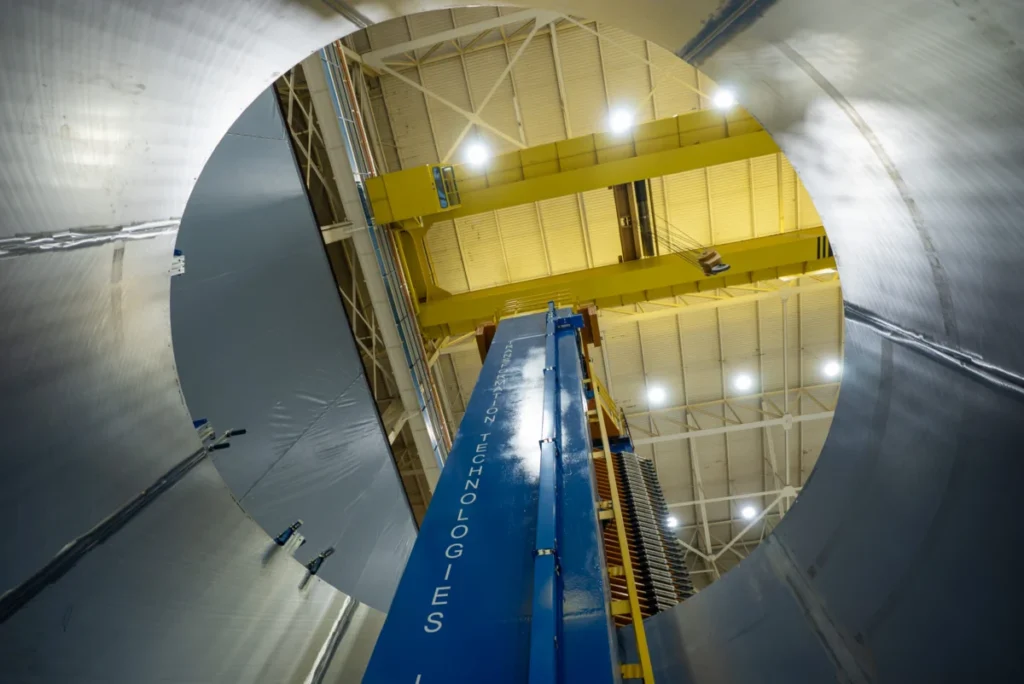
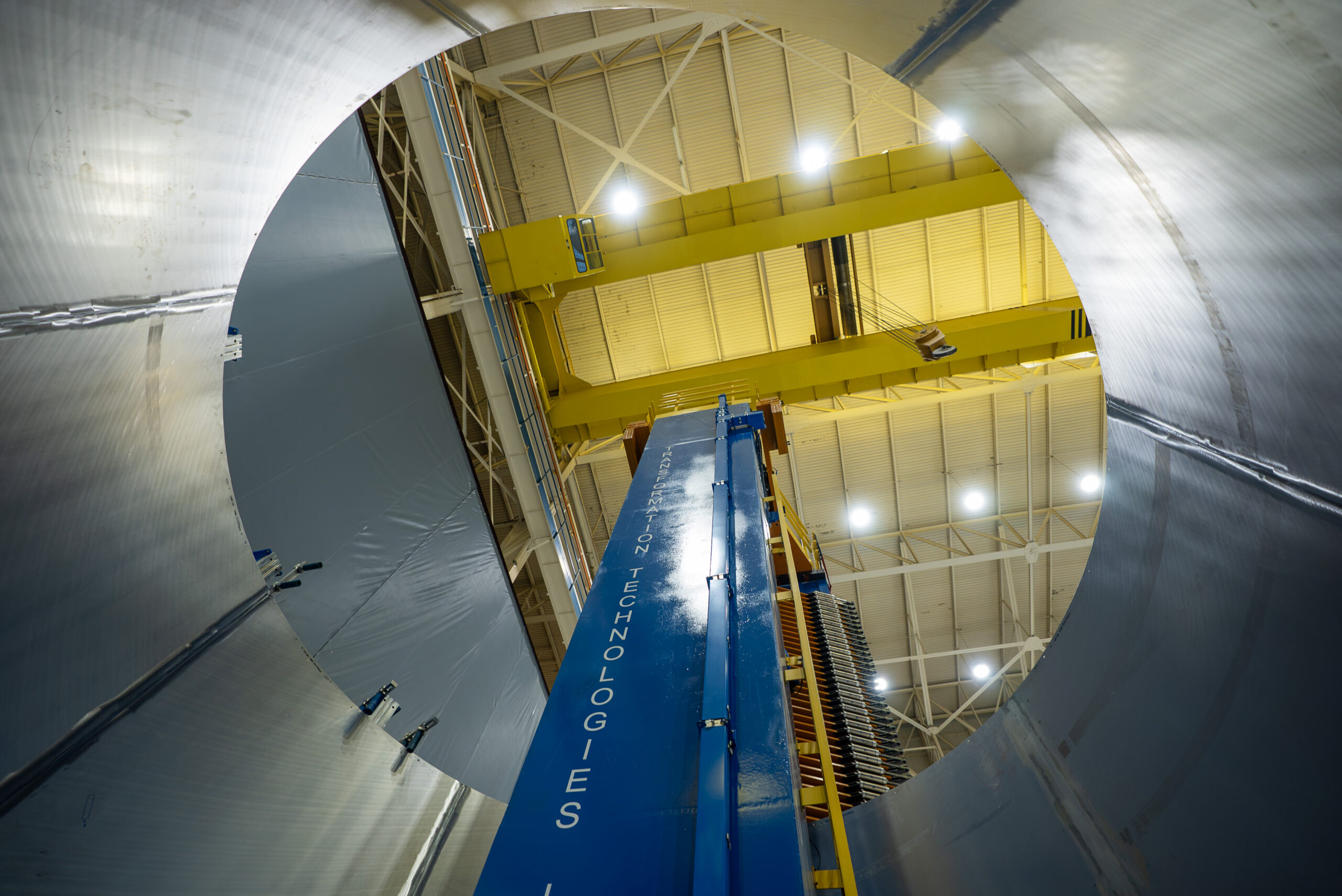
Inside a sprawling, multi-story warehouse at NASA’s Marshall Space Flight Center in Huntsville, Alabama, a massive metal cylinder rotates slowly on a colossal turntable. A nearby industrial machine meticulously carves into its surface, yielding a cascade of shimmering metallic chips and filling the air with a distinct metallic aroma. A team of engineers, intently monitoring a bank of computer screens, track the progress: approximately 13 centimeters per minute, with a slightly slower pace at the crucial joins. The operation requires four complete passes to achieve the precise cut. This component, known as a spacer, is slated to ascend to orbit next year, serving as the upper stage for the Space Launch System (SLS) rocket during the Artemis III mission.
This precise trimming operation represents a significant milestone in the development efforts spurred by NASA’s pivotal decision in February to reconfigure the Artemis III mission. Originally envisioned as the program’s inaugural lunar landing, Artemis III will now serve as a critical demonstration in low-Earth orbit. In this revised scenario, an SLS rocket will carry four astronauts in an Orion capsule, tasked with practicing rendezvous and docking maneuvers with test articles of Blue Origin’s Blue Moon lander and SpaceX’s Starship lander. This strategic shift, driven by the imperative to accelerate the overall Artemis program and increase the frequency of launches, has necessitated an ingenious approach to hardware utilization and development.
The new Artemis III mission profile does not demand the substantial thrust provided by the Interim Cryogenic Propulsion Stage (ICPS), the dedicated upper stage designed to propel Orion on its trajectory to lunar orbit. Consequently, in April, NASA made the strategic decision to substitute the ICPS with the newly fabricated spacer. This allows the sole remaining ICPS to be reserved for the Artemis IV mission, thereby enhancing the probability of maintaining the targeted 2028 lunar landing schedule. Concurrently, the agency is actively pursuing a standardization of the SLS design, opting to adapt an existing commercial upper stage rather than proceeding with a long-envisioned, bespoke upgrade. With the Artemis III launch target of 2027 rapidly approaching, preparations for this mission and subsequent flights are progressing apace at NASA Marshall, which holds oversight for SLS development and the crucial Human Landing Systems.
A "Hodgepodge" Rocket for Artemis III: Ingenuity in Action
A significant portion of NASA Marshall’s current SLS work revolves around the ingenious repurposing of existing hardware and test articles to ensure Artemis III remains on its accelerated schedule. This pragmatic approach has led to what NASA’s Chief Engineer for SLS, John Blevins, describes as a "hodgepodge" rocket for this particular mission. The engineering team opted for a cylindrical "barrel" shape for the spacer, incorporating two flanges designed to meticulously mimic the profile of the ICPS. Patrick Hull, the engineering lead for the center’s Spacecraft/Payload Integration and Evolution Office, explained that the "outer mold line" and "interfaces will remain the same," ensuring compatibility with the existing rocket structure.
To circumvent the delays associated with sourcing new materials, the team unearthed and repurposed components dating back three decades. "We found old material – 30-year-old material – and studied it, inspected it, measured it and cleaned it up," Hull elaborated. The primary material utilized is surplus from the Space Shuttle’s external tanks. Furthermore, a ring forging, originally manufactured for the now-canceled Ares program, was salvaged from a nearby storage facility, affectionately referred to as the "boneyard." This remarkable turnaround, initiated in April and with a flight hardware barrel already constructed by August, aims for a December completion date, representing an ambitious eight-month build cycle for critical flight components.
In tandem with these upper stage modifications, engineers are conducting extensive launch simulations within the center’s SLS Systems Integration Lab. This state-of-the-art facility integrates mockup hardware with actual flight software. Adjacent to a massive, semicircular rack—roughly the width of the rocket’s core stage—Dustin Baker, the facility’s testing lead, and Ariel Kramer, the lab manager, highlighted the presence of representative avionics and flight computers. For practical engineering access, this entire assembly is configured upside down, mirroring an inverted SLS. "The testing that we’re going to focus on is the changes from Artemis II," Baker stated, emphasizing that these modifications are minimal and primarily centered around the new spacer configuration. Development testing and dry runs are already complete, with formal verification testing scheduled to commence in October.
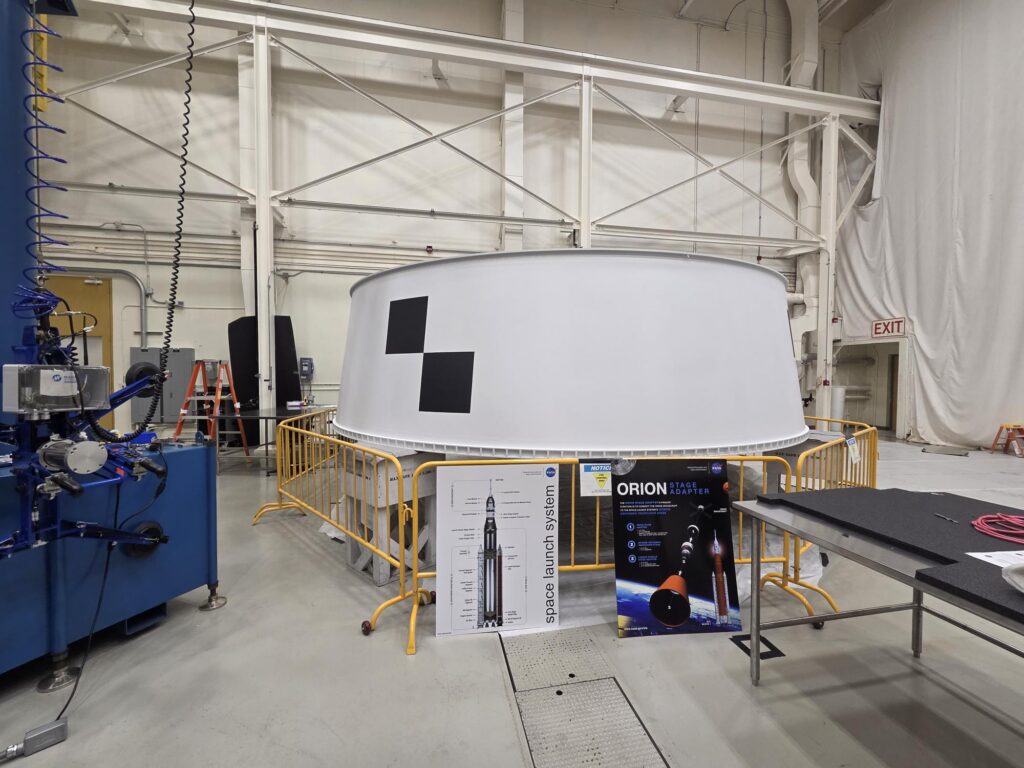
The crucial adapters required to seamlessly connect the spacer to the core stage below and the Orion capsule above are also being derived from repurposed hardware. Blevins confirmed that structural test articles, originally built and tested in preparation for Artemis I in 2022, are being utilized. This strategy preserves the flight-certified Orion Stage Adapter (OSA) and Launch Vehicle Stage Adapter (LVSA) that were designed for the ICPS, ensuring they are available for the Artemis IV mission. The LVSA test article, initially not anticipated for use, has now "earned its way in" for Artemis III, with the decision to incorporate it made only weeks prior to the article’s writing. The OSA test article, considered "more overbuilt," offered a higher degree of confidence for repurposing from the outset.
Reimagining Hardware for Lunar Lander Demonstrations
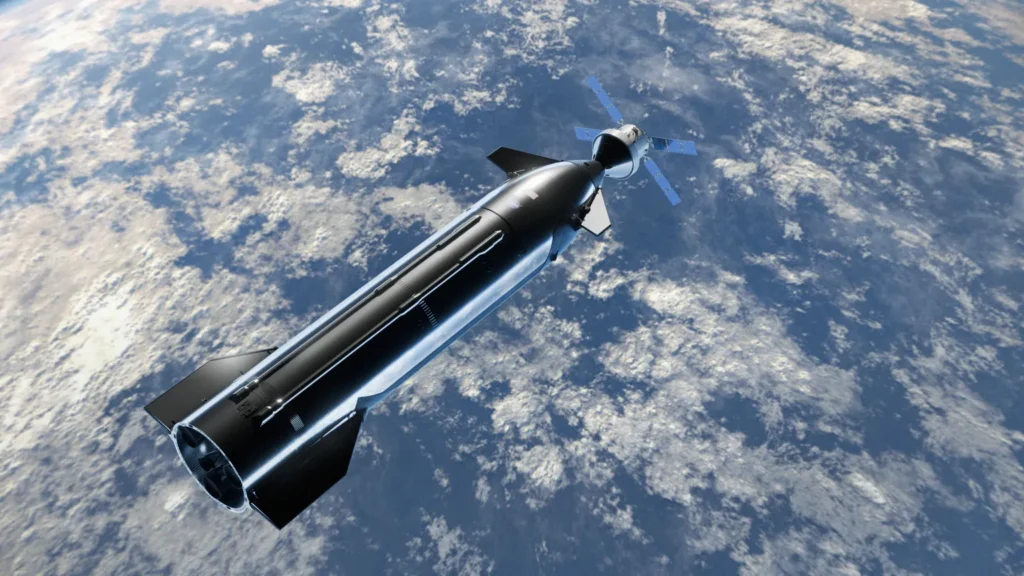
The Artemis III mission’s secondary objective—demonstrating lunar lander capabilities in orbit—also necessitates innovative solutions. Blue Origin and SpaceX have previously conducted ground-based testing of their respective lunar lander docking systems, but Artemis III will mark the first on-orbit operational deployment. Over the course of the approximately two-week mission, the Orion capsule is scheduled to first dock with a Blue Moon Mark 2 test article, allowing up to two crew members to enter its cabin. Following this, Orion will rendezvous and dock with the SpaceX Starship test lander, though astronauts will not enter this vehicle.
Kent Criswell, the lead systems engineer for the Human Landing Systems program, expressed confidence in the progress of both lander developments. For Blue Origin, the focus remains on constructing their lunar crew module, with recent efforts at NASA Marshall concentrating on testing the BT-7 thrusters for the lander. SpaceX is reportedly modifying one of their Starship vehicles by integrating a docking adapter, signifying substantial progress. NASA Administrator Bill Nelson has indicated that SpaceX has already begun fabricating components for this crucial test vehicle.
The path forward for these lander demonstrations involves multiple design reviews, with a key upcoming meeting dedicated to discussing how the companies’ testing methodologies will validate their adherence to NASA’s stringent requirements. During a mid-August press conference at Kennedy Space Center, Administrator Nelson conveyed significant optimism regarding lander development and the Artemis III timeline, stating that the insights gained from this mission will be "significant" in reducing risk for subsequent Artemis missions, particularly Artemis IV.
Standardizing the SLS: A Vision for Increased Launch Cadence
A cornerstone of NASA’s ambitious Artemis plan is to increase the SLS launch cadence to at least one mission annually, commencing with Artemis III. To achieve this objective, NASA awarded a contract in March to United Launch Alliance (ULA) for its Centaur V upper stage, destined for use on the Vulcan Centaur rockets. This standardized upper stage is slated to make its debut on the Artemis V mission, targeted for late 2028. The Centaur V is designed to deliver larger payloads further into space compared to the ICPS, although it represents a different design philosophy than the originally planned Exploration Upper Stage (EUS). Notably, the Centaur V features two RL10 engines, a configuration offering enhanced performance over the ICPS’s single engine, and possesses slightly larger dimensions.
NASA Marshall is currently in the process of designing new adapters to accommodate the Centaur V. The earlier Block 1B upgrade had envisioned the SLS flight computers being housed within the EUS. However, with the move towards standardization, NASA intends to retain the flight computers within the core stage, aligning with the original SLS configuration. Blevins reiterated that the ICPS was always conceived as a temporary solution, and the Centaur V represents a more integrated approach. Close collaboration with ULA and NASA software developers is underway to ensure critical crew safety features are incorporated.
Wind tunnel testing of the Centaur V is actively progressing at NASA’s Ames Research Center. This week, crucial testing is being conducted to determine the optimal flight parameters for the new upper stage. While the design is considered "strategically complete," NASA anticipates making further modifications based on the ongoing testing results. The core stage of the SLS is expected to remain largely consistent across missions, and the integration of the Centaur V is viewed as the final piece in achieving the program’s overarching mission standardization goals.
The broader implications of these strategic shifts are profound. By repurposing existing hardware and embracing commercial off-the-shelf solutions where feasible, NASA is demonstrating a commitment to fiscal responsibility and accelerated timelines. The Artemis III mission, while deviating from its original lunar landing objective, will provide invaluable operational experience with critical rendezvous and docking technologies, essential for future lunar surface operations. The standardization of the SLS upper stage promises to streamline production, reduce costs, and facilitate a more frequent launch cadence, paving the way for sustained human presence on the Moon and eventual missions to Mars. This period of intense development underscores NASA’s adaptability and ingenuity in navigating the complex challenges of deep space exploration, ensuring the Artemis program remains on a trajectory towards achieving its ambitious long-term objectives.